

VinaCapital: VIFC is a capital challenge, not a Dubai dream
VIFC is not an attempt to copy Dubai, but a place to attract international capital, reduce the cost of capital and pilot financial reforms for Vietnam, according to VinaCapital.
VIFC is not an attempt to copy Dubai, but a place to attract international capital, reduce the cost of capital and pilot financial reforms for Vietnam, according to VinaCapital.
Information about the Vietnam International Financial Centre (VIFC) has attracted much attention over the past year. From an ambitious idea, the project became reality with its launch event in February 2026, together with the completion of important legal frameworks.
Domestic expectations are very high, but not many international financial experts truly understand the nature and mission of VIFC. They mistakenly believe that Vietnam is trying to compete directly with Dubai or other long-established financial centers.
Mr. Michael Kokalari, CFA, Director of Macroeconomic Analysis and Market Research at VinaCapital, argues that this view does not accurately reflect the nature of VIFC. According to him, Vietnam is not building an international financial centre to become the “next Dubai,” but to create a more efficient channel to channel capital into the economy.
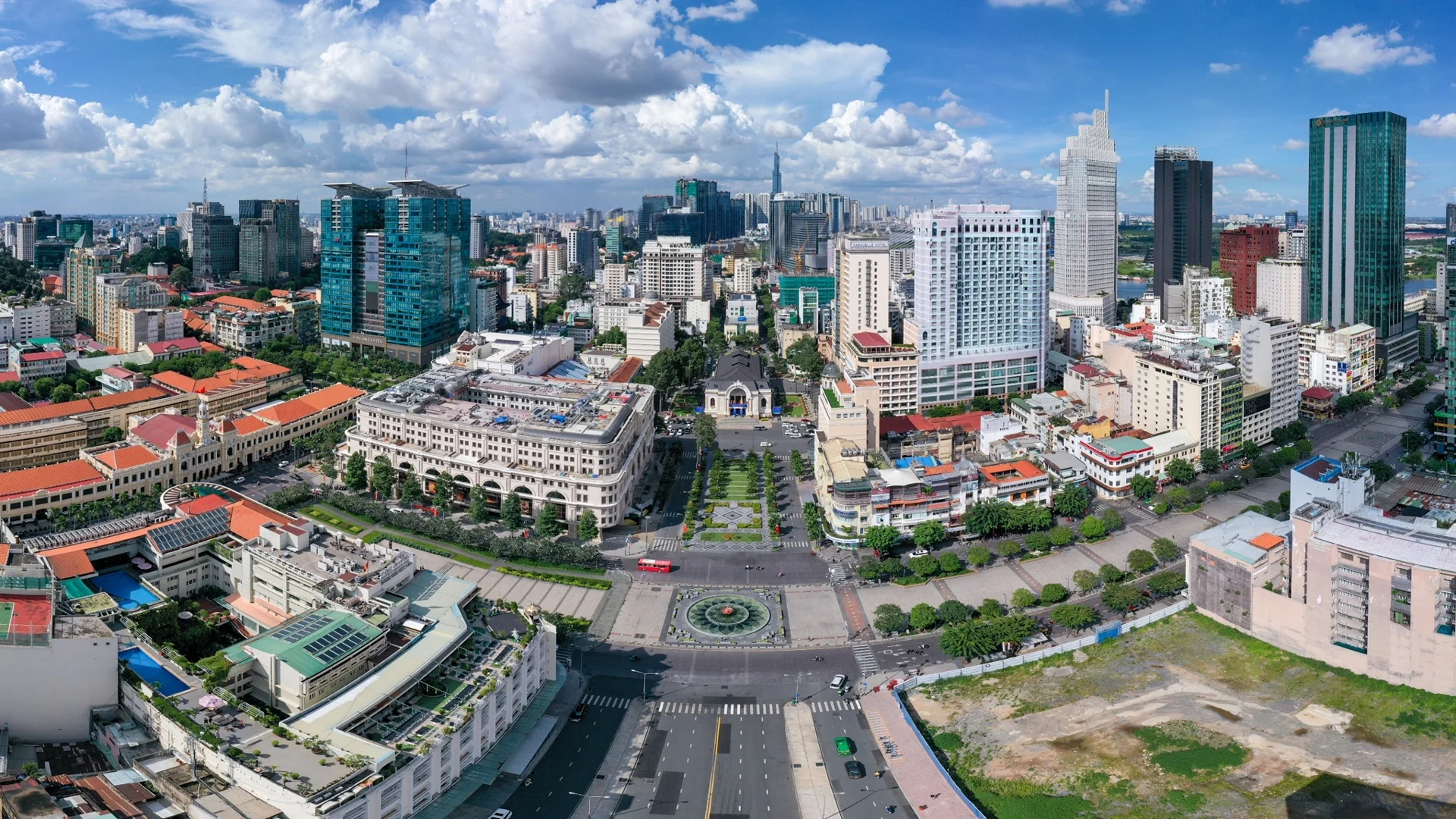
VIFC is designed as a separate regulatory mechanism – with a scale of about 900 ha in Ho Chi Minh City and 300 ha in Da Nang. Photo: Hoang Anh
A gateway for foreign capital into Vietnam
The biggest difference between VIFC and DIFC lies in their core economic function.
Dubai, especially through the Dubai International Financial Centre (DIFC), is known as a destination for wealth management, an asset haven and an ecosystem of financial services serving the ultra-wealthy. This model creates high-value spillover effects, from fund management and corporate legal services to luxury real estate.
Meanwhile, VIFC is positioned in a different direction. According to VinaCapital, the establishment of VIFC stems from the need for large investment capital – estimated at up to 1.5 trillion USD – that Vietnam must mobilize in the coming years to serve its reform and industrialization efforts.
Therefore, the core objective of VIFC is to help foreign investors access and inject capital into Vietnam more easily, thereby jointly sharing the benefits of the economy's growth momentum.
With VIFC, the measure is not merely how many financial institutions set up offices, or whether the centre creates a sufficiently attractive international image. The more important question is whether VIFC helps Vietnam attract long-term capital, reduce the cost of capital and expand financial products serving the real economy.
Therefore, VinaCapital believes that Vietnam's IFC model bears a strong resemblance to New York during America's industrialization period, rather than modern Dubai. New York at that time played the role of attracting international capital to finance America's railways, industry and infrastructure. For Vietnam, VIFC is also expected to perform a similar function: unblocking foreign capital flows for key domestic projects.
However, in terms of legal institutions, VIFC bears more resemblance to DIFC (Dubai). The centre is designed as a separate regulatory mechanism – with a scale of about 900 ha in Ho Chi Minh City and 300 ha in Da Nang. In these sub-zones, a specific legal framework will be applied, offering financial institutions operating in VIFC a series of superior preferential policies.
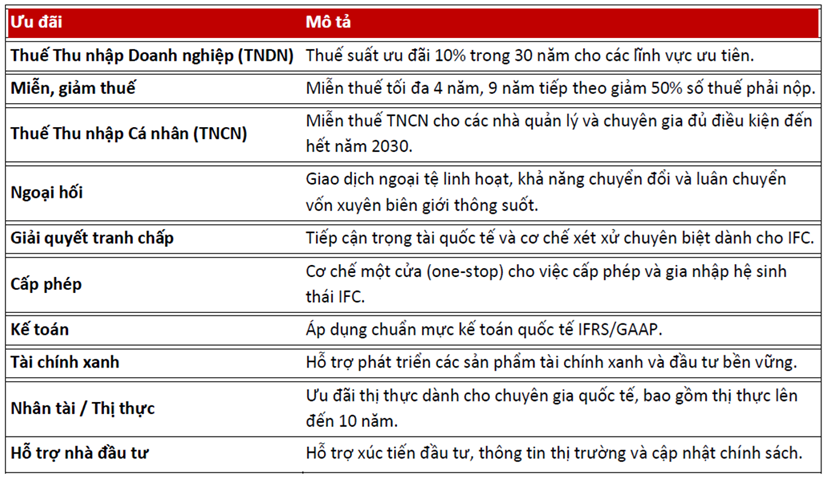
Incentives for members of Vietnam's IFC.
According to VinaCapital, the closest reference model to VIFC is not the Gulf financial centres, but India's GIFT-IFSC.
GIFT-IFSC, launched in 2015 in Gujarat, was built in the context of India being a large, fast-growing emerging economy with a need to bring financial activities related to domestic enterprises back home from abroad. At the same time, the centre also plays the role of a gateway to channel foreign capital into the domestic economy.
This is quite similar to Vietnam. VinaCapital believes there are two notable lessons from GIFT-IFSC.
The first concerns the regulator. India established a single, unified regulator for GIFT-IFSC, rather than leaving authority dispersed among many different agencies. Meanwhile, financial supervision in Vietnam currently involves many focal points such as the State Bank, the State Securities Commission and the Ministry of Finance.
Therefore, a centralized regulatory mechanism for VIFC from the outset will help minimize operational obstacles.
The second is that GIFT's development was carried out by groups of financial products and took many years to truly gain momentum.
Starting from banking, asset management and bonds
An important lesson from countries that have gone before is that Vietnam should develop the International Financial Centre along a cautious roadmap.
According to VinaCapital, the priority in VIFC's early stage should be to establish a network of commercial banks within the centre. This is a step to unblock the circulation of foreign capital in and out of Vietnam.
After banking, the next focus is to attract asset management companies. This can help reduce dependence on structuring financial assets through legal entities at offshore financial centres such as Singapore.
In parallel, the corporate bond market is also being oriented for development to supply long-term capital for projects, including financial instruments tied to ESG standards such as green bonds.
Only after these foundational pillars are established does VinaCapital expect VIFC to be able to expand into more complex products and fields such as commodity exchanges, industrial real estate investment trusts (REITs), digital assets, aviation and maritime finance, green finance, carbon markets, fintech, trade finance and supply chain finance.
This approach shows that VIFC needs to start from the foundation before expanding into new financial products. This is a cautious but necessary direction. Because for a financial centre, rapid development without adequate supervision can create risks greater than the benefits.
An important ‘launchpad’ for the economy in the new era
Dubai's international financial centre, despite many successes, has also witnessed notable risks, typified by the collapse of the Abraaj fund amid a fraud investigation.
These lessons show that VIFC needs to be implemented cautiously. In the early stage, Vietnam should focus on a small group of reputable financial institutions, while strengthening its capacity for supervision, anti-money laundering, beneficial ownership transparency and dispute resolution mechanisms.
According to VinaCapital, VIFC also needs a high-quality workforce, including banking experts, fund managers, lawyers, accountants, compliance officers, AML/KYC specialists, managers and arbitrators.
Another important condition is a portfolio of viable projects. To attract capital, Vietnam needs reputable issuers, audited financial statements, transparent information disclosure, stable cash flows and contracts with high legal enforceability.
From a long-term perspective, VinaCapital believes VIFC can serve as a controlled policy testing mechanism (sandbox).
This would be a place to incubate innovative models such as tokenized securities, artificial intelligence (AI)-powered compliance monitoring tools and blockchain-based payment systems. Once successfully proven at a limited scale, these models can entirely be scaled up across the whole economy.
At that point, VIFC would not only be a place to attract financial institutions, but also a springboard to promote and spread deeper, broader reform efforts across the entire financial system and the economy.
As one of the seven founding members of VIFC, VinaCapital believes the success of VIFC will depend on a methodical and cautious implementation roadmap. The first step is to attract reputable banks and asset management companies.
Next is to gradually complete the supervisory institutional framework, build a high-quality workforce, form a portfolio of financially viable projects and – no less important – continue to promote macro reform efforts across the entire economy, beyond the boundaries of this separate-mechanism zone.
If operated effectively, VIFC can entirely become a “launchpad” to drive deeper, broader financial and economic reform; while also helping the Vietnamese economy reduce its overall cost of capital and bring more diverse financial products to international investors.
Source: TheLeader — theleader.vn. This article is republished to share knowledge with the community of founders and investors in the HCM VIF ecosystem.
Category & tags
Related news
 Ecosystem
Venture capital will be a new asset class
Mr. Hoang Duc Trung believes that, with the State taking the lead and large organizations and enterprises joining forces to spread the momentum, venture capital will fulfil its role as an engine of growth and innovation
 Finance & Banking05/2026
The success of a public-private venture fund is not measured by the number of unicorns
With an initial size of VND 500 billion, how will the government's “seed capital” from the public-private venture fund catalyze the flow of financing into startups?
 Finance & Banking18/05/2026
Ho Chi Minh City sets up venture capital fund: 'Seed capital' for Vietnamese tech
For the first time, Ho Chi Minh City has a venture capital fund operating under a joint-stock company model with the participation of the State and major private corporations.