

VinaCapital expert: Market valuations are as cheap as in a crisis
Mr. Kokalari says current valuations do not accurately reflect the state of the economy, as production and consumption still show stable growth.
Mr. Kokalari says current valuations do not accurately reflect the state of the economy, as production and consumption still show stable growth.
Vietnam's stock market is showing a paradoxical divergence: "on the surface," the VN Index still maintains its appeal thanks to support from a few large-cap stocks.
Yet "behind" the index's movement, most stocks on the market are trading at rarely seen low valuations - levels that usually appear only during periods of deep crisis.
This assessment was pointed out by Mr. Michael Kokalari, CFA, Head of Macroeconomic Analysis and Market Research at VinaCapital, in an analysis report just released by the fund.
Accordingly, Mr. Kokalari believes that although market valuations are at levels typically seen during crisis periods, Vietnam's economy still maintains good resilience and a positive growth outlook. This could open up opportunities for patient investors capable of selecting stocks.
Divergence between valuation and market reality
Delving deeper into the valuation picture, Mr. Kokalari says the current low valuations usually appear only when the market fears a recession, while the fundamentals of many Vietnamese businesses remain fairly solid.
Businesses in the Vingroup ecosystem now account for nearly 30% of the VN Index's market capitalization, up sharply from a proportion of only about 8% two years ago. Thanks to this group's rally, the VN Index is trading at a forward P/E of up to about 13 times, with expected profit growth of 15% in 2026.
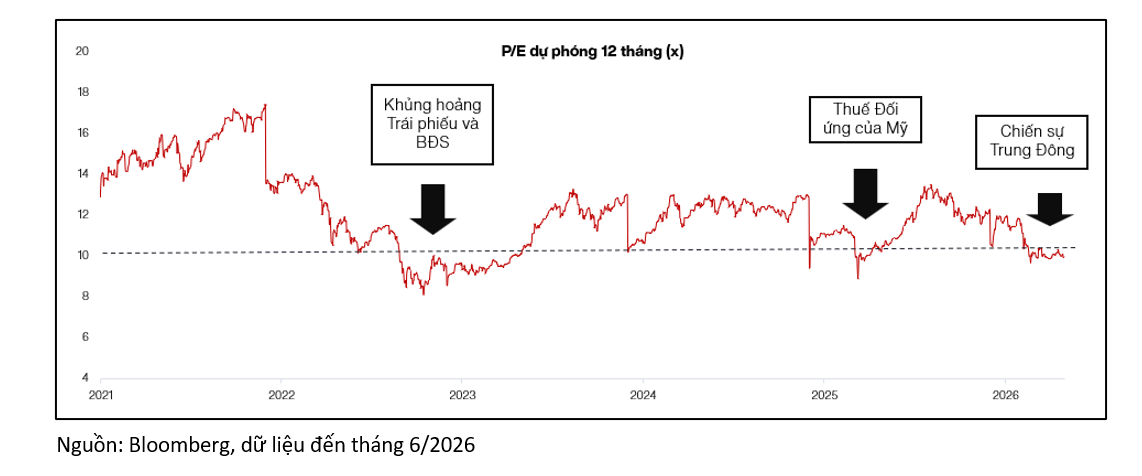
VN-Index valuation (excluding the Vingroup group). Photo: VinaCapital
On the other hand, more than 70% of stocks on the market are trading below a P/E of 10 times - a valuation zone that usually appears only during crisis periods.
Last year, the VN Index rose about 41%, but excluding the Vingroup group, the increase was only about 10%. This year, this gap continues to widen by another 4-5 percentage points.
Explaining this development, the expert said the Vingroup group's rally comes from three main drivers: the VinFast restructuring plan, the Green SM IPO plan and Vinhomes' positive business results. These factors support the VIC share price while further highlighting the degree of divergence in the market.
Even so, the expert believes current valuations do not accurately reflect the state of the economy, as production and consumption remain stable and high-tech exports continue to grow strongly.
From the valuation story, the perspective broadens to the economy's resilience against external fluctuations.
The market is currently under pressure from transport disruptions at the Strait of Hormuz, a trade deficit that rose from 3% of GDP to more than 6% of GDP by mid-May, inflation exceeding 5% and net foreign capital outflows of about USD2 billion since the start of the year. Nevertheless, Mr. Kokalari still expects Vietnam's GDP to grow 7% in 2026 thanks to the Government's management capacity.
The expert believes the impact from the Strait of Hormuz will be limited if the US and Iran reach an agreement soon, while the "bamboo diplomacy" strategy helps Vietnam maintain a stable energy supply. To date, the conflict has not caused significant disruption to daily life and domestic economic activity.
One of the important foundations creating this resilience is high-tech exports. Exports of computers and electronics rose nearly 50% this year, following a similar increase the previous year. This helps Vietnam maintain an advantage over many Asian economies that depend heavily on energy imports.
In addition, Mr. Kokalari believes the rising trade deficit mainly reflects the wave of AI-related investment. FDI businesses, especially Chinese high-tech companies, are stepping up imports of machinery and production equipment.
This is a "J-curve" phenomenon, where imports rise sharply in the early stage but will be offset by exports after a few months once the projects come into operation. Therefore, the VND, the currency market and the stock market are not currently under significant pressure.
Breakout profits and reform prospects
In addition to macro factors, Kokalari emphasizes the corporate profit picture together with long-term reform prospects.
According to him, Q1/2026 profits of listed businesses rose 51% year on year, far exceeding the market's expectation of 15%. A large contribution came from Vinhomes, but even excluding this factor, profits still rose about 30%, double the expectation.
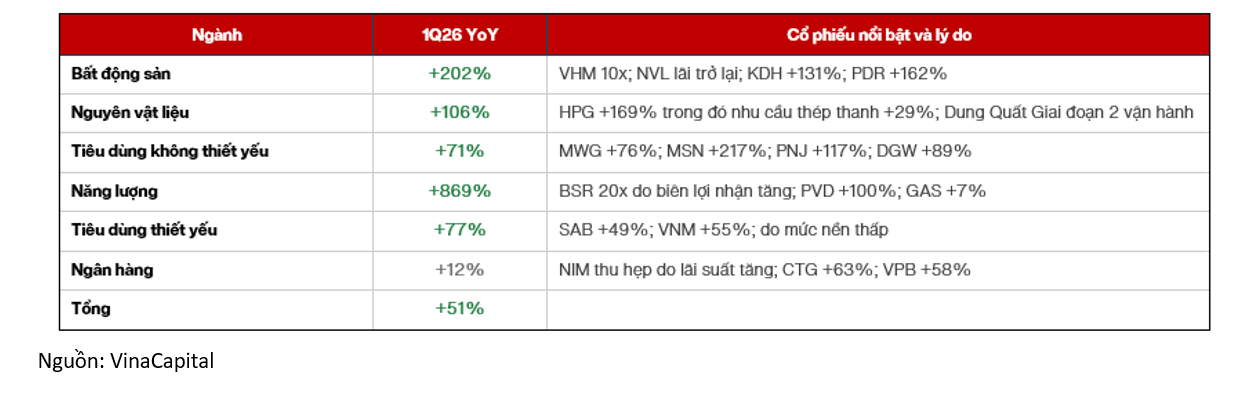
Q1 profits far exceeded businesses' forecasts. Photo: VinaCapital
The growth momentum is spreading across many sectors such as real estate, materials, retail, energy and consumer goods. Materials businesses benefit from rising steel demand, refineries are supported by improved margins, while the consumer group is recovering from a low base last year.
From this perspective, he believes that although the risk from the Middle East conflict still exists, most stocks are trading at valuations equivalent to crisis periods while corporate fundamentals remain solid.
Another notable point is the reforms Vietnam is implementing on a broad scale. Efforts to improve the efficiency of state-owned enterprises, meet FTSE's criteria for upgrading to emerging-market status, and remove obstacles to restart stalled real estate projects are assessed to create positive impacts in the long term.
According to him, these benefits have not been fully reflected in share prices and will gradually manifest through improved liquidity, an increased number of listed businesses and more vibrant investment activity.
In addition, the expert notes that just a few large stocks can significantly affect the profits of an entire sector, making the stock-selection strategy especially important.
Currently, many sectors - such as banking with a P/B of about 1.3 times and double-digit ROE, along with consumer, information technology and energy stocks - are still trading below their five-year average valuation.
New cycle prospects from the experts' perspective
In addition to VinaCapital's assessment, many other experts also offer a positive view of the market's prospects in the coming period.
Sharing about recent stock market developments, Mr. Nguyen The Minh, Director of the Investment Banking Division at An Binh Securities JSC, said the current correction pressure comes mainly from external factors rather than internal problems of the economy or Vietnam's market. In his view, this is most likely just a short-term wobble, and the market may soon stabilize again.
Mr. Minh assessed that individual investors' sentiment is a factor strongly affecting market movements. When negative warnings appear, such as about inflation, the initial reaction is usually not too pronounced.
However, when negative information is confirmed or spreads, fears can rise quickly, leading to strong sell-offs. Meanwhile, institutional investors usually prepare and adjust their portfolios earlier.
Even so, the expert believes that pressures such as inflation in the current period are not overly worrying. In his view, oil prices staying at high levels are largely driven by sentiment and short-term speculation. Therefore, although the market may continue to fluctuate in the short term, the general trend is expected to soon stabilize and return to a growth trajectory in the medium and long term.
From a valuation standpoint, Mr. Nguyen Minh Hoang - Head of Analysis at Viet First Securities - said that excluding VIC and VHM, the VN Index's P/E is around 11 times, lower than the 10-year historical average and attractive enough for the next upcycle. He expects that with profit growth of 16-17% and the P/E expanding to 15 times, the index could head toward the 2,100-point mark in a reasonable scenario.
Sharing VinaCapital's view on business results, Ms. Do Hong Van from FiinGroup noted that Q1 profits rose 38.4%, although most of it was concentrated in large-scale businesses.
In her view, this shows the market is shifting toward prioritizing the quality of growth. Deeply discounted mid-cap and small-cap groups have become a base for businesses with their own stories to have stronger recovery room in the coming period.
Source: TheLeader — theleader.vn. This article is republished for the purpose of sharing knowledge with the community of founders and investors in the HCM VIF ecosystem.
Category & tags
Related news
 Ecosystem
Venture capital will be a new asset class
Mr. Hoang Duc Trung believes that, with the State taking the lead and large organizations and enterprises joining forces to spread the momentum, venture capital will fulfil its role as an engine of growth and innovation
 Finance & Banking05/2026
The success of a public-private venture fund is not measured by the number of unicorns
With an initial size of VND 500 billion, how will the government's “seed capital” from the public-private venture fund catalyze the flow of financing into startups?
 Finance & Banking18/05/2026
Ho Chi Minh City sets up venture capital fund: 'Seed capital' for Vietnamese tech
For the first time, Ho Chi Minh City has a venture capital fund operating under a joint-stock company model with the participation of the State and major private corporations.