

The shift from digital banking to AI banking
The digital banking race has entered the stage of applying artificial intelligence, in order to instantly capture and serve every need of consumers.
The digital banking race has entered the stage of applying artificial intelligence, in order to instantly capture and serve every need of consumers.
The transformation of the banking industry
“MSB’s total transformation spending over the past three years is VND1,800 billion, a significant part of which is dedicated to artificial intelligence (AI),” revealed Mr. Vu Ngoc Bong Lai, Director of Strategy and Innovation at MSB.
According to Mr. Lai, this investment is used not only to maintain existing technology systems, but also to create a dedicated testing space for AI, from which to seek business breakthroughs.
MSB’s ambition is to complete its entire intelligent interaction system this year, before bringing AI assistants into autonomous operation in 2027.
MSB’s determination partly reflects the transformation of the entire banking industry. In the past, to approve a loan, a customer had to wait for many departments to pass paper submissions from hand to hand, a process lasting from a few weeks to a whole month. Now, AI takes part in processing data, helping shorten the turnaround time to a few minutes, or even a few seconds.
This change stems from the fact that consumer habits have changed completely. Mr. Ravi Kittane, senior advisor in financial services at Ernst & Young (EY), argued that banks today are no longer merely a place to deposit money. “Instead, banks must ‘immerse’ themselves in daily life,” he said.
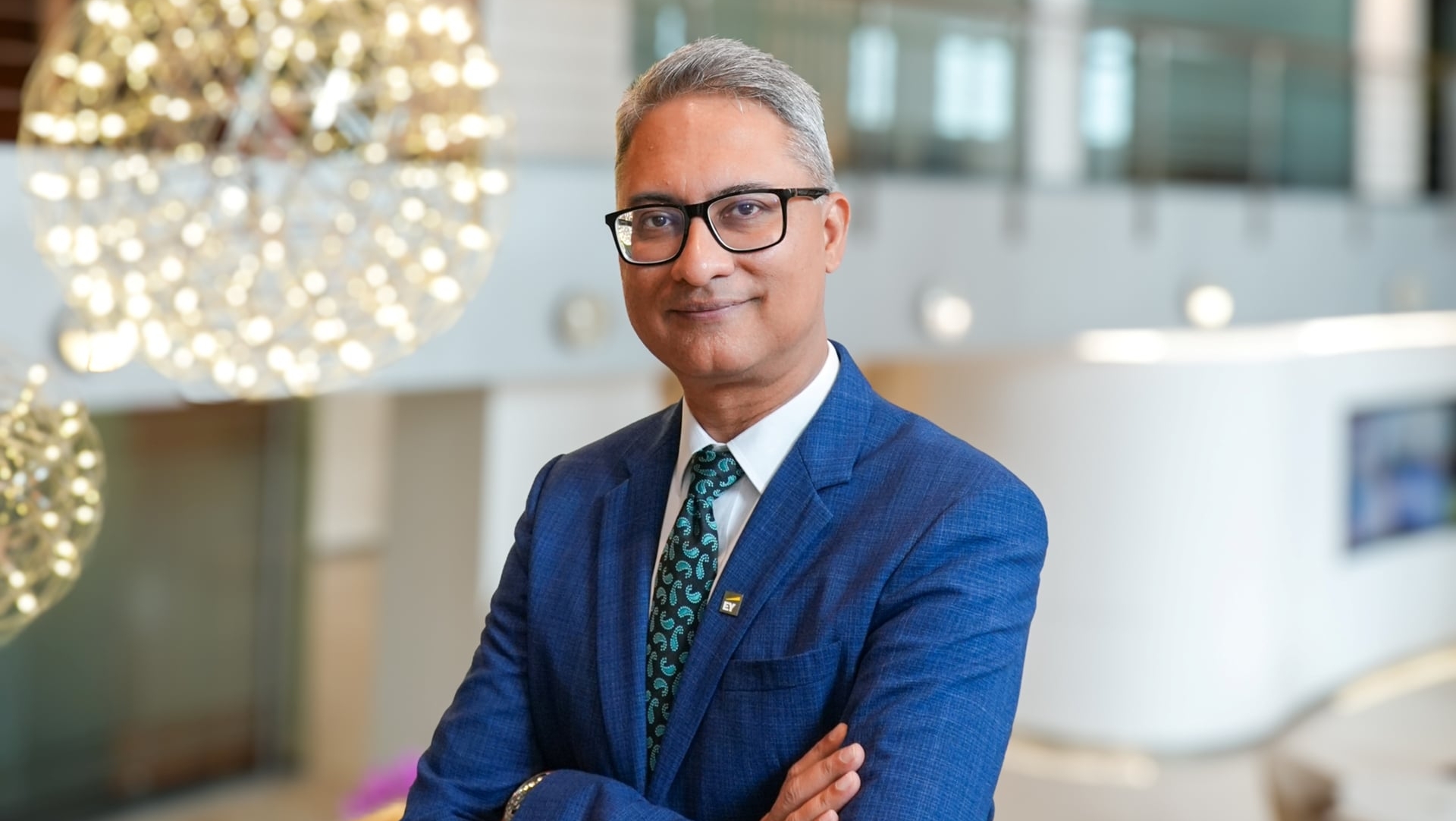
Mr. Ravi Kittane, senior advisor in financial services at Ernst & Young. Photo: EY
Looking back, traditional banks were often designed to “sell products,” through loan packages and credit cards, then find ways to push sales. Every transaction usually had to wait until the end of the day for the system to gather and process the books.
But today, users want everything to happen in real time. The EY expert argued that the banking industry’s game has shifted to a “transaction-led” model.
This model means that banks today do not just sell ready-made products, but provide services at the exact “moment” the customer needs them.
For example, a ride-hailing driver, or any user, can borrow a small amount of money at the end of the month to cover living expenses. By “embedding” financial services into daily habits, banks can attract large deposits at low cost.
The “formula” for profitability
The shift to a “transaction-led” model has begun to emerge in many places around the world. In the United Kingdom, Starling Bank does not serve the mass market but focuses on small businesses. It integrates tax-calculation tools and accounting software directly into the banking app to address exactly the needs of the business community.
This approach has helped Starling capture up to 9.4% market share, while bringing the cost of serving each customer down to a record low of just GBP42.4.
According to the EY expert, in Vietnam this path is also being applied by Cake by VPBank, with positive results. Targeting Gen Z and Millennials, Cake weaves financial services into ride-hailing and shopping apps. Drivers need only a few taps on the screen to receive a small loan approved instantly. Not only is it convenient, this approach has attracted more than 7 million users to Cake.
Of course, to serve such a huge number of customers as Cake does, AI is the key. Mr. Nguyen Huu Quang, CEO of Cake by VPBank, said that artificial intelligence is like the DNA of this digital bank. From marketing and credit scoring to risk management, AI is present at every stage. Currently, AI virtual assistants automatically handle up to 80% of the operational workload and support customers around the clock, 24/7.
Mr. Quang calls this the shift from positioning as a digital bank to an AI bank. In it, Cake’s advantage is applying big data and artificial intelligence from an early stage. Unlike the traditional banking model, Cake delivers a seamless financial-service experience, entirely processed automatically in the digital environment.

Digital bank Cake by VPBank has attracted more than 7 million users. Photo: Cake
In fact, despite a workforce of only nearly 400 people, Cake easily processes millions of credit applications each month. Its team of 100% Vietnamese engineers even builds specialized Vietnamese large language models (LLMs) for the financial sector in-house to understand the consumer psychology of Vietnamese people.
They also design and operate the core security system themselves, achieving international certifications such as PCI DSS 4.0.1 Level 1, PCI 3DS, ISO/IEC 27001:2022, ISO/IEC 30107-3 iBeta Level 2 and FIDO2, without having to buy them from a third party.
Thanks to mastering AI, in Q3/2024 Cake by VPBank posted positive EBITDA for the first time after just 3.5 years of operation, becoming the pioneering pure-digital bank in Vietnam to date to achieve earnings before interest, taxes, depreciation and amortization.
Average revenue per user (ARPU) rose from USD5 in 2023 to USD25 in 2025. This year, Cake expects to be able to raise ARPU to around USD44.
The modernization gap
Cake by VPBank is only one of the few digital banks in the region that are profitable, while the rest of the market is still struggling with the challenge of profitability. According to Boston Consulting Group, only about 5% of digital banks globally are truly operationally profitable.
According to the EY expert, although traditional banks have been investing more and more in technology, these institutions themselves still follow the well-worn “product-centric” path, regardless of whether customers need it or not.
In addition, there are outdated work processes and a lack of coordination between departments. Fragmented work among departments means a business proposal often takes many months to be approved, and by the time the product launches it has already become outdated.
More importantly, quite a few banks are constrained by outdated core technology systems. Data is not yet fully utilized, leaving banks unable to have a comprehensive view of shifts in customer behavior.
Faced with this challenge, Mr. Ravi Kittane argued that banks must first stop mass selling and instead find the right group of high-value customers to serve.
Next, the way banks work needs to change. Departments need to communicate on a shared technology system to increase connectivity.
Finally, the mindset about technology personnel must also change. Engineers cannot just type on keyboards and wait for the business unit to assign work. They must have a seat at the table with leadership to make strategic decisions.
The EY expert emphasized that only when technology, operating processes and customer understanding become one will banks truly be digital banks.
Source: TheLeader — theleader.vn. The article is republished for the purpose of sharing knowledge with the community of founders and investors in the HCM VIF ecosystem.
Category & tags
Related news
 Ecosystem
Venture capital will be a new asset class
Mr. Hoang Duc Trung believes that, with the State taking the lead and large organizations and enterprises joining forces to spread the momentum, venture capital will fulfil its role as an engine of growth and innovation
 Finance & Banking05/2026
The success of a public-private venture fund is not measured by the number of unicorns
With an initial size of VND 500 billion, how will the government's “seed capital” from the public-private venture fund catalyze the flow of financing into startups?
 Finance & Banking18/05/2026
Ho Chi Minh City sets up venture capital fund: 'Seed capital' for Vietnamese tech
For the first time, Ho Chi Minh City has a venture capital fund operating under a joint-stock company model with the participation of the State and major private corporations.