

The digital finance era: A faster experience that must still be safe
No longer stopping at digitizing services, Vietnam’s finance, banking and insurance industries are entering a deep and broad restructuring, bringing AI into the core of operations and reshaping the service ecosystem as they face increasingly complex cybersecurity pressures.
No longer stopping at digitizing services, Vietnam’s finance, banking and insurance industries are entering a deep and broad restructuring, bringing AI into the core of operations and reshaping the service ecosystem as they face increasingly complex cybersecurity pressures.
Dr. Dao Minh Tu, Vice Chairman and Secretary General of the Vietnam Banks Association (VNBA), assessed that Vietnam is accelerating strongly to become one of the fastest-growing digital finance markets in Southeast Asia. In his view, digital transformation is no longer an external “display shell,” but has gone straight to the core of operations, reshaping the governance structure and the way financial institutions create value.
Citing data from the State Bank of Vietnam, he said that more than 95% of credit institutions have deployed a digital transformation strategy, while nearly 80% of financial transactions in Vietnam are now carried out entirely on digital channels. This shows that the banking industry is moving past the “service digitization” stage to advance into a comprehensive restructuring driven by data and technology.
“Whereas in the past banks mainly provided services under the traditional model, today data has become a strategic asset, and the customer experience is at the center of every development decision,” Mr. Tu emphasized at the 4th “World Financial Innovation Series 2026 (WFIS 2026)” event in Vietnam, organized by VNBA in cooperation with TradePass (India).
Innovating in technology, but not trading away “social trust”
According to Mr. Tu, although this digitization “whirlwind” is taking place strongly in the finance, banking and insurance industry, the pressure it brings is also extremely large.
Citing Visa’s Asia-Pacific cybersecurity risk report (April 2026), VNBA emphasized that attacks applying artificial intelligence (AI) are increasing rapidly in both scale and sophistication. More worryingly, the World Economic Forum (WEF) also pointed out that up to 65% of large organizations admit that vulnerabilities from third parties and the supply chain are the “Achilles’ heel” challenging their resilience.
Analyzing the flow of technology more deeply, Mr. Le Anh Dung, Deputy Director of the Payment Department of the State Bank of Vietnam, said that global payment trends are shifting strongly toward comprehensively connected ecosystems such as super apps, real-time cross-border payments, stablecoins and, in particular, agentic payments powered by artificial intelligence (AI).
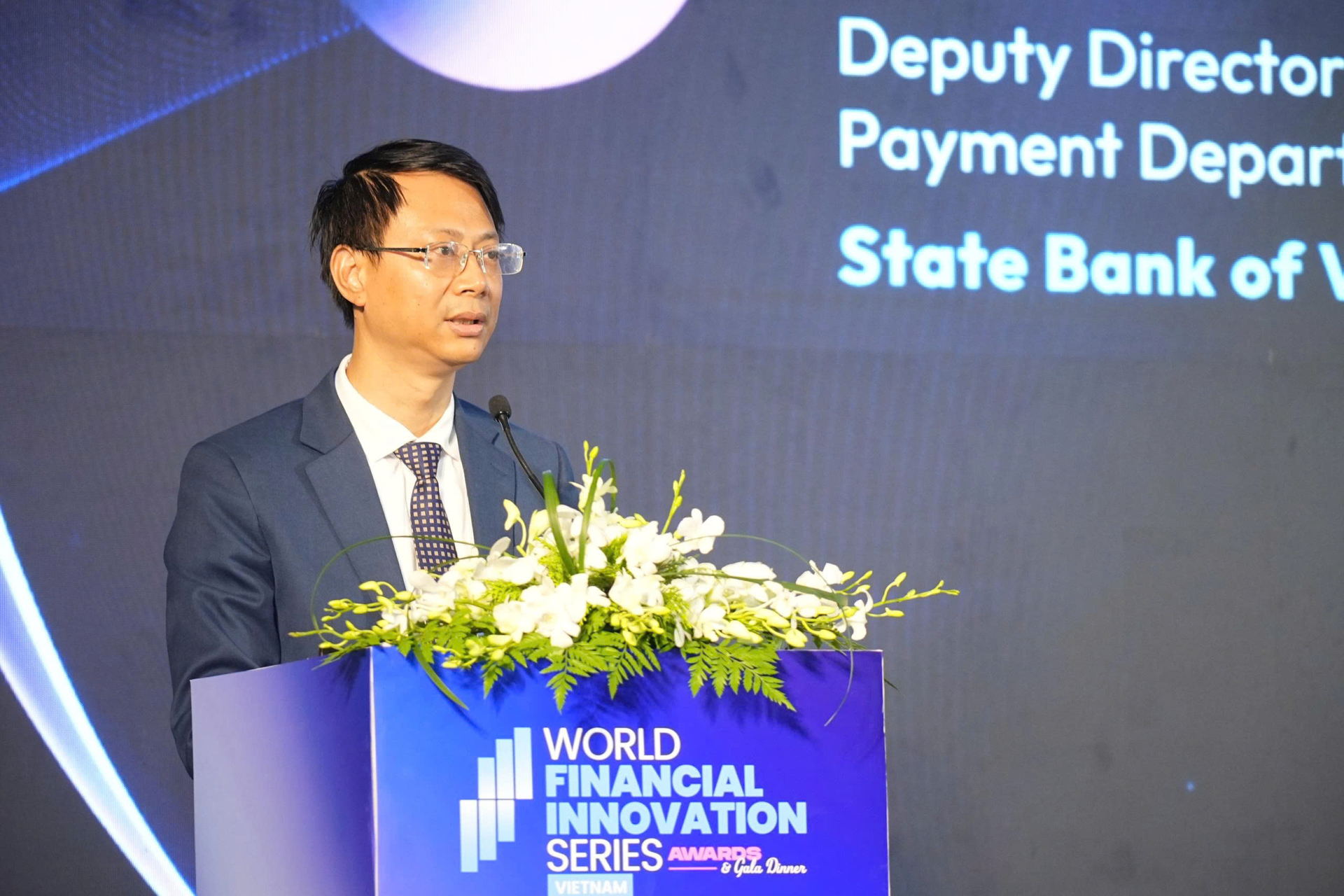
Mr. Le Anh Dung, Deputy Director of the Payment Department, State Bank of Vietnam.
According to the Worldpay GPR 2026 report, app-based payments now account for 37% of global POS value and will approach the 46% mark by 2030.
In Vietnam, digital infrastructure has reached impressive figures, with more than 21,000 ATMs, 864,000 POS terminals and more than 70% of credit institutions having applied AI to core activities such as credit scoring, eKYC, fraud detection and anti-money laundering.
In the face of accelerating digitization, according to Mr. Dung, the core requirement lies not in speed, but in the capacity to “build trust.” In his view, payments can be faster thanks to AI and data, but convenience only has meaning when accompanied by the ability to protect customers and ensure the safety of the system.
“Innovation cannot be traded off against financial stability and social trust,” he emphasized.
From the experts’ perspective, the technology race in the financial industry is not only a matter of accelerating digitization, but also a careful balancing act between investment costs, adaptive capacity and the ability to expand new resources.
Dr. Can Van Luc, Chief Economist of the Joint Stock Commercial Bank for Investment and Development of Vietnam and a member of the Prime Minister’s policy advisory council, said that the digital economy currently contributes about 20% of gross domestic product (GDP) and is expected to rise to 30% by 2030. In his view, to achieve this goal, the financial ecosystem cannot rely solely on traditional credit but must expand into new drivers such as green finance, digital assets and the carbon market.
From the angle of operational solutions, Mr. Mike Breen, Chief Commercial Officer of Audax, argued that banks do not need to plunge into a “Big Bang”-style core banking “major surgery” full of risks. Instead, a more effective strategy is “coexistence” – keeping the existing core system stable while expanding innovation at the “edge” with cloud-native platforms and APIs to accelerate digitization without disrupting the entire system.
Meanwhile, Mr. Anthony Morris, Industry Transformation Director at nCino, emphasized that AI is becoming a “lever” reshaping credit operations.
“Simplifying the loan process, making the credit experience as fast and convenient as online shopping, is precisely the key that helps financial institutions safely manage a loan portfolio worth thousands of billions of USD,” Mr. Anthony Morris added.
Don’t put dry processes online – ‘touch’ the customer’s emotions
A fresh highlight at this year’s WFIS 2026 was the participation of insurance industry leaders. At the roundtable discussion on “Digital transformation in the insurance industry in Vietnam,” Mr. Nguyen Ngoc Tu, Deputy General Director of Chubb Life Vietnam, brought a deeply humanistic perspective on digital insurance.
In his view, digital transformation in insurance is not just about “bringing paperwork online,” but a complete rebuilding of the entire customer journey to make insurance more transparent, more accessible and, most importantly, more trustworthy.
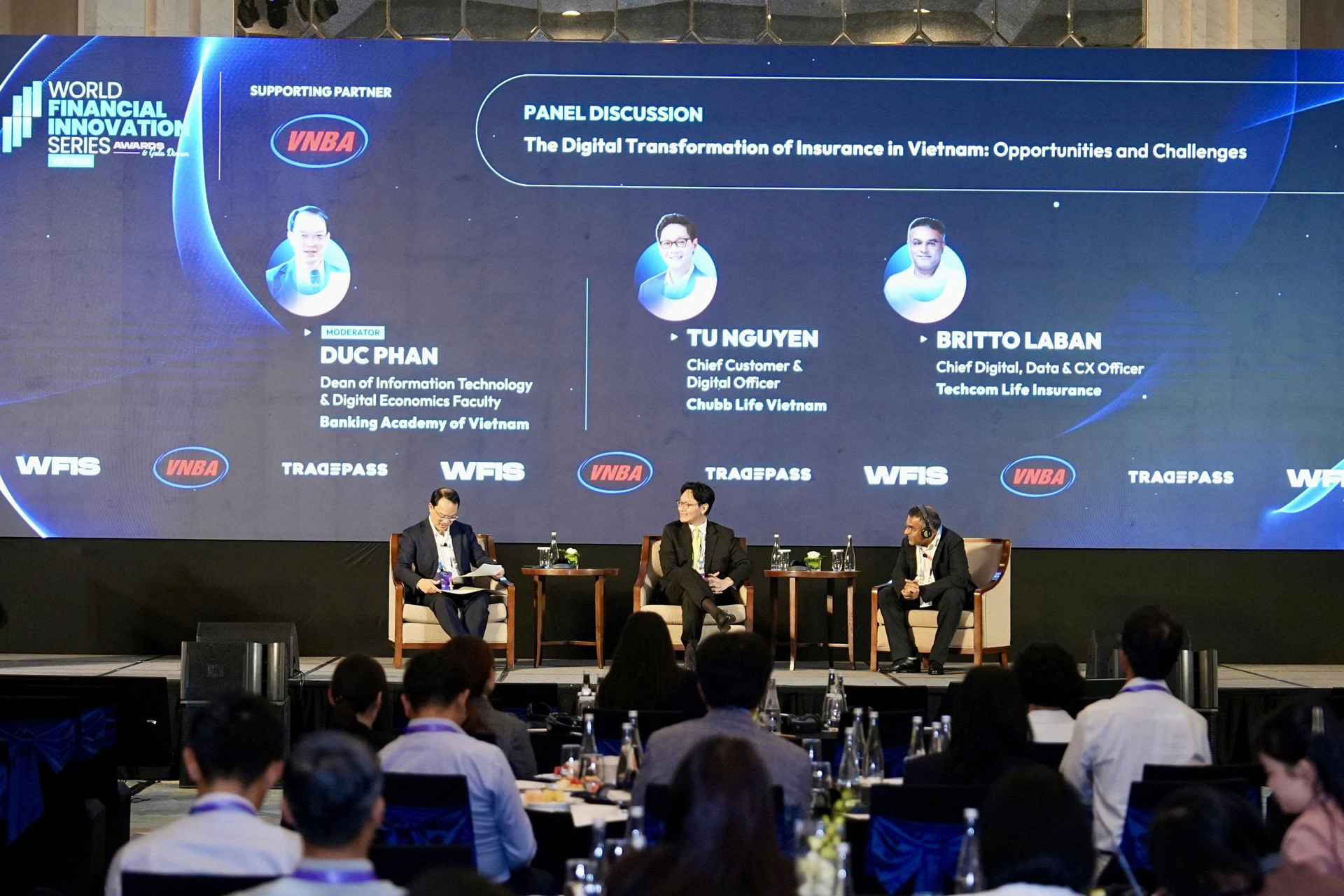
Business leaders discuss the opportunities and challenges of digital transformation in the insurance industry.
The pressure to change in the industry no longer comes from insurance companies competing with one another, but from the very seamless experiences that customers have become accustomed to in banking or e-commerce.
“That is precisely why insurance companies today need to make a clear transformation, not just distributing products but understanding customers’ needs and designing a comprehensive experience for customers in the digital environment,” Mr. Tu analyzed.
At the same time, the Deputy General Director of Chubb Life Vietnam also frankly acknowledged that no matter how modern digital insurance may be, it still needs the human touch. When facing long-term financial decisions, customers always need explanation, reassurance and responsible advice. The audio and video recording requirements under the 2022 Law on Insurance Business are a good “filter” to reinforce this trust.
In his role moderating the discussion, Dr. Phan Thanh Duc, Dean of the Faculty of Information Technology and Digital Economy (Banking Academy), affirmed: “All financial institutions are dreaming of building a ‘super app,’ and to do this requires an ecosystem, open banking and open finance. At present, the circulars of state management agencies are building a legal corridor for Open API, so that the ‘super app’ dream can soon become reality.”
Source: TheLeader — theleader.vn. The article is republished for the purpose of sharing knowledge with the community of founders and investors in the HCM VIF ecosystem.
Category & tags
Related news
 Ecosystem
Venture capital will be a new asset class
Mr. Hoang Duc Trung believes that, with the State taking the lead and large organizations and enterprises joining forces to spread the momentum, venture capital will fulfil its role as an engine of growth and innovation
 Finance & Banking05/2026
The success of a public-private venture fund is not measured by the number of unicorns
With an initial size of VND 500 billion, how will the government's “seed capital” from the public-private venture fund catalyze the flow of financing into startups?
 Finance & Banking18/05/2026
Ho Chi Minh City sets up venture capital fund: 'Seed capital' for Vietnamese tech
For the first time, Ho Chi Minh City has a venture capital fund operating under a joint-stock company model with the participation of the State and major private corporations.