

The capital market is accelerating
Bank credit, equities and bonds are moving in a mutually complementary direction, laying the foundation for a more balanced financial structure and a more sustainable growth cycle for the economy.
Bank credit, equities and bonds are moving in a mutually complementary direction, laying the foundation for a more balanced financial structure and a more sustainable growth cycle for the economy.

The capital market is gradually sharing the burden with credit. Photo: Hoang Anh
A lively race in issuance, bonds and IPOs
According to data from FiinGroup, as of the end of May 2026, the total planned equity capital raising and IPO value of listed and registered-for-trading enterprises reached about VND289,500 billion, up 86.5% from the amount of capital actually raised in 2025 and the highest level since the boom period of 2021.
This figure does not merely reflect the vibrancy of the stock market but also shows a notable shift in the economy's capital-raising structure.
Among them, the banking sector is precisely the group of enterprises with the strongest demand for capital increases. According to plans approved by general shareholders' meetings, the banking sector plans to raise about VND128,000 billion in equity capital this year, more than seven times the 2025 figure and about 72% higher than the average of the past 5 years.
The capital increase plans of many large banks such as Vietcombank, BIDV, VPBank, HDBank and MBBank reflect the need to supplement Tier 1 capital to meet increasingly high safety standards, while also creating room for a new credit growth cycle.
Meanwhile, in the non-banking group, equity capital raising plans continue to concentrate in the financial services sector, such as securities companies HCM, VNDirect, Nhat Viet and Rong Viet (about VND8.2 trillion in 2026 through private placements and rights offerings to existing shareholders).
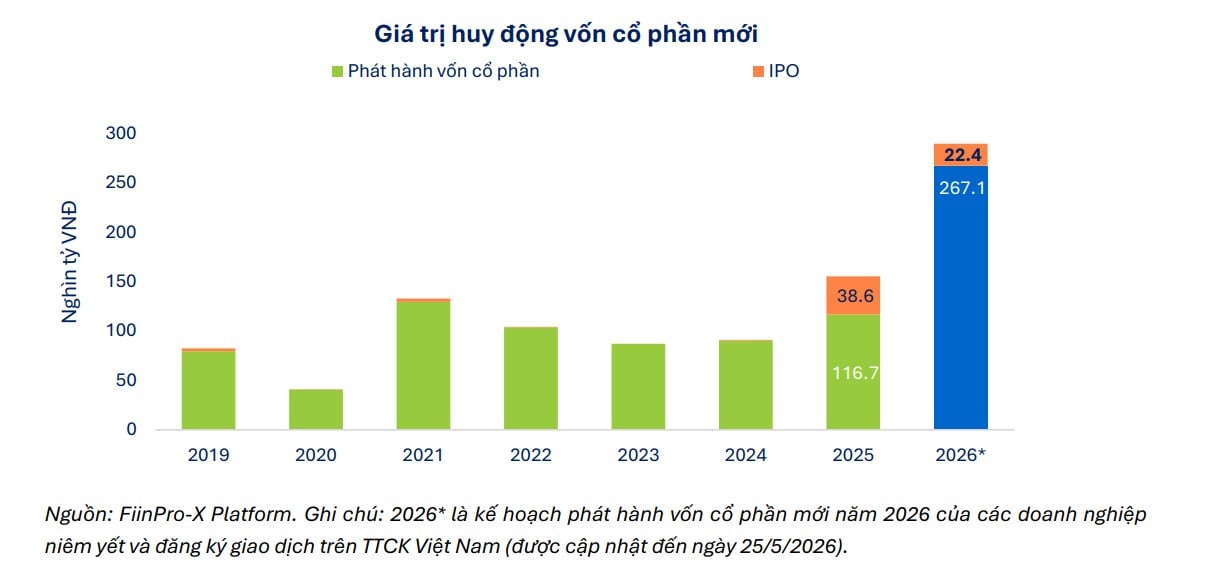
Similarly, in the real estate group, the scale of equity capital issuance is expected to reach nearly VND37.3 trillion, surging compared with the same period last year. Notable among them are Novaland, Fideco and the Vietnam Rubber Group – enterprises focusing on restructuring their capital sources, reducing debt pressure and preparing resources for a new investment phase.
This trend reflects the reality that, as the economy's capital demand grows ever larger, enterprises no longer want to depend entirely on bank credit. Instead, raising equity capital through the stock market is becoming an important option to strengthen financial capacity and improve balance-sheet health.
This is driven by the significant improvement of the stock market over the past year. The VN-Index has far surpassed the bottom set after the 2022-2023 correction period, market liquidity has recovered strongly, while improved valuations have made it easier for enterprises to implement capital-raising plans.
From a macro perspective, this is also a positive signal for the banking system. When enterprises can increase their equity capital, their leverage ratios decline, their ability to absorb loans improves and credit risk for lenders also decreases.
If the stock market is taking on the role of raising equity capital, the corporate bond market is also gradually regaining its position as an important channel for raising medium- and long-term capital for the economy.
After a prolonged difficult period from 2022 to 2024, the bond market is recording many signs of recovery. Bond maturity pressure at many large enterprises has fallen considerably after debt-restructuring rounds, while the increasingly complete legal framework helps bolster investor confidence.
According to data from the Vietnam Bond Market Association (VBMA), over 5 months, the total value of corporate bond transactions reached more than VND574 trillion, up 18.1% from 2025.
Of this, private placements reached more than VND107 trillion and public offerings reached more than VND20 trillion. This development shows that capital raising through bonds is gradually regaining its role in enterprises' capital structure after a period in which the market focused on addressing issues related to liquidity, debt restructuring and bolstering investor confidence.
The improvement in the primary market has also occurred alongside liquidity in the secondary market remaining high, thereby reflecting the market's improving ability to absorb new supply.
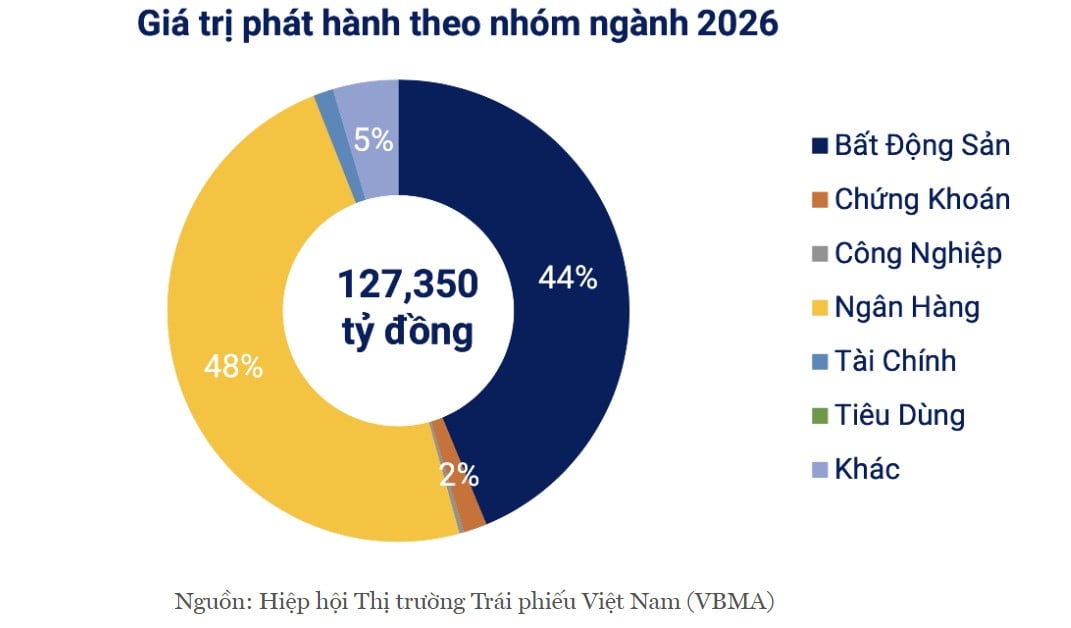
One of the most notable points in the corporate bond market since the start of the year is that the issuance structure continues to concentrate heavily in two sectors: banking and real estate.
According to VBMA statistics, the banking group accounted for about 48% of total issuance value in the first 5 months of 2026, while the real estate group accounted for about 44%. This structure partly reflects the characteristics of the economy's current capital demand.
While banks need to supplement medium- and long-term capital to meet credit growth and capital adequacy targets, real estate enterprises are the group with large long-term capital needs to implement projects. Compared with many other sectors, these are also the two sectors with experience accessing the bond market and with significantly larger capital-raising scale.
The capital market is "sharing the load" with credit
For many years, bank credit has always been the main capital-supply channel for Vietnam's economy. With outstanding loans equivalent to about 130% of GDP, most of enterprises' capital needs are still being met through the banking system.
However, the simultaneous recovery of the equity and bond markets is helping to create a more balanced capital-raising structure. On one hand, enterprises increase equity capital to reduce debt pressure and improve financial capacity. On the other hand, corporate bonds provide medium- and long-term capital for investment projects, thereby easing the long-term financing burden on the banking system.
Even commercial banks are leveraging the capital market to strengthen their financial capacity, creating more room to expand credit. This shows an increasingly clear complementary relationship between the capital market and the banking system.

Nevertheless, the capital market still faces many challenges before it can truly become a driver of long-term capital. Photo: Hoang Anh
In particular, in the context where infrastructure, energy, urban, digital transformation and green transformation projects all require large amounts of capital and long payback periods, the need for long-term capital sources is becoming increasingly urgent.
Mr. Nguyen Ba Hung, senior national economist at the Asian Development Bank (ADB), believes that short- and medium-term credit should be supplied through the banking system, while long-term capital needs should be mobilized through the bond market and capital market instruments.
According to Mr. Hung, the current problem is not that banks "lack money" in an absolute sense but that they lack capital of an appropriate maturity. When short-term funds have to finance long-term loans, liquidity pressure will rise, driving up the cost of capital and lending rates.
Therefore, developing the capital market is not intended to replace the banking system but to complete the financial structure in a more balanced and sustainable direction. In it, banks continue to play the leading role in supplying working capital and short-term capital, while the capital market better takes on the function of providing medium- and long-term resources for large-scale projects.
At the macro management level, Deputy Prime Minister Nguyen Van Thang assessed that monetary policy has made a significant contribution to growth and macroeconomic stability in recent times. However, the room for monetary policy is gradually narrowing. Therefore, in the coming time, monetary policy must continue to be managed to ensure liquidity and short-term resources for the economy, but the focus of mobilizing resources needs to be placed more on fiscal policy.
In particular, to solve the medium- and long-term capital problem, the Government is resolutely directing the development of the stock market with the goal of bringing market capitalization to about 120% of GDP by 2028, on par with many countries in the region.
Nevertheless, the capital market still faces many challenges. In the stock market, the biggest pressure comes from the very large issuance scale while the ability of cash flow to absorb it remains a question mark.
According to FiinGroup, about 70% of the 2026 capital increase plans have yet to be implemented. This raises the question of cash flow absorption capacity as well as the risk of diluting existing shareholders' interests.
Meanwhile, in the bond market, issues related to credit quality, information transparency and investor protection mechanisms still need to be improved further. The market's recovery process will only be sustainable when confidence is built on a foundation of better governance and transparency.
However, these challenges mainly reflect the market's maturing process rather than a sign of weakness. What matters is that, after many years, bank credit, equities and bonds are moving in a mutually complementary direction, laying the foundation for a more balanced financial structure and a more sustainable growth cycle for the economy.
Source: TheLeader — theleader.vn. This article is republished to share knowledge with the community of founders and investors in the HCM VIF ecosystem.
Category & tags
Related news
 Ecosystem
Venture capital will be a new asset class
Mr. Hoang Duc Trung believes that, with the State taking the lead and large organizations and enterprises joining forces to spread the momentum, venture capital will fulfil its role as an engine of growth and innovation
 Finance & Banking05/2026
The success of a public-private venture fund is not measured by the number of unicorns
With an initial size of VND 500 billion, how will the government's “seed capital” from the public-private venture fund catalyze the flow of financing into startups?
 Finance & Banking18/05/2026
Ho Chi Minh City sets up venture capital fund: 'Seed capital' for Vietnamese tech
For the first time, Ho Chi Minh City has a venture capital fund operating under a joint-stock company model with the participation of the State and major private corporations.