

SSI: Vietnam is creating its own wave
Behind signals that appear less positive in trade or liquidity, Vietnam's economy is witnessing a shift toward a new growth model, relying more on domestic investment, infrastructure, and institutional reform.
Vietnam is no longer waiting for opportunities to come from outside but is increasingly creating its own wave, through infrastructure investment, institutional reform, capital market development, and many other strategies.
The first months of 2026 witnessed quite a few signals that made investors on the stock market more cautious.
The trade balance shifted from a surplus to a trade deficit. Interest rates remained at a high level. Liquidity in the banking system was not yet truly abundant, while consumer purchasing power recovered more slowly than expected.
Looking at these short-term indicators, many wondered whether the economy's growth momentum was stalling after the strong recovery period of 2024-2025.
Assessing this issue, SSI Securities Corporation argues that what the economy is going through is not a slowdown in growth but a process of "pivoting" toward a new growth model.
Instead of relying on exports, consumption, or a favorable global cycle, growth is increasingly being driven by domestic investment, infrastructure development, institutional reform, and the deepening of the capital market.
Pivoting the drivers of growth
One of the most notable developments in Vietnam's economy in the first half of the year was the sharp change in the trade balance.
After many years of continuously maintaining a surplus, Vietnam recorded a trade deficit of USD13.8 billion in the first five months of the year. In an economy with a high degree of openness, this is often seen as a warning signal for growth and macroeconomic stability.
But this time, the structure of imports tells a different story. Most of the increase came from machinery, equipment, electronic components, and inputs serving production. At the same time, disbursed FDI capital continued to remain high, concentrated mainly in the processing and manufacturing sector. A series of production-expansion projects by international corporations continued to be implemented.
Therefore, the rapid rise in the trade deficit should be viewed not as a sign of weakness but rather as the "import footprint" of a country expanding its production capacity.
A trade deficit is a feature of this growth model, not necessarily a problem. Third-quarter export data will be the test to determine whether it reflects stepped-up imports to produce for exports and invest in expanding production capacity, and/or the acceleration of imports ahead of potential trade action from the United States.
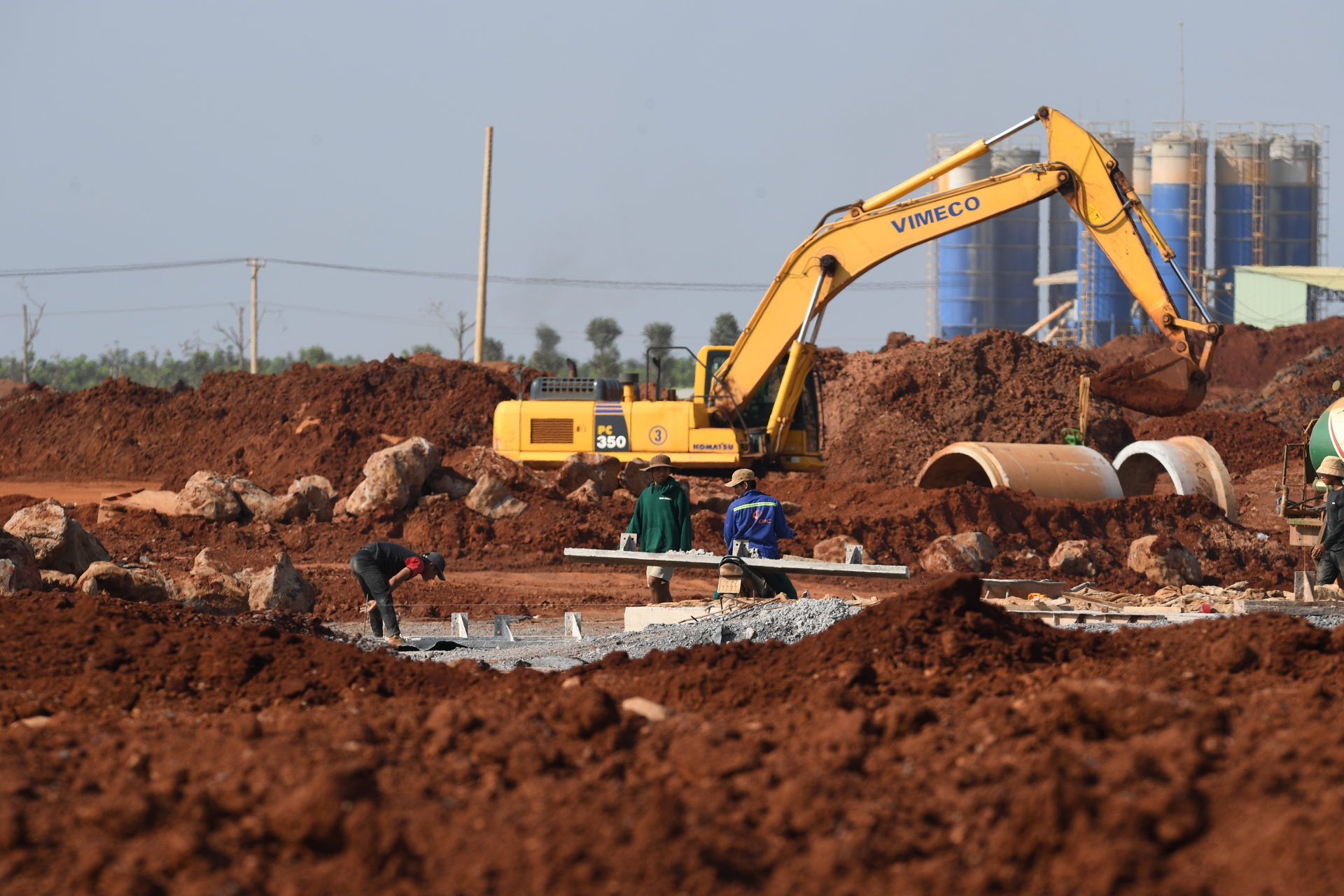
Boosting public investment. Photo: Hoang Anh
Looking back at previous growth periods, exports and consumption were often the two most important drivers of the economy.
However, amid a still highly uncertain global economy and external demand no longer growing as strongly as before, Vietnam is gradually shifting its focus toward expanding production capacity and enhancing the economy's capital absorption capacity.
This is clearly reflected in the increase in FDI flows. FDI disbursement in the first five months of this year reached USD9.75 billion, up 9.6% year-on-year, the highest for a first five-month period in five years, with 82.7% directed to the processing and manufacturing sector. Large-scale expansion projects from Samsung, SK, and BYD continue to reinforce Vietnam's position as a regional manufacturing hub.
At the same time, a series of infrastructure projects are being pushed forward. From expressways, seaports, and airports to energy and logistics, investment projects are playing an increasingly larger role in generating growth.
The analysts assess that the most important development of the current cycle is not weakening demand but the pivot toward a growth model led by domestic investment, in which asset accumulation increasingly replaces consumption and net exports to become the main driver.
This is also why the analysts maintain a positive view of Vietnam's economic outlook in the second half of the year, expecting growth to be supported by public investment disbursement and continued acceleration of FDI flows.
If public investment and FDI are the more visible part of the new growth picture, then institutional reform is the more important underlying layer.
As with the financial market, Vietnam's market upgrade story is moving beyond the traditional focus on the classification decisions of FTSE or MSCI.
The more important development is that the Government is increasingly focused on making Vietnam truly investable, through raising the free-float ratio, divesting state-owned enterprises, deepening the capital market, improving the clearing and settlement infrastructure, enhancing governance quality, strengthening investor protection, and expanding the supply of investable assets.
In this sense, a market upgrade is not just about earning a "title." What matters more is the process of building the foundations and conditions necessary for Vietnam to truly become a market into which global investors can deploy capital with confidence.
From a broader perspective, similar logic is also appearing in many other areas of the economy.
Public investment, FDI attraction, easing of business conditions, and legal reform are increasingly aimed at the same goal: reducing the cost of doing business and enhancing the economy's capital absorption capacity.
In other words, the focus is gradually shifting from short-term demand management to expanding long-term production capacity.
Beneath the cyclical noise, the macroeconomic foundation is improving. Infrastructure is becoming more financially viable, the capital market is more accessible to investment flows, housing policy is increasingly oriented toward real demand, and the economy is placing greater emphasis on execution.

FDI attraction is increasing. Photo: Hoang Anh
A different growth cycle is taking shape
According to SSI, the deeper story of 2026 is that Vietnam is increasingly focused on building intrinsic growth drivers.
Vietnam is no longer waiting for opportunities to come from outside but is increasingly creating its own wave, through infrastructure investment, institutional reform, capital market development, and reforms that make both the economy and the market investable. A market upgrade may follow, but it is increasingly becoming a consequence rather than a catalyst.
The firm forecasts real GDP growth for Q2/2026 at 8.2–8.5% year-on-year, with the possibility of exceeding expectations toward 9% if June data comes in stronger, accelerating from the 7.83% of Q1 as growth pivots more decisively toward the investment pillar.
This jump is driven by the ongoing FDI disbursement cycle and back-loaded public investment spending plans that are gradually taking effect in the second half of the year.
On the stock market, toward the end of 2026, SSI Research maintains its base-case scenario for the VN-Index at 1,920 points and an optimistic scenario at 2,120 points. According to the firm, the market may continue to fluctuate within a narrow band in the short term, given that interest rate levels remain high, system liquidity is not yet truly abundant, and net selling pressure from foreign investors remains present.
However, corporate earnings growth, forecast at over 20%, continues to be an important support for market valuations.
Amid the economy's growth drivers shifting toward investment and expanding production capacity, SSI highly rates the infrastructure, construction, and building-materials groups as the sectors most clearly benefiting from the wave of public investment disbursement expected to accelerate in the second half of the year.
In a high-interest-rate environment, priority should be given to industry-leading enterprises with pricing power and strong balance sheets, maintaining selectivity in the banking sector with a preference for state-owned banks with superior asset quality, and recognizing defensive appeal in cash-rich enterprises in the rubber, oil and gas, and fertilizer sectors.
The increasingly expanding IPO pipeline and the resilience of the information technology sector provide additional channels to rotate portfolios toward new growth opportunities.
Source: TheLeader — theleader.vn. This article is republished for the purpose of sharing knowledge with the community of founders and investors within the HCM VIF ecosystem.
Category & tags
Related news
 Ecosystem
Venture capital will be a new asset class
Mr. Hoang Duc Trung believes that, with the State taking the lead and large organizations and enterprises joining forces to spread the momentum, venture capital will fulfil its role as an engine of growth and innovation
 Finance & Banking05/2026
The success of a public-private venture fund is not measured by the number of unicorns
With an initial size of VND 500 billion, how will the government's “seed capital” from the public-private venture fund catalyze the flow of financing into startups?
 Finance & Banking18/05/2026
Ho Chi Minh City sets up venture capital fund: 'Seed capital' for Vietnamese tech
For the first time, Ho Chi Minh City has a venture capital fund operating under a joint-stock company model with the participation of the State and major private corporations.