

Solving the VND38.5 quadrillion puzzle for double-digit growth ambitions
At the end of 2025, Vietnam’s economy reached a new milestone as GDP surpassed USD500 billion and per capita income exceeded USD5,000, officially joining the group of upper-middle-income countries. These figures...
At the end of 2025, Vietnam’s economy reached a new milestone as GDP surpassed USD500 billion and per capita income exceeded USD5,000, officially joining the group of upper-middle-income countries.
These figures do not merely reflect the increasingly large scale of the economy but also open up an important period of transformation for Vietnam over the coming decade.
Accompanying the new growth aspiration is the enormous challenge of capital. In the 2026-2030 period, total social investment capital demand is expected to reach about VND38.5 quadrillion to serve the goal of double-digit GDP growth.
Of this total resource, the state budget is expected to account for only about 20%, with the remainder to be mobilized from the private sector, FDI and the capital market.
That also means the old growth model, which relied heavily on bank credit, is gradually reaching its limits, forcing the economy to shift to a more multi-tiered and sustainable financial structure.
An urgent need for enormous capital flows
The economy’s enormous capital flows are gradually taking shape through the mega construction sites stretching across the country, step by step forming a connected infrastructure system and creating new growth drivers.
The capital demand for transport infrastructure alone in the 2026-2030 period has reached about VND3 quadrillion, focused on completing the network connecting key economic regions from North to South and the major cities.
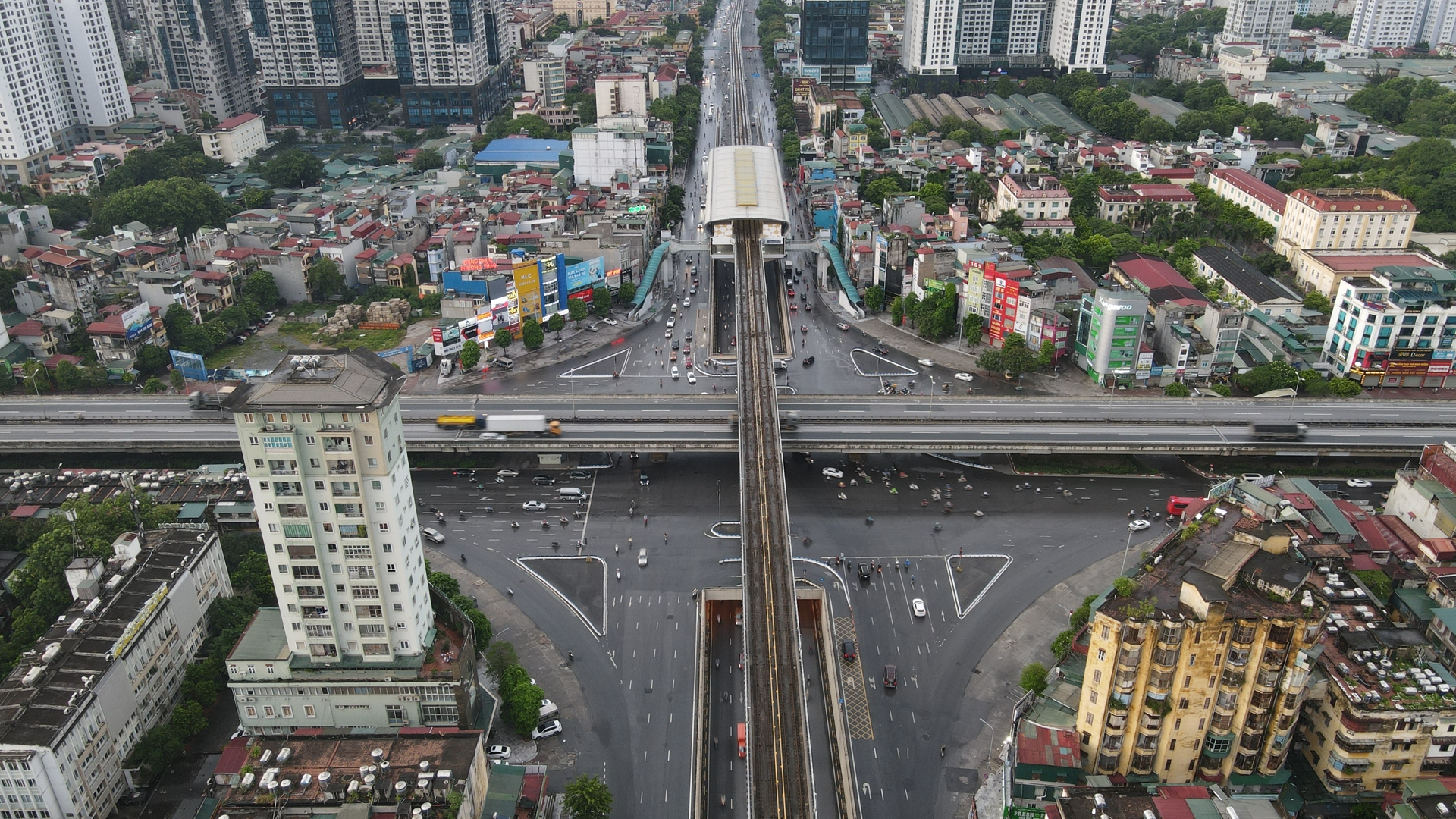
The economy’s enormous capital flows are gradually taking shape through the mega construction sites stretching across the country. Photo: Hoang Anh
The biggest highlight is the North–South high-speed rail project, with a preliminary total investment of about VND1.7 quadrillion, equivalent to more than USD67 billion.
The 1,541-km line passing through 20 provinces and cities is seen as the new “backbone” of the economy, helping to shorten travel time and expand development space for industry, logistics and supply chains.
In parallel, Hanoi and Ho Chi Minh City are also entering a phase of accelerating metro investment, with capital demand of nearly VND744,000 billion. These urban rail lines are expected to reduce congestion and reshape a more modern urban space.
In the South, Long Thanh Airport and the Can Gio mega-port continue to demonstrate Vietnam’s long-term vision. One is a new international aviation gateway, the other a logistics hub capable of receiving large-tonnage vessels, thereby reducing logistics costs, which are currently high, as Vietnam integrates ever more deeply into the global supply chain.
However, the economy’s capital demand does not stop at transport infrastructure. In the coming years, sectors such as energy, digital transformation, data centers, artificial intelligence, semiconductors, smart cities, next-generation telecommunications infrastructure and high-tech industrial parks will also require enormous investment capital.
Just realizing the goals of Power Development Plan VIII, developing renewable energy and upgrading the power transmission system already requires quadrillions of dong in investment capital over the coming years.
The growing volume of projects and capital demand shows that Vietnam’s economy still has very large investment room.
This is both a challenge in mobilizing resources and an opportunity for the capital market, the financial system, the private sector and FDI flows to play their role, creating a foundation for a new growth cycle based on modern infrastructure, high productivity and greater added value.
The credit “bloodstream” reaches its limit
As the mega construction sites of the future gradually take shape, the economy also faces a thorny problem, as bank credit – the main “bloodstream” for the entire economy – is approaching its safety limit.
For many decades, bank credit has been an important driver helping Vietnam sustain growth and overcome many economic shocks. However, the current scale of credit has pushed the credit-to-GDP ratio to a very high level, creating growing pressure on macroeconomic stability.
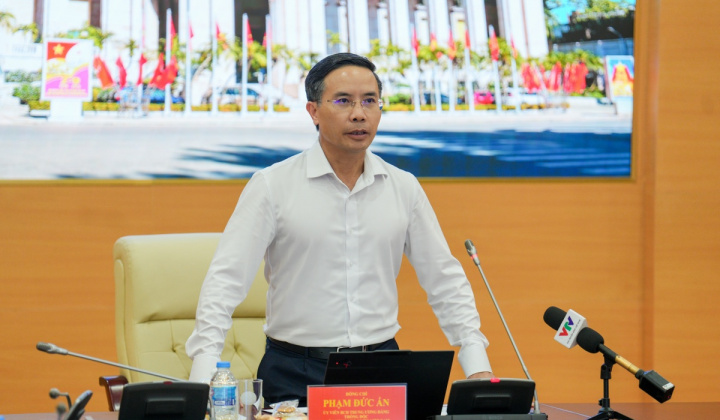
Governor Pham Duc An said the scale of the economy’s credit has reached a high threshold relative to GDP.
Mr. Pham Duc An, Governor of the State Bank of Vietnam, made it clear: “After the period of high credit growth in recent years to meet the capital needs for economic growth, the scale of credit has now reached 145% of GDP.”
To achieve the goal of GDP growth of about 10% per year, credit usually has to grow more than 20% annually. That means the pressure on inflation, system liquidity and bad-debt risk will grow ever larger, especially as many infrastructure and industrial projects need stable medium- and long-term capital.
The economy at this point is like a body growing very fast. If it continues to depend too heavily on a single capital channel, the financial system risks becoming overloaded, thereby directly affecting the ability to control inflation as well as to maintain macroeconomic stability over the long term.
For that reason, a shift in capital sources has become an inevitable requirement. The banking system still plays an important role in supporting small and medium-sized enterprises, consumer credit and priority sectors. But for large-scale mega infrastructure projects, the capital market – with its more stable characteristics and lower sensitivity to short-term interest-rate cycles – will be more suitable.
Diversifying the economy’s “nutrition” sources does not mean reducing the role of banks. What is more important is creating a reasonable rebalancing so that the economy can maintain a high growth pace while still keeping systemic risk well under control.
Seeking a solution to the capital-market puzzle
As bank credit room gradually narrows and the capital demand for infrastructure grows ever larger, other capital markets together with new mechanisms are expected to take on a more central role in allocating resources for the economy.
Speaking with TheLEADER, Dr. Can Van Luc, Chief Economist of BIDV and a member of the National Financial and Monetary Policy Advisory Council, said the answer to the problem of mobilizing resources to achieve the goal of double-digit economic growth in the coming period has been quite clearly reflected in the major guidelines and policies of the Party and State, especially Resolution 68 of the Politburo on developing the private economy.
He said the private sector currently contributes about 56-57% of total social investment capital, and it is hoped that this ratio will rise to at least 60% in the coming period.
To achieve that goal, the prerequisite is to continue to strongly improve the business investment environment, remove institutional and administrative barriers, and create more favorable conditions for enterprises to develop. This is also the overarching spirit of Resolution 68 as well as the new guidelines on improving the business environment.
Besides domestic resources, Dr. Can Van Luc emphasized that the role of foreign direct investment (FDI) flows cannot be overlooked. The FDI sector currently contributes about 16-17% of the economy’s total capital.
In his view, in the coming period there need to be new policies to attract high-quality, more efficient FDI flows, thereby combining with the domestic economic sector to create resources large enough for the goal of fast and sustainable growth.
Another important solution he mentioned is to accelerate financial-market reform. According to Mr. Luc, the economy still depends quite heavily on the banking system, especially for medium- and long-term capital.
Therefore, there is a need to soon build and implement a comprehensive reform plan for the financial sector, develop the financial market toward greater balance, and at the same time diversify capital channels to meet the economy’s investment needs.
In addition to mobilizing new capital sources, Dr. Can Van Luc argued that particular attention must be paid to practicing thrift and combating waste. He cited that the country currently has more than 3,300 projects facing obstacles and bottlenecks.
If these projects’ difficulties are removed and their resources unlocked, together with resolving other capital bottlenecks, the economy will gain a very large additional resource to serve growth in the coming years.
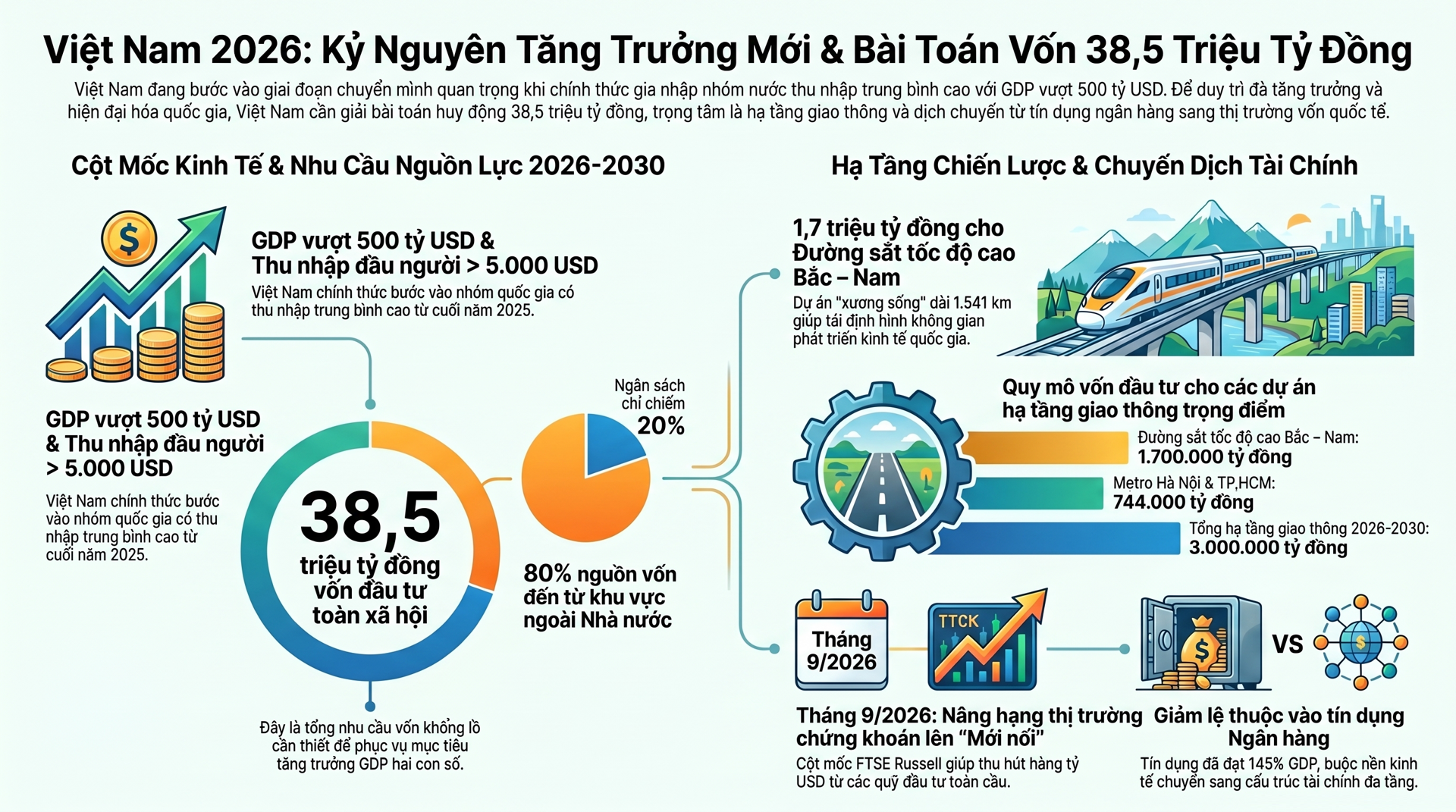
September 2026 is seen as an important milestone, when FTSE Russell officially upgrades Vietnam’s stock market from frontier to secondary emerging.
Not only opening up the opportunity to attract billions of USD from global ETFs, this event also creates conditions for the stock market to step by step become a more effective medium- and long-term capital-raising channel for the economy.
Ms. Le Thi Viet Nga, Deputy Chairwoman of the State Securities Commission, said the stock market raised about VND744,000 billion in 2025, up nearly 43% year-on-year.
In her view, enterprises need to shift from a passive capital-access mindset to actively raising capital, treating the capital market as part of their long-term development strategy.
Besides the equity market, corporate bonds are also seen as a capital channel that needs to be strongly unblocked soon. Completing the national credit-rating system, professional valuation services and a transparent legal framework will help enterprises access long-term capital at more reasonable costs.
In a recent comment, Mr. Le Hong Khang, Director of Research and Analysis at FiinRatings, argued that in the coming period, commercial banks will tend to shift to a defensive stance to protect their loan portfolios amid rising credit risk and an upward interest-rate trend.
According to Mr. Khang, as credit becomes increasingly selective and lending room narrows, enterprises will be forced to seek new capital sources more often through the bond market.
After a period of rebuilding market discipline, corporate bonds are recording positive signals. The late-payment ratio over the past year fell to only about 2.8% of total outstanding bonds, while the group of issuers with high credit risk has also narrowed considerably.
Many large corporations such as Vingroup, Hoa Phat, Gelex, Sun Group and Sovico Group are leading the trend of raising capital for infrastructure, high-tech, energy transition and modern supply-chain projects.
At the same time, new capital channels such as green bonds, venture capital funds, green credit funds and ETFs are also increasingly developing, expanding capital-access opportunities for enterprises and startups.
The development of the capital market not only supplements financial resources for the economy but also promotes transparency and raises the quality of corporate governance in line with international standards.
However, for the market to truly become a pillar of long-term growth, Vietnam still needs to continue strong reforms in investor protection, risk management and strengthening market confidence.
Source: TheLeader — theleader.vn. The article is republished for the purpose of sharing knowledge with the community of founders and investors in the HCM VIF ecosystem.
Category & tags
Related news
 Ecosystem
Venture capital will be a new asset class
Mr. Hoang Duc Trung believes that, with the State taking the lead and large organizations and enterprises joining forces to spread the momentum, venture capital will fulfil its role as an engine of growth and innovation
 Finance & Banking05/2026
The success of a public-private venture fund is not measured by the number of unicorns
With an initial size of VND 500 billion, how will the government's “seed capital” from the public-private venture fund catalyze the flow of financing into startups?
 Finance & Banking18/05/2026
Ho Chi Minh City sets up venture capital fund: 'Seed capital' for Vietnamese tech
For the first time, Ho Chi Minh City has a venture capital fund operating under a joint-stock company model with the participation of the State and major private corporations.