

Removing the 'bottleneck' from ambition to execution in the economy
According to experts at SSI, the question is no longer whether Vietnam can grow faster, but whether existing resources are being put into the economy at the right pace.
According to experts at SSI, the question is no longer whether Vietnam can grow faster, but whether existing resources are being put into the economy at the right pace.
"2026 is the time to position, and 2027 will be the time to verify." Experts at securities firm SSI emphasized in a recent strategy report.
This message reflects a more long-term perspective from the organization on economic growth. The success of an economy is not determined by the number of targets announced, nor does it come from the size of policy packages.
What makes the difference lies in the ability to turn plans into completed works, to turn capital flows into production capacity, and to turn reforms into real growth.
When the problem is no longer the growth target
In the first half of 2026, Vietnam's economy continued to record many positive signals. GDP grew 8.18%, with the second quarter alone reaching 8.39%. Manufacturing and processing grew 10.23%, and the industrial production index rose 10.8%. Disbursed FDI exceeded 13 billion USD, the highest first-half level in the past 5 years, while registered FDI increased 61%, to nearly 34.7 billion USD.
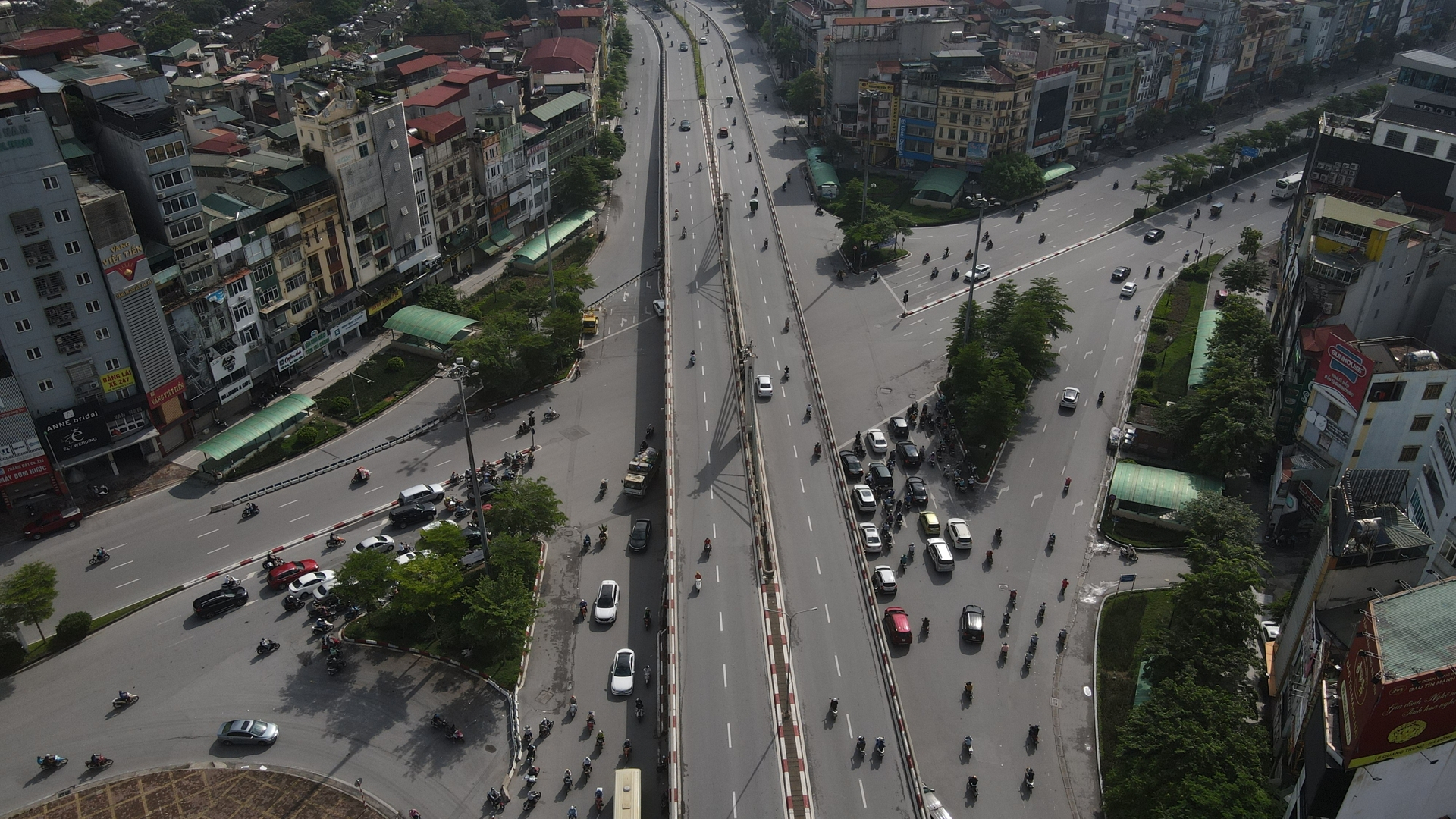
Growth in the coming period will depend mainly on the ability to leverage available resources. Photo: HA
These figures show that growth drivers are being maintained. However, as the economy continues to receive encouraging signals, the focus of economic management is gradually shifting.
Instead of discussing stimulus packages or new growth targets, the current concern is the pace of disbursement, the responsibility of each ministry, sector and locality, and the effectiveness of policy implementation.
According to SSI, this change reflects the reality that the economy's bottleneck no longer lies in a lack of resources, but in the ability to convert resources into growth.
SSI's experts call this a shift from "ambition" to "execution." Accordingly, the question is no longer whether Vietnam can grow faster, but whether existing resources are being put into the economy at the right pace.
In fact, most of the necessary conditions are already in place, from FDI, production and credit to public investment and reform programs. What is still lacking is the ability to connect these resources into an efficient operating chain.
Therefore, SSI maintains its 2026 GDP forecast at 8.5 - 9%, and believes that growth in the coming period will depend mainly on the speed of putting available resources into the economy rather than creating new resources.
Enough capital, but the flow is not smooth
If the bottleneck is not resources, the current question is: where is the blockage? According to SSI, Vietnam does not lack capital. The economy's problem is that money is circulating more slowly than expected.
By the end of June, credit grew 7.41% from the start of the year, while deposits rose only 5.02%, causing the gap between credit and mobilization to continue widening. This is typically easy to interpret as the banking system lacking capital.
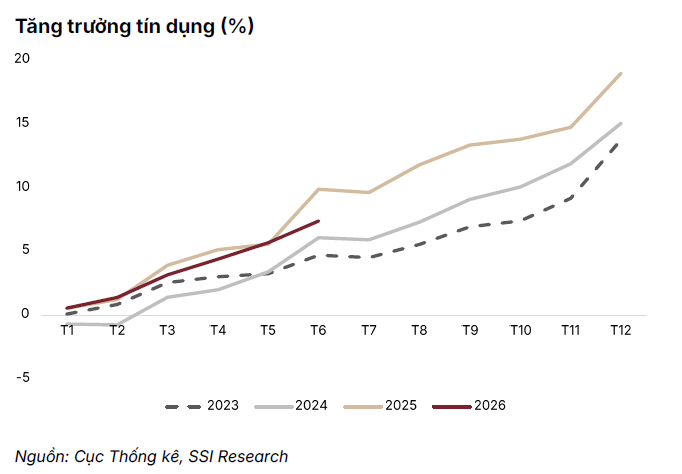
Credit continues to grow strongly over the years.
However, according to SSI, "this is not a credit shortage, but a circulation problem." Liquidity remains abundant but money is returning to the system more slowly.
This is clearly shown in the fiscal picture. State budget revenue in the first half of the year rose 17.4% year-on-year, while total spending was almost flat. This means a large amount of money is still sitting in the public sector instead of returning to the economy.
When public investment is disbursed quickly, money flows to contractors, suppliers and workers, then returns to the banking system as deposits, creating resources for the next credit cycle.
Conversely, if disbursement is slow, the circulation loop is prolonged. Credit continues to grow but mobilization does not keep pace, causing the cost of capital to rise and narrowing the room for monetary management.
For this reason, SSI believes that the economy's "release valve" today does not lie in continuing to loosen monetary policy but in the ability to execute fiscal policy.
That is also why the Government continuously emphasizes the pace of disbursement. Public investment not only adds to GDP but also helps unblock liquidity across the entire economy.
From that perspective, disbursement becomes the decisive link in the operation of the financial system and the real economy.
If money continues to circulate slowly, the gap between credit and mobilization will keep widening, the cost of capital will rise and financial conditions will become more expensive.
Conversely, effective public investment disbursement will create a spillover effect on production, employment and the banking system.
Precisely at the intersection between fiscal policy and liquidity flow, the story of "execution" carries far greater meaning than a management slogan.
When the focus shifts to execution capacity
If the growth bottleneck lies in the speed of capital circulation, is monetary policy still capable of removing this blockage?
According to SSI, the room for monetary support is narrowing significantly.
The first pressure comes from inflation. The average consumer price index in the first six months rose 4.38%, with the second quarter alone up 5.25%. Notably, the driver of price increases is no longer mainly energy but has spread to housing, construction materials, education, healthcare and services. Core inflation also remained above 4%, showing that price pressure is now present on a broad front.
In that context, further strong monetary easing becomes more difficult as the regulator must simultaneously balance growth, inflation, the exchange rate and capital mobilization conditions.
Even though the State Bank has implemented many measures to support credit, such as raising the ratio of short-term funds used for medium- and long-term lending from 30% to 40%, expanding the proportion of State Treasury deposits counted in the loan-to-deposit ratio and easing conditions for infrastructure credit, SSI still believes that liquidity pressure has not disappeared.
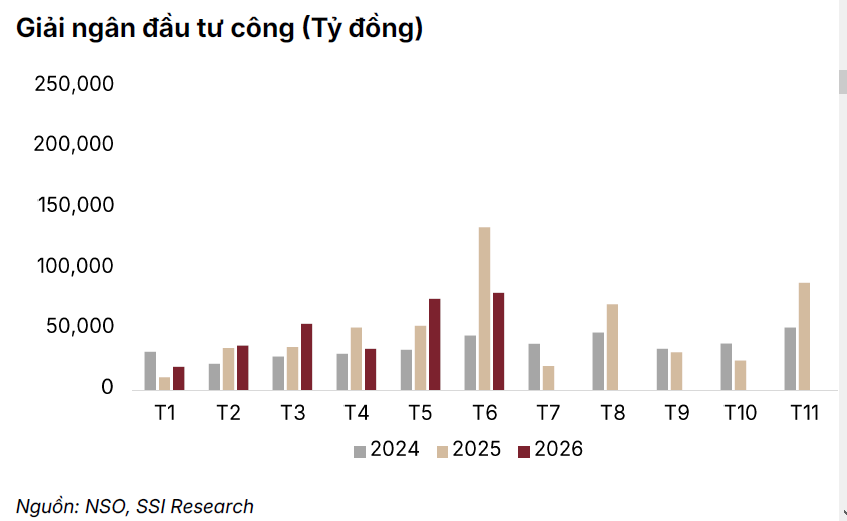
Public investment is expected to be the locomotive driving growth.
Deposits improved in May and June but the gap between mobilization and credit remains at a historically high level. As capital demand continues to rise together with infrastructure projects and private investment, mobilization pressure is likely to return.
In addition, the USD remains strong and exchange-rate pressure persists, making it difficult to significantly ease capital mobilization conditions. According to SSI, deposit rates are likely to remain at the current level rather than fall sharply.
Overall, the driver leading growth is gradually shifting from monetary policy to fiscal policy and investment implementation capacity.
That is also why SSI continuously emphasizes the execution factor rather than counting on new stimulus packages. As monetary room narrows, growth will depend more on the speed of putting plans and capital flows into the real economy.
In addition, Vietnam ran a trade deficit of about 16.65 billion USD in the first half of the year. However, SSI believes the nature of this trade deficit should be viewed from a different angle.
About 94% of import turnover is machinery, equipment, components and raw materials serving production. This shows that most of the capital flow is being directed toward expanding production capacity.
According to SSI, this trade deficit reflects a new investment cycle taking shape.
Nonetheless, these investments only create value when they are converted into export capacity. If projects are implemented slowly or the production chain operates without synchronization, that invested capital will not yet be able to generate growth as expected.
Once again, the story returns to execution capacity, as Vietnam enters a growth phase that relies more on building new capacity and realizing reforms already launched.
The resources for growth are already present across many areas of the economy. What remains to be verified is not the ability to mobilize capital but the ability to turn those resources into real results. That is also the test that SSI believes will determine Vietnam's growth story in the coming years.
Source: TheLeader — theleader.vn. This article is republished to share knowledge with the community of founders and investors in the HCM VIF ecosystem.
Category & tags
Related news
 Ecosystem
Venture capital will be a new asset class
Mr. Hoang Duc Trung believes that, with the State taking the lead and large organizations and enterprises joining forces to spread the momentum, venture capital will fulfil its role as an engine of growth and innovation
 Finance & Banking05/2026
The success of a public-private venture fund is not measured by the number of unicorns
With an initial size of VND 500 billion, how will the government's “seed capital” from the public-private venture fund catalyze the flow of financing into startups?
 Finance & Banking18/05/2026
Ho Chi Minh City sets up venture capital fund: 'Seed capital' for Vietnamese tech
For the first time, Ho Chi Minh City has a venture capital fund operating under a joint-stock company model with the participation of the State and major private corporations.