

Raising the short-term funding limit: A 'boost' for infrastructure under liquidity-management pressure
A FiinRatings expert says the new measure will help address the urgent capital problem, but also means banks accept loans with longer capital-recovery cycles, higher uncertainty and greater sensitivity to hard-to-predict future economic fluctuations.
A FiinRatings expert says the new measure will help address the urgent capital problem, but also means banks accept loans with longer capital-recovery cycles, higher uncertainty and greater sensitivity to hard-to-predict future economic fluctuations.
The State Bank has just officially raised the ceiling on the maximum proportion of short-term funding that may be used for medium- and long-term lending from 30% to 40%, reversing the gradual reduction path pursued over many years to control funding-balance risk in the banking system.
Loosening the limit could widen the room for credit institutions to increase medium- and long-term lending, supporting businesses and sectors that need large amounts of capital. However, the policy also raises higher requirements for liquidity management, credit quality and the balance between growth targets and system safety.
Ahead of what could be an important change in the orientation of monetary policy management and banking system safety oversight, TheLEADER spoke with Mr. Nguyen Anh Quan - Deputy Director of Analysis & Research at FiinRatings - to clarify the impact of raising the ratio of short-term funding used for medium- and long-term lending, as well as its effects on the banking sector, corporate capital flows and the outlook for Vietnam's capital market in the new growth cycle.
Room for credit growth for banks
According to FiinRatings, what are the factors that led the regulator to choose this moment to loosen the limit again after many years of tightening?
Expert Nguyen Anh Quan: Demand for medium- and long-term capital is currently large, with a series of infrastructure projects being implemented, while other long-term credit funding channels - including corporate bonds - are in the process of reform, and international credit borrowing is not really favorable.
Against this backdrop, the SBV has chosen to adjust a technical indicator to loosen credit toward serving this specific purpose, in order to promptly resolve the long-term capital problem for infrastructure and thereby also support the high economic growth target.

Mr. Quan says the new policy measure will help address long-term capital needs in the current context. Photo: Provided
In fact, this tool was used before, back in 2014. Specifically, the SBV raised the maximum ratio of short-term funding used for medium- and long-term lending by commercial banks from 30% to 60% under Circular 36/2014/TT-NHNN, then gradually reduced it to 40% at the end of 2020 and to the current ceiling of 30% from late 2023.
At that time, the economy was in the post-restructuring phase following the 2011-2013 cycle of instability; businesses' demand for medium- and long-term capital was quite large, the capital market was still nascent, while the banking system was almost the dominant channel for channeling capital. Raising the limit was seen as a tool to expand the capacity to fund investment and support the growth recovery.
The SBV's choice of this moment to raise the maximum ratio of short-term funding used for medium- and long-term lending back to 40% reflects a deliberate shift in policy priorities, from a focus on system safety toward a target of balance with a leaning toward supporting economic growth.
After a prolonged period of tightening aimed at reducing maturity-mismatch risk, strengthening liquidity and promoting the implementation of risk-management and capital-adequacy standards, the economy is now entering a cycle with significantly higher investment capital needs, especially for infrastructure and industrial projects and sectors that require medium- and long-term funding.
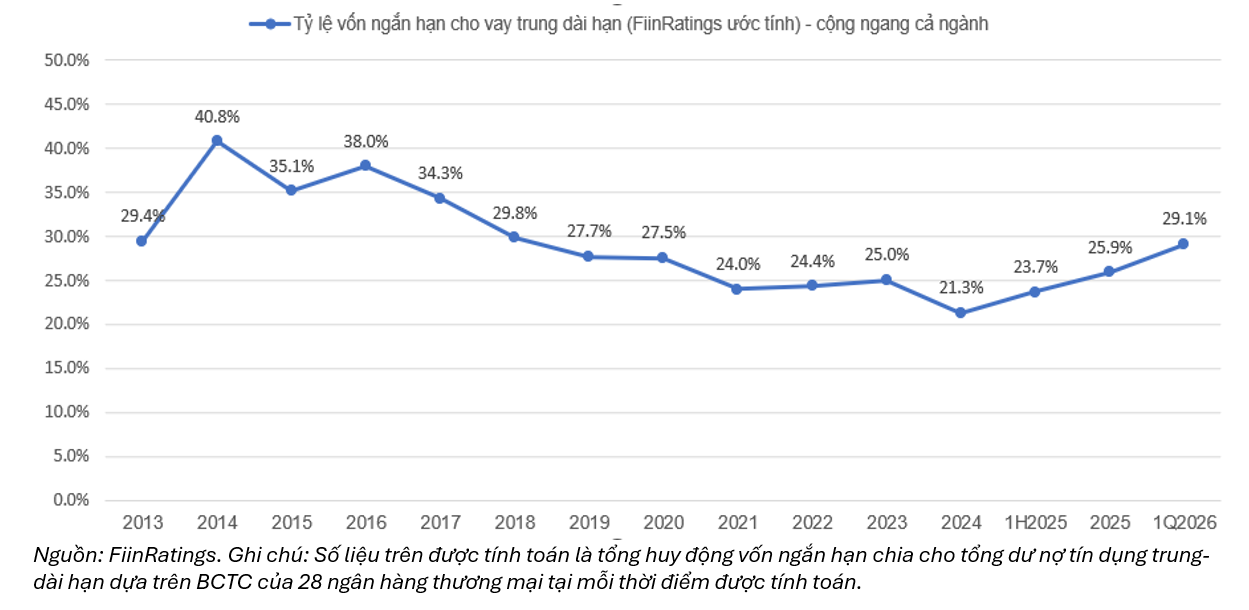
Chart 1: Ratio of short-term funding used for medium- and long-term lending (2013 - Q1 2026). Source: FiinRatings
Among the policy options, applying this technical measure also has the positive aspect of steering commercial banks to prioritize medium- and long-term credit growth, and may not necessarily lead to a sharp increase in total credit balance growth.
In my view, the fundamental solution will still have to be increasing the Tier 1 and Tier 2 capital buffers of commercial banks, but in a context where the scale of outstanding credit has already approached high-risk levels, adjusting this ratio can therefore be seen as a solution to unlock part of the existing balance-sheet room of the banking system in the short and medium term.
In fact, at the end of 2025, the credit-to-GDP ratio had exceeded 140% after remaining above 100% since 2017 and trending upward over the years. This is a notable threshold as it has begun to approach a risky level for an emerging economy like Vietnam, thereby limiting the ability to continue expanding lending scale in a massive way.
In addition, maturity mismatch risk currently exists, as about 90% of customer deposits are short-term (under 12 months), while the banking system is expected to have to finance certain long-term infrastructure projects with lifecycles that can reach or exceed 20 years.
From a broader perspective, the adjustment also reflects the reality that Vietnam's capital market, especially the corporate bond market, although it has improved, has yet to reach a scale large enough to absorb the economy's long-term capital needs.
During this transitional period, banks continue to play the role of the dominant channel for channeling capital, and therefore this policy measure will also help address long-term capital needs in the current context.
Opening more credit room accompanied by maturity risk
How will raising the ratio of short-term funding used for medium- and long-term lending to 40% affect credit growth, and which group of banks will benefit?
Expert Nguyen Anh Quan: Raising the ratio of short-term funding used for medium- and long-term lending is expected to create more credit-growth room for the whole system, especially in segments with long-maturity capital needs; thereby helping improve banks' NIM - which has already tended to decline in some recent years.
Of course, one point we also need to note is that the credit risk profile will also increase, because in principle long-term credit carries a higher level of risk than short- and medium-term credit.
Therefore, we also expect that the design of policies related to infrastructure projects - including the BT (build-transfer) model currently being implemented and the PPP (public-private partnership) model - will be built and designed to reduce risks for these projects.
The impact will not be evenly distributed among banks and does not mean the whole system will expand credit correspondingly. I believe the banks that will benefit most clearly are most likely the mid-sized joint-stock commercial banks, which have high credit growth rates but face greater constraints on their funding structure.
These are typically banks with a lower ability to mobilize funds than the leading group, more dependent on term deposits, and with credit portfolios concentrated in individual customers and/or in industries and projects with longer capital turnover periods.
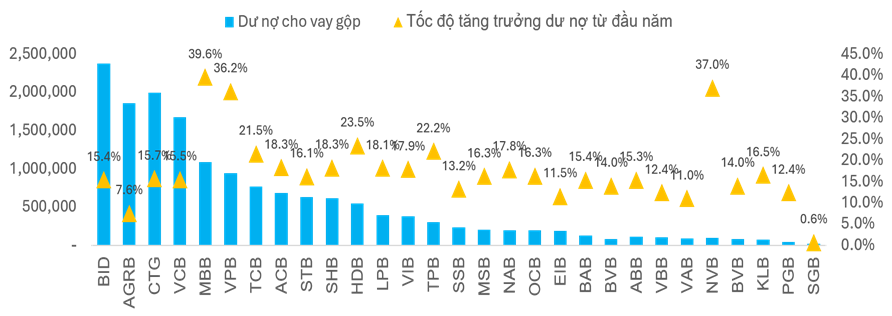
Chart 2: Outstanding loans (VND billion, left axis) and credit balance growth rates of commercial banks (right axis), end of 2025. Source: FiinRatings
Conversely, for banks that have maintained a strong liquidity foundation, use short-term funding at a low ratio, or have large capital room, the impact may not be clear in the short term.
However, in the medium and long term, this policy could also cause the business model of some of these banks to shift toward increasing the proportion of long-term interest-earning assets and reducing the pressure to mobilize long-term funding, at least in the early stage of the cycle.
In your view, what risks could loosening this ratio create for the safety of the banking system?
Expert Nguyen Anh Quan: The risk from raising the ratio, besides contributing to continued high credit growth, also lies in increasing the degree of maturity mismatch on banks' balance sheets.
When the proportion of short-term funding financing long-term assets rises, the system's liquidity resilience against fluctuations within the system or economic shocks will decline.
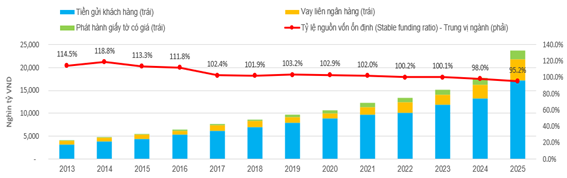
Chart 3: Funding structure and the Stable funding ratio of the sector. Source: FiinRatings
Under normal conditions, maturity mismatch is a natural feature of banking activity. However, in a context where credit continues to grow faster than mobilization as in recent years, some banks increasingly depend on interbank funding and the issuance of valuable papers; this trend is expected to prolong liquidity pressure and increase the cost of funds in the coming time.
Regarding asset quality, increasing medium- and long-term lending will not have a negative impact on asset-quality indicators in the short term. However, in essence, increasing medium- and long-term lending also means that banks accept loans with longer capital-recovery cycles, higher uncertainty and greater sensitivity to hard-to-predict future economic fluctuations.
This is particularly noteworthy for sectors with long investment lifecycles such as infrastructure, real estate or large-scale manufacturing.
Therefore, from FiinRatings' experience in assessing the credit risk of Vietnam's infrastructure projects, the Government's design and proposal of policy mechanisms for projects will be an important factor in improving the financial feasibility (bankability) of projects, thereby reducing the likelihood of having to restructure debt or the risk of non-performing loans forming in the future.
Increasing medium- and long-term lending also means that banks accept loans with longer capital-recovery cycles, higher uncertainty and greater sensitivity to hard-to-predict future economic fluctuations.
How will this policy affect capital flows, and which sectors may benefit as banks expand their room for medium- and long-term lending?
Expert Nguyen Anh Quan: The sectors that will benefit most include infrastructure, construction, energy, industrial parks, industrial manufacturing, industrial real estate and part of the residential real estate market with complete legal status.
In addition, large-scale businesses with good credit profiles and a high capacity to absorb capital will also have more favorable conditions to carry out their long-term investment plans.
However, expanding credit does not mean that capital-allocation risk decreases. In a high-growth environment, the quality of credit growth and each bank's ability to select customers (credit allocation) will become an even more important differentiating factor.
A positive outlook for the capital market
How does the expansion of bank credit affect the capital market and the process of diversifying long-term funding sources?
Expert Nguyen Anh Quan: FiinRatings takes a more positive view of the other two channels of the capital market: raising funds through corporate bonds and raising equity capital on the stock market.
The reason is that the large infrastructure projects targeted by the current policy can all design a diversified capital structure with multiple products, including long-term credit from banks, project bonds and equity raising via the stock market or even the equity of non-public companies.
In addition, as policies move toward unlocking this medium- and long-term credit, it will also help improve conditions for those infrastructure projects, or the developer business may issue corporate bonds.
Currently, the SSC and the Ministry of Finance are also advising on and drafting a Decree on the issuance of infrastructure (PPP) bonds. If this policy is issued soon, it will be a measure that contributes to resolving capital for Vietnam's infrastructure projects in a more synchronized manner.
However, from a long-term perspective, to best meet the long-term capital needs of current projects, developing the capital market, especially corporate bonds, should still be the main channel, rather than depending on bank credit and short-term foreign capital flows with the very sharp interest-rate volatility seen in the recent period.
In the long run, how does FiinRatings assess the balance between growth and risk control when raising this ratio to 40%? Is this a cyclical adjustment or a new orientation?
Expert Nguyen Anh Quan: As mentioned above, raising the ratio to 40% suits the current context but is more likely cyclical than a long-term structural change in banking management orientation.
This is an adjustment aimed at increasing the economy's capacity to absorb capital during the high-growth phase, rather than a signal of reversing the philosophy of the management process and raising system safety standards.
In the long run, the general trend of Vietnam's banking sector is still to strengthen capital requirements, liquidity management and the application of standards approaching international norms. That means banks will increasingly have to rely more on equity, long-term funding sources and market instruments rather than on widening maturity mismatch.
From a credit-rating perspective, I believe this decision is a deliberate trade-off: accepting an increased use of the balance sheet in the short term to support growth, but in return requiring that risk-management capacity, asset-liability management and liquidity buffers be strengthened accordingly to maintain the system's resilience in subsequent cycles.
Thank you very much!
Source: TheLeader — theleader.vn. This article is republished for the purpose of sharing knowledge with the community of founders and investors in the HCM VIF ecosystem.
Category & tags
Related news
 Ecosystem
Venture capital will be a new asset class
Mr. Hoang Duc Trung believes that, with the State taking the lead and large organizations and enterprises joining forces to spread the momentum, venture capital will fulfil its role as an engine of growth and innovation
 Finance & Banking05/2026
The success of a public-private venture fund is not measured by the number of unicorns
With an initial size of VND 500 billion, how will the government's “seed capital” from the public-private venture fund catalyze the flow of financing into startups?
 Finance & Banking18/05/2026
Ho Chi Minh City sets up venture capital fund: 'Seed capital' for Vietnamese tech
For the first time, Ho Chi Minh City has a venture capital fund operating under a joint-stock company model with the participation of the State and major private corporations.