

Not just for payment, scanning a code opens the door to digital finance for small vendors
From a few code scans, digital payments are gradually expanding from a transaction tool into a data platform and an opportunity for small vendors and small household businesses to access digital finance.
From a few code scans, digital payments are gradually expanding from a transaction tool into a data platform and an opportunity for small vendors and small household businesses to access digital finance.
QR Pay helps small vendors digitize their business operations
It takes only a few seconds to complete a payment transaction at a candied-fruit stall in Ben Thanh Market. When the customer holds up their phone to scan the QR code, the banking app instantly displays full transaction details, from the account name and payment description to the VND130,000 invoice to be confirmed, replacing the manual entry of the amount as before.
This seemingly small change reflects a notable shift in digital payments at traditional retail points. Whereas the QR code previously served mainly as a "link" to a bank account, with customers still having to enter the amount and transfer description themselves, QR Pay is taking payment operations to a new level.
When scanning the code, the system can automatically display the order value, sync with sales data, and connect directly to electronic invoices. This significantly reduces cases of entering the wrong amount, transferring to the wrong account, or underpaying, especially during busy periods.
The more notable point lies in the data layer formed behind each transaction. When payment begins to connect with sales operations, aggregating revenue, checking cash flow, or issuing invoices also becomes clearer and more convenient. The role of digital payments is therefore expanding beyond mere money transfers to gradually become part of the infrastructure for day-to-day business operations.
According to Ms. Quyen, the owner of a beverage shop, about 80% of customers at her counter now choose cashless payment, and among young customers this can reach as high as 90%. However, most transactions previously were still the "scan and enter the amount yourself" type, which is fairly close to a manual bank transfer rather than a complete payment process.
"Before, when it was busy, I often had to sell and check at the same time whether the customer had transferred the right amount. Some entered the wrong amount, some sent the wrong description, and I had to recheck, which took a lot of time. Now the system displays the amount automatically, so it is much faster, reduces errors, and also makes it easier to manage revenue," Quyen shared.
The shift in QR Pay shows that digital payments are penetrating more deeply into everyday business life. As transactions begin to be tied to invoices, sales data, and cash-flow history, many small household businesses are also gradually getting closer to the professional way of operating that previously appeared mainly at modern retail chains.
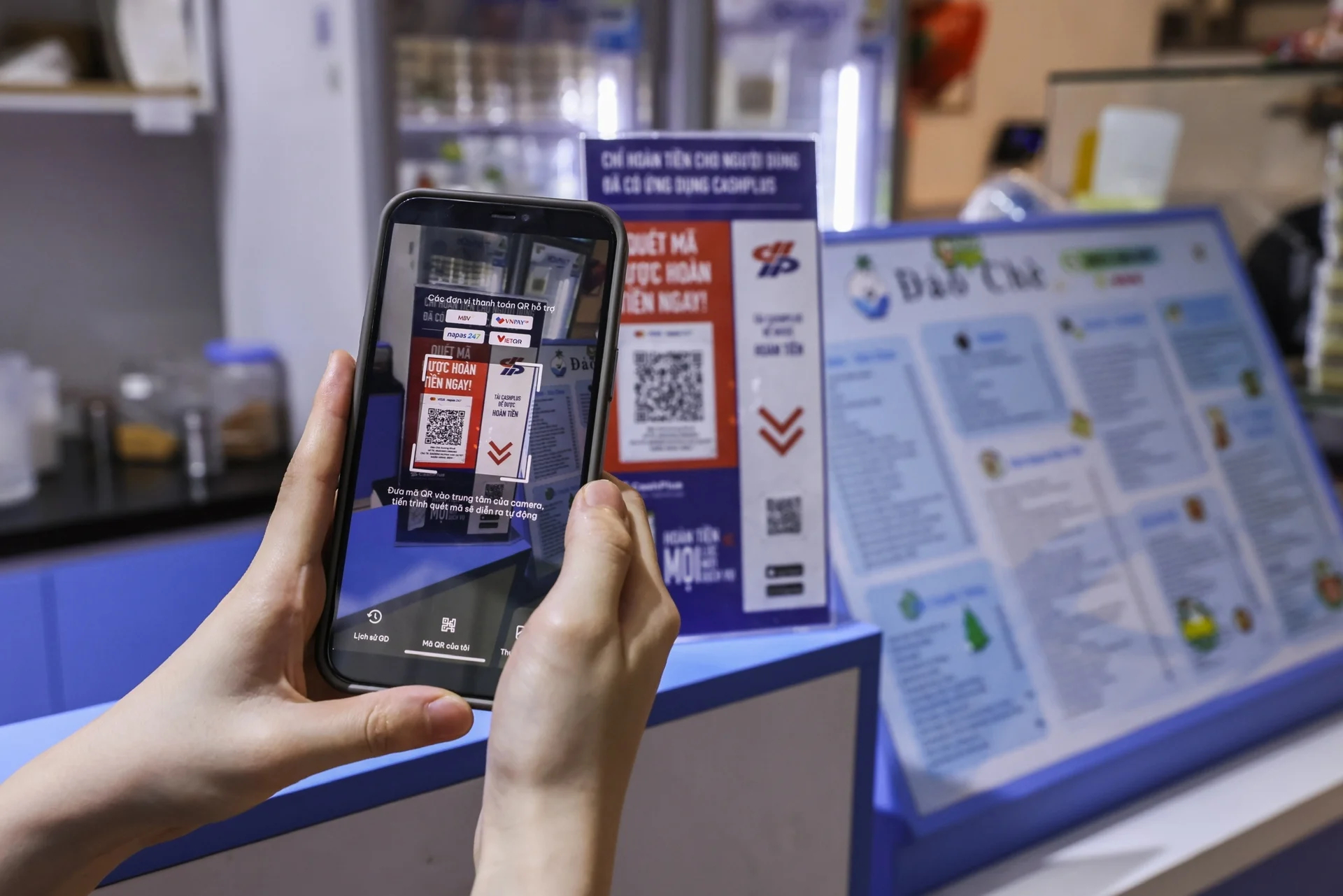
QR Pay helps payment, order management, and electronic invoice connection run more seamlessly at small shops. Photo: Hoang Anh
A foundation for expanding digital finance
The above changes show that digital finance in Vietnam is moving beyond the phase focused solely on cashless payments. From a tool serving transactions, digital platforms are beginning to become an infrastructure layer connecting cash flows, data, and the ability of people and small household businesses to access financial services.
This is also the direction of many countries in the region. For instance, Singapore is pursuing the ambition of becoming Asia's leading digital finance hub, Thailand is universalizing digital payments across the population, while Indonesia is leveraging its e-commerce ecosystem to expand financial access for tens of millions of people.
At the press conference announcing the Digital Finance Day 2026 program, Pham Anh Tuan, Director of the Payment Department at the State Bank of Vietnam (SBV), said that from a phase when users were still unfamiliar with e-wallets and QR codes, by the end of 2025 Vietnam had recorded more than 25.2 billion cashless payment transactions, with a total value exceeding VND362 quadrillion.

Pham Anh Tuan, Director of the Payment Department at the State Bank of Vietnam. Photo: Quang Dinh
"This is an important foundation for the banking industry to move into a phase of deeper digital finance development, instead of stopping at merely reducing cash usage," Tuan emphasized.
That is also why, after seven years of implementation, the "Cashless Day" program officially enters a new phase under the name "Digital Finance Day 2026," expanding its goal from promoting cashless payment to building a comprehensive digital finance ecosystem.
As digital payments are no longer viewed merely as a transaction tool, the focus of development is also gradually shifting to the small-scale economic segment, where the digitalization process still has many gaps.
Nguyen Nguyen Phuong, Deputy Director of the Ho Chi Minh City Department of Industry and Trade, said the largest headroom today lies not in modern shopping malls but in the traditional-market segment, grocery stores, and small household businesses, where digital payment has not yet been deployed synchronously and effectively.
After implementing the two-tier government model, Ho Chi Minh City now has 168 traditional markets facing strong pressure to transform. The digitalization process in this segment not only makes transactions more convenient but also supports revenue management, tax declaration, and the standardization of business operations.
According to Tuan, when the cash flows of household businesses, small vendors, and small enterprises are regularly recorded through digital platforms, the digital transaction history can become a basis for banks to assess financial capacity and actual cash-flow generation. From there, credit products can be designed more suitably, expanding capital access for a customer group that has long faced difficulties due to a lack of collateral or transparent financial records.
From a management perspective, the SBV is also shaping a roadmap for digital finance development based on three pillars: completing the legal framework, developing safe and synchronized payment infrastructure, and expanding international payment connectivity together with requirements to ensure system security.
These three pillars will determine the scalability of digital finance in the coming period. Because for digital payments to truly become the operating infrastructure of the digital economy, the system must not only be convenient at the transaction layer but also sufficiently secure, standardized, and interoperable so that data can be exploited more effectively in governance, commerce, and finance.

Vendors at Ben Thanh Market sign a commitment to participate in the transition to QR code payment. Photo: Quang Dinh
When each transaction begins to leave a "data trail," the role of digital payments also changes. Its value at this point lies no longer in replacing cash, but in the ability to turn the flow of financial data into a foundation for transparent governance, expanding credit, and bringing more people into the formal financial ecosystem.
Source: TheLeader — theleader.vn. This article is republished for the purpose of sharing knowledge with the community of founders and investors within the HCM VIF ecosystem.
Category & tags
Related news
 Ecosystem
Venture capital will be a new asset class
Mr. Hoang Duc Trung believes that, with the State taking the lead and large organizations and enterprises joining forces to spread the momentum, venture capital will fulfil its role as an engine of growth and innovation
 Finance & Banking05/2026
The success of a public-private venture fund is not measured by the number of unicorns
With an initial size of VND 500 billion, how will the government's “seed capital” from the public-private venture fund catalyze the flow of financing into startups?
 Finance & Banking18/05/2026
Ho Chi Minh City sets up venture capital fund: 'Seed capital' for Vietnamese tech
For the first time, Ho Chi Minh City has a venture capital fund operating under a joint-stock company model with the participation of the State and major private corporations.