

KBSV: Banking Sector Margins Unlikely to Recover in 2026
KBSV believes that the banking sector’s net interest margin (NIM) will remain under pressure in the second half of the year as funding costs rise faster than lending yields can improve, even though deposit interest rates are expected to cool from the fourth quarter.
KBSV believes that the banking sector’s net interest margin (NIM) will remain under pressure in the second half of the year as funding costs rise faster than lending yields can improve, even though deposit interest rates are expected to cool from the fourth quarter.
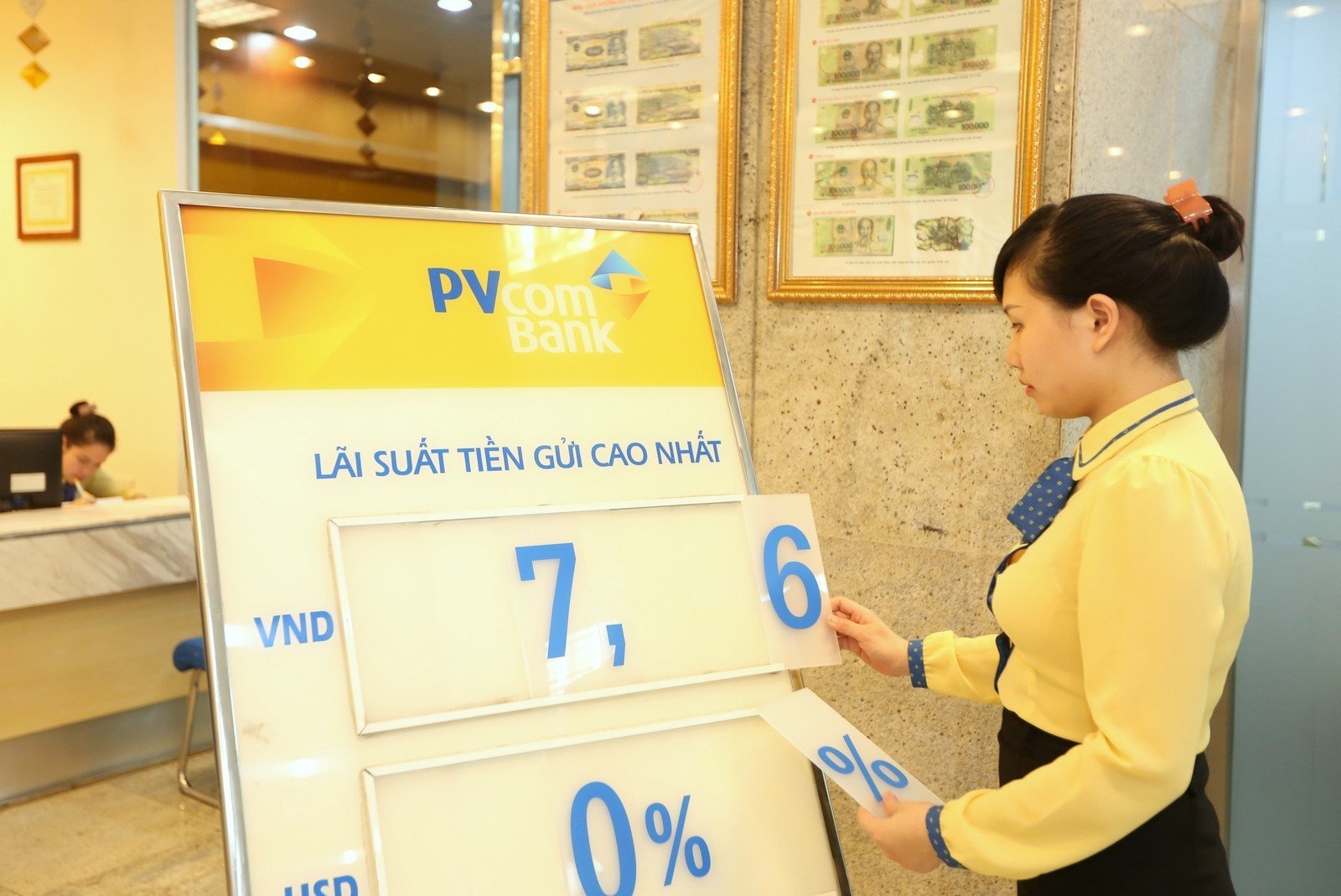
Deposit interest rates have most likely peaked. Photo: Hoang Anh
Although the pre-tax profit of 27 listed banks maintained double-digit growth of 14.2% in the first quarter of 2026, pressure on the net interest margin (NIM) became evident as the deposit-mobilization race heated up and system liquidity has not truly improved.
According to KB Securities Vietnam (KBSV), this will continue to be one of the biggest challenges for the banking sector for the rest of the year.
NIM falls to a multi-year low
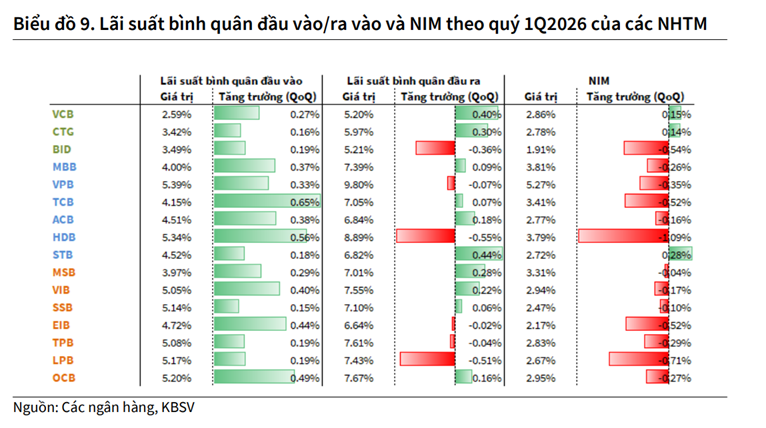
According to KBSV, the NIM of most banks in its coverage universe declined in the first quarter. The average NIM of listed banks fell 16 basis points (bps) quarter-on-quarter, to the lowest level in many years.
The main cause was input interest rates rising faster than output rates. In the first quarter, the average deposit rate rose 31 bps, while the average lending rate rose only 18 bps, significantly narrowing banks’ profit spread.
Not every bank was affected equally. Some banks such as Vietcombank, VietinBank and Sacombank still recorded a slight improvement in NIM thanks to their ability to pass the increase in funding costs on to customers. Meanwhile, most of the remaining banks recorded a decline in NIM, with HDBank, LPBank and BIDV posting the sharpest drops in the quarter.
KBSV said that over the past period, funding costs rose sharply amid difficult deposit mobilization, forcing many banks to step up competition on deposit rates and to increase mobilization through issuing valuable papers and borrowing on the interbank market at higher funding costs than traditional deposits.
In addition, funds also shifted from demand deposits (CASA) to term deposits to enjoy higher interest rates. In the first quarter, the system’s total CASA deposits fell sharply by VND 187.5 trillion, pulling the CASA ratio down to 20.8%, the lowest level since the third quarter of 2023. This further increased banks’ funding costs.
While input costs rose, the room to widen lending rates was quite limited. Banks faced pressure to keep lending rates competitive enough to support credit growth, especially banks with a high proportion of real-estate lending, which must restructure their credit portfolios in line with the State Bank of Vietnam’s (SBV) direction of controlling real-estate credit.
Differentiation will become clear in the banking sector
KBSV believes that pressure on NIM will not be evenly distributed among banks in the second half of this year.
State-owned banks are assessed to have an advantage thanks to lower funding costs than the general level and deposits from the State Treasury.
Meanwhile, large-scale banks with high CASA ratios or supported with liquidity through mandatory transfers — such as Techcombank, MB, VPBank and HDBank — are expected to better control the pace of funding-cost increases, thereby keeping NIM stable or declining only slightly.
Conversely, small and medium-sized private banks may face greater pressure on NIM compression due to limited deposit-mobilization capacity and higher funding costs.
According to KBSV, deposit interest rates have most likely peaked and will stay high in the third quarter before gradually declining from the beginning of the fourth quarter.
This is thanks to positive progress in the U.S.–Iran conflict, which is expected to ease pressure on oil prices and domestic inflation. Together with the USD/VND exchange rate remaining stable, this gives the SBV more room to support system liquidity.
In addition, public-investment disbursement is expected to accelerate for the rest of the year to meet the 10% growth target, thereby releasing abundant capital from the state budget into the banking system.
Changes in the SBV’s policy operation aimed at cooling interest rates and easing banks’ mobilization pressure are expected to take effect from the third quarter of 2026. At the same time, KBSV also expects further new policies to be introduced in the second half of the year by the Government and the SBV to meet the growth target.
Similar to the trajectory of funding costs in the second half of this year, KBSV forecasts that lending rates will also decline gradually, with a certain lag as banks need time to absorb the high funding costs of the previous period.
However, the downward trend in lending rates is likely to be selective, focusing on priority sectors such as exports, industrial production, infrastructure and industries that serve as drivers of economic growth. These sectors have lower yields than retail credit. This also means the average earning yield is expected to improve only to a more limited extent than the rise in funding costs.
As a result, the banking system’s NIM this year is still forecast to decline slightly compared with 2025.
[

![\[Interactive\] What business models are Vietnamese banks using to make money? "[Interactive] What business models are Vietnamese banks using to make money?")
[\[Interactive\] What business models are Vietnamese banks using to make money? "[Interactive] What business models are Vietnamese banks using to make money?")
Finance - 1 month
Data for the first quarter of 2026 shows that Vietnamese banks are pursuing three different business models: a low-cost-funding group, a high-margin group and a group under deposit-mobilization pressure. Each model brings its own profit and risk structure.
[
![\[Interactive\] What business models are Vietnamese banks using to make money? "[Interactive] What business models are Vietnamese banks using to make money?")
[\[Interactive\] What business models are Vietnamese banks using to make money? "[Interactive] What business models are Vietnamese banks using to make money?")
Finance - 1 month
Data for the first quarter of 2026 shows that Vietnamese banks are pursuing three different business models: a low-cost-funding group, a high-margin group and a group under deposit-mobilization pressure. Each model brings its own profit and risk structure.
Source: TheLeader — theleader.vn. This article is republished to share knowledge with the community of founders and investors in the HCM VIF ecosystem.
Category & tags
Related news
 Ecosystem
Venture capital will be a new asset class
Mr. Hoang Duc Trung believes that, with the State taking the lead and large organizations and enterprises joining forces to spread the momentum, venture capital will fulfil its role as an engine of growth and innovation
 Finance & Banking05/2026
The success of a public-private venture fund is not measured by the number of unicorns
With an initial size of VND 500 billion, how will the government's “seed capital” from the public-private venture fund catalyze the flow of financing into startups?
 Finance & Banking18/05/2026
Ho Chi Minh City sets up venture capital fund: 'Seed capital' for Vietnamese tech
For the first time, Ho Chi Minh City has a venture capital fund operating under a joint-stock company model with the participation of the State and major private corporations.