

Inflation rises, the SBV tightens liquidity: What awaits the asset market?
SGI Capital assesses that high oil prices, rising inflation, elevated interest rates and tight liquidity are forcing the asset market to correct.
SGI Capital assesses that high oil prices, rising inflation, elevated interest rates and tight liquidity are forcing the asset market to correct.
Oil prices have been anchored at high levels for more than two months. In that context, developments in the Middle East, though not yet escalating militarily, are disrupting freedom of navigation and quickly spreading their impact worldwide. Energy costs are rising sharply, inflationary pressure is returning, and economies are beginning to face a new spiral of interest rates and liquidity.
In a recent report, SGI Capital argued that a series of macro risks are gradually becoming clear in Vietnam. From inflation, interest rates, liquidity and the exchange rate to trade, every factor is putting pressure on the financial market. According to this fund's assessment, the market may continue to go through a period of strong volatility and valuation discounting.
Twin pressures on Vietnam's economy
The shocks from outside appear at precisely the time when Vietnam's economy is also revealing many internal pressures.
Recently, Moody's upgraded Vietnam's long-term outlook to Positive thanks to efforts at institutional reform and completing infrastructure planning. That said, the agency also noted that risks could increase if debt leverage remains high or international conflicts escalate, undermining FDI appeal.
One of the most notable signals is the trade deficit. In just the first four months of the year, Vietnam ran a trade deficit of over USD7.1 billion. The domestic business bloc alone ran a trade deficit of up to USD15.6 billion. Besides the impact of high gasoline and oil prices, imports of electronics and machinery from China also rose sharply.
According to SGI Capital, the explanations that this level of imports mainly serves the FDI sector and exports are not truly convincing, because most of the trade deficit comes from the domestic business sector.
In addition, infrastructure and real-estate investment, with import needs accounting for about 20-40% of total investment, is also adding pressure on the exchange rate in the time ahead. This fund emphasized that the current trade deficit is equivalent to about 10% of foreign-exchange reserves, a scale rarely seen since the 2010-2011 period.
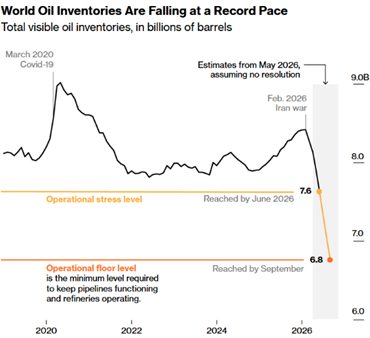
Sharply falling oil reserves create pressure on inflation. Photo: SGI Capital
Inflationary pressure is also becoming more pronounced. After the two months of March and April, inflation reached 5.4%, exceeding the target set by the National Assembly. Amid sharply rising global commodity prices, Vietnam is still striving to promote investment and maintain high growth.
This causes the inflationary pressure from expanding infrastructure investment and credit growth to now resonate further with rising input costs due to higher oil prices.
SGI Capital argued that inflation being higher than the refinancing rate as it is now is a very rare phenomenon over the past 15 years. These resonating forces make inflation risk more persistent and it could become a focal point for monetary policy as well as for asset markets.
In that context, the State Bank of Vietnam continues to show its determination to tighten management of the banking system. The draft circular replacing Circular 22/2019/TT-NHNN is seen as a step aimed at strengthening the system's health, reducing dependence on short-term interbank capital and limiting reliance on liquidity support from the SBV.
In the long term, this policy is expected to reduce liquidity risk and interest-rate pressure. However, during the transition period through 2028, banks will have to step up capital mobilization and slow their lending pace to balance their capital sources. Banks that depend heavily on interbank borrowing, bonds and certificates of deposit will be the most clearly affected.
Market liquidity and diverging valuations
On the stock market, macro tensions are also being reflected more and more clearly.
The first-quarter 2026 business results of the non-financial group grew by as much as 77%, showing that the profit foundation is still very positive. That said, cash-flow developments are moving in the opposite direction.
Foreign investors continued to net-sell more than VND10 trillion per month in the first four months of the year, despite FTSE having upgraded the market. Meanwhile, supply pressure from additional issuances remained high, equivalent to the fourth quarter of 2025.
According to SGI Capital, market liquidity is declining clearly as the credit channel is tightened and the stock market becomes an alternative capital-raising channel.
The market's valuation picture is also being significantly skewed by a group of large-cap stocks, in which Vingroup accounts for nearly one-third of the entire market's capitalization. Meanwhile, most of the remaining businesses, despite recording positive business results, have yet to receive due attention from the market and are becoming ever cheaper.
This phenomenon began to appear in the fourth quarter of 2025 and continued into 2026. According to SGI Capital, this shows that investment cash flow is weakening while short-term speculative sentiment is increasingly gaining the upper hand. Notably, the margin loan balance has risen to a record level both in absolute value and as a ratio to market capitalization, even as margin interest rates have risen in line with the general interest-rate level.
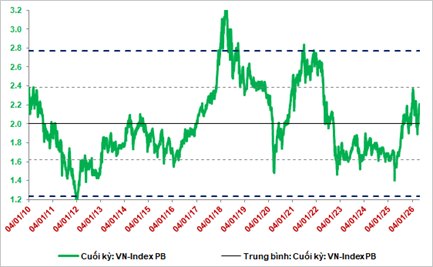
SGI Capital argues that only when risk is fully discounted will clear investment opportunities emerge. Photo: SGI Capital
This fund also warned that a greater risk could appear when major shareholders and business owners who borrow on margin face difficulties with cash flow from their core business operations, mainly related to the real-estate sector.
As repayment ability weakens, the risk of forced selling (margin calls) could erupt. In the coming period, the level of margin lending rates and the liquidity of the real-estate market will be important early indicators.
The oil and global inflation picture
Domestic pressures become all the more worrying when placed in a highly unstable international context.
According to SGI Capital, tensions in the Middle East, though not yet escalating into direct military conflict, are still causing serious congestion in global maritime activity, rapidly depleting strategic reserves.
Goldman Sachs estimates that each month of transport congestion could push oil prices up by an additional USD15 per barrel. Meanwhile, JPMorgan Chase warned that the global gasoline and oil supply risks falling into a dangerous state from June, with even localized disruptions appearing.
Oil prices holding in the USD90-110 per barrel range for more than two months are also beginning to trigger the self-adjustment mechanism of the energy market.
According to this fund, oil consumption demand is falling rapidly while supply tends to rise strongly as the UAE leaves OPEC to expand exports. The United States, Venezuela and many other countries are also increasing production thanks to record-high profit margins.
However, before supply and demand rebalance, high oil prices will continue to put pressure on global inflation.
In the United States, inflation has risen to 3.2%, making the likelihood of the Fed cutting interest rates in 2026 almost nonexistent. Many G10 economies are also being priced by the market for a scenario of interest-rate hikes from June, reflecting the trend of the global interest-rate level continuing to rise.
Combining the factors above, SGI Capital argued that the market is entering a period of rising macro risk both at home and abroad. The pressure comes from high inflation, the SBV tightening credit, the risk of the United States raising tariffs after Vietnam was classified as a "Priority Foreign Country," and exchange-rate pressure due to the large trade deficit.
Meanwhile, the real-estate market is trading more slowly even as supply is about to rise sharply, causing the pace of capital circulation in the economy to weaken further.
Although the government has taken many timely policy decisions, the process of resolving the banking system's liquidity imbalance will require many more quarters. During that transition period, the stock market still faces liquidity pressure and valuation discounting.
This fund also argued that short-term cash flow is concentrating in the group of high-valuation stocks, thereby creating opportunities for businesses with positive business fundamentals that have yet to be noticed by the market.
Looking more broadly, SGI Capital views this as a natural cleansing cycle. High oil prices, rising inflation, elevated interest rates and tight liquidity are forcing the market to readjust its equilibrium state. Risks not yet fully reflected in asset prices will gradually be revealed, bringing stronger volatility in the time ahead.
According to this fund, only when risks are fully discounted into the general valuation level will attractive investment opportunities with lower risk truly become clear.
Source: TheLeader — theleader.vn. This article is republished for the purpose of sharing knowledge with the community of founders and investors within the HCM VIF ecosystem.
Category & tags
Related news
 Ecosystem
Venture capital will be a new asset class
Mr. Hoang Duc Trung believes that, with the State taking the lead and large organizations and enterprises joining forces to spread the momentum, venture capital will fulfil its role as an engine of growth and innovation
 Finance & Banking05/2026
The success of a public-private venture fund is not measured by the number of unicorns
With an initial size of VND 500 billion, how will the government's “seed capital” from the public-private venture fund catalyze the flow of financing into startups?
 Finance & Banking18/05/2026
Ho Chi Minh City sets up venture capital fund: 'Seed capital' for Vietnamese tech
For the first time, Ho Chi Minh City has a venture capital fund operating under a joint-stock company model with the participation of the State and major private corporations.