

How is the market valuing bank stocks?
>> This article is part of the special report \"An overview of Vietnamese banking: From financial statements to the pulse of the economy\". Does a P/E of 8 truly reflect the banking industry? After more than three years through a highly volatile cycle...
\>> This article is part of the special report "An overview of Vietnamese banking: From financial statements to the pulse of the economy"
Does a P/E of 8 truly reflect the banking industry?
After more than three years through a highly volatile cycle, from the shock in corporate bonds and the real-estate market in 2023 to the strong recovery in credit and profits in 2025-2026, bank stocks have had a remarkable price rally.
Many stocks have risen by tens, even hundreds of percent from their lows. However, the surprising thing is that the industry's valuation level is still not truly expensive.
After excluding the outlier NCB, the median P/E of the 26 listed banks stands at only 7.99 times. This is significantly lower than in many previous exuberant phases of the Vietnamese stock market. That shows the rise in bank stocks over the past three years has been supported mainly by a genuine improvement in profits rather than by an excessive expansion of valuation.
In other words, the market is not valuing the banking industry as a single bloc. Instead, each bank is being viewed according to its own story.
Interactive chart (hover over the chart to see detailed data)
Vietcombank and the "insurance premium" for safety
If there is one bank granted a special status by the market, it is Vietcombank.
As of the end of the first quarter of 2026, Vietcombank had a market capitalization of over VND516 trillion, accounting for nearly 19% of the total market capitalization of the entire banking industry. The gap between Vietcombank and the rest of the market remains very large, despite the fact that many private banks have grown strongly in recent years.
More notably, Vietcombank is trading at a P/E of about 14.3 times, nearly double the industry median.
What does this valuation level reflect?
The market is paying an "insurance premium" for safety. Throughout the past three highly volatile years, Vietcombank has continued to maintain asset quality among the best in the system, with a low bad-debt ratio and a large provisioning buffer. For many long-term investment funds, especially foreign institutional investors, Vietcombank is not merely a bank stock but also a defensive asset of Vietnam's financial market.
That is why this bank is always valued higher than most of its rivals.
The market is rewarding the banks that have recovered the most strongly
One of the most interesting findings when looking back over the three-year cycle is the way the market treats the group of Techcombank, VPBank and MBBank.
These are banks that were significantly affected during the period of difficulty in the real-estate and bond markets. Their stock prices once fell deeply in 2023 before entering a strong recovery cycle that continues to this day.
However, the notable thing is that although stock prices have risen very strongly from their lows, current valuations remain rather modest.
MBBank is trading at a P/E of about 7.2 times. VPBank is at 7.9 times, while Techcombank is around 8.6 times. These figures are almost equivalent to the general level of the banking industry.
That shows the market is no longer buying the simple "recovery" story. Instead, these banks' profits have recovered strongly enough to absorb most of the rise in their stock prices.
In other words, this is the group of banks the market is rewarding for the genuine improvement of their business operations rather than for speculative expectations.
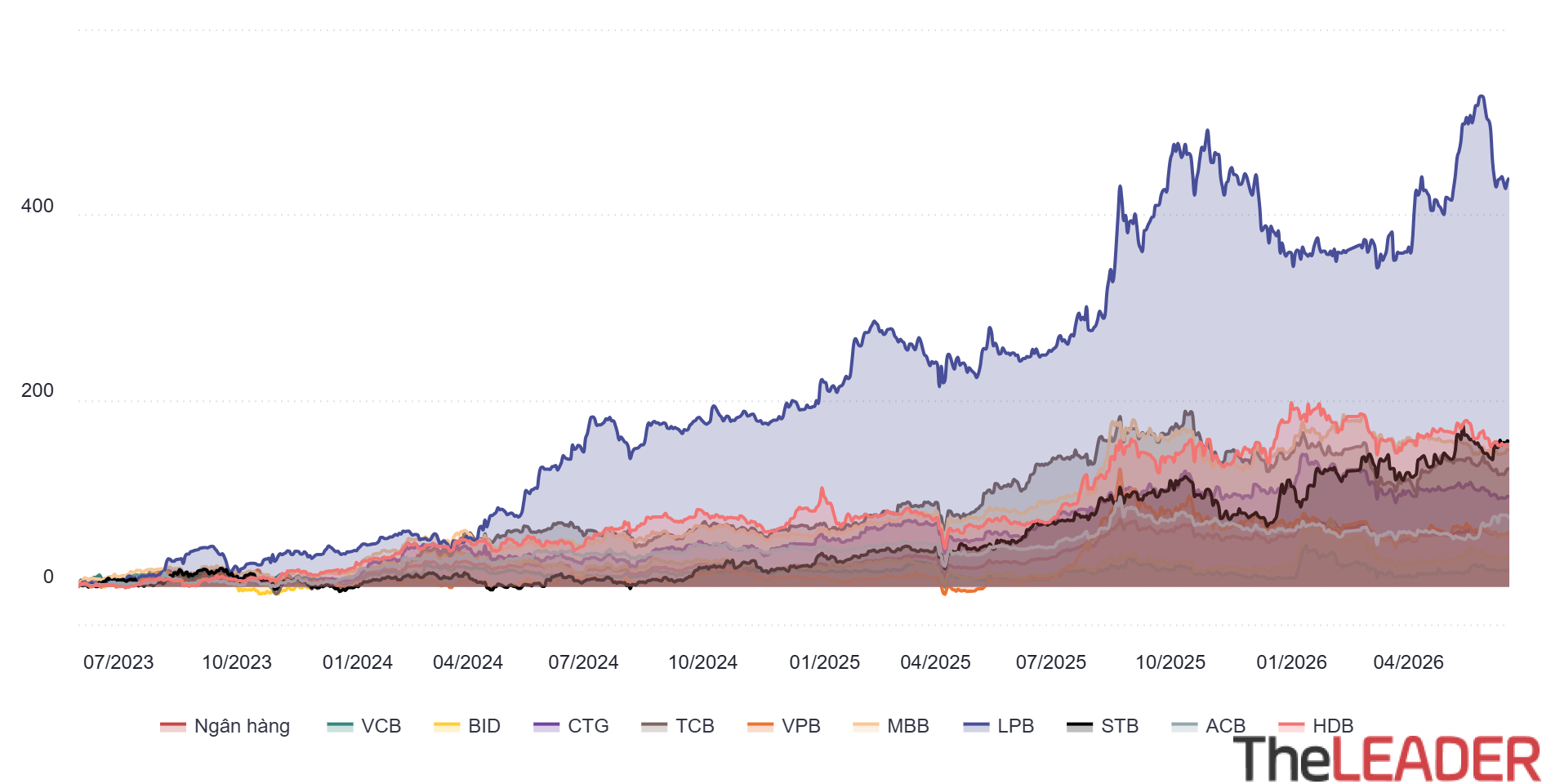
Chart of the 3-year price movement of the Top 10 highest-capitalization banks.
LPBank and Sacombank: When the market buys the future
If Techcombank, VPBank and MBBank are valued based on what has recovered, then LPBank and Sacombank are valued based on what could happen in the future.
LPBank is currently trading at a P/E of about 12.4 times, significantly higher than the industry average. Meanwhile, Sacombank is being valued by the market at about 29 times earnings.
These are valuation levels that are hard to explain looking only at current business results.
With Sacombank, the market is betting on the post-restructuring phase. After many years of handling legacy assets and VAMC-related debts, investors may be expecting the bank's profits to break out strongly once the balance-sheet cleanup process is complete.
Meanwhile, LPBank is undergoing a comprehensive repositioning, from its business model and growth strategy to its brand image. That may make the market willing to pay a higher valuation for future prospects rather than looking only at current results.
The banks the market is valuing the lowest
In the current valuation picture, the most notable group is perhaps the banks that possess strong operating fundamentals but still trade at low P/E levels.
VietinBank is the most prominent case. Although it is one of the largest banks in the system, with a market capitalization of about VND260 trillion and profits among the leading group, CTG stock trades at a P/E of only about 6.8 times, the lowest in the Big 4 group.
ACB and HDBank are in a similar state. ACB has a P/E of about 7.9 times, while HDBank is around 7.4 times.
Notably, all three of these banks possess many operating metrics among the best in the system. HDBank maintains high ROA and ROE. ACB stands out for stable asset quality over many years. VietinBank is recording profit growth among the strongest in the large-bank bloc.
The fact that these banks still trade below the P/E threshold of 8 times shows that the market is relatively cautious, or at least not yet ready to pay a valuation as high as for Vietcombank or Sacombank.
This is also the group of stocks that value investors are usually most interested in.
After three years of volatility, what is the market valuing?
Looking at the entire picture, it is clear that the market no longer values banks based on asset scale or absolute profit.
Instead, investors are paying for four different factors.
Vietcombank is paid a premium for safety and asset quality. Techcombank, VPBank and MBBank are rewarded for their strong recovery after the difficult period. LPBank and Sacombank are valued based on their future growth or restructuring stories. Meanwhile, VietinBank, ACB and HDBank are in the value-stock group, with valuations significantly lower than their operating quality.
That is why, operating in the same industry, the P/E levels of these banks currently range from below 7 times to nearly 30 times.
After three highly volatile years, the stock market no longer views the banking industry as a homogeneous group of stocks. Instead, each bank is valued according to its profit quality, growth capability, level of safety and its own story.
And it is precisely this divergence that is creating the most interesting valuation picture of Vietnam's banking industry at the present time.
\>> This article is part of the special report "An overview of Vietnamese banking: From financial statements to the pulse of the economy"

Source: TheLeader — theleader.vn. This article is republished for the purpose of sharing knowledge with the community of founders and investors within the HCM VIF ecosystem.
Category & tags
Related news
 Ecosystem
Venture capital will be a new asset class
Mr. Hoang Duc Trung believes that, with the State taking the lead and large organizations and enterprises joining forces to spread the momentum, venture capital will fulfil its role as an engine of growth and innovation
 Finance & Banking05/2026
The success of a public-private venture fund is not measured by the number of unicorns
With an initial size of VND 500 billion, how will the government's “seed capital” from the public-private venture fund catalyze the flow of financing into startups?
 Finance & Banking18/05/2026
Ho Chi Minh City sets up venture capital fund: 'Seed capital' for Vietnamese tech
For the first time, Ho Chi Minh City has a venture capital fund operating under a joint-stock company model with the participation of the State and major private corporations.