

Ho Chi Minh City establishes Venture Capital Fund, with nine enterprises contributing VND 300 billion
Nine private enterprises contributed VND 300 billion (60%), together with a VND 200 billion state budget contribution, to establish the Ho Chi Minh City Venture Capital Fund - the first venture capital fund model with State capital to operate as a joint-stock company in Vietnam.
On the afternoon of April 17, the Ho Chi Minh City Department of Science and Technology held a ceremony announcing the establishment of the Ho Chi Minh City Venture Capital Fund Joint Stock Company with a charter capital of VND 500 billion. Of this, the state budget contributes VND 200 billion (40%), while the remaining VND 300 billion (60%) comes from private investors.
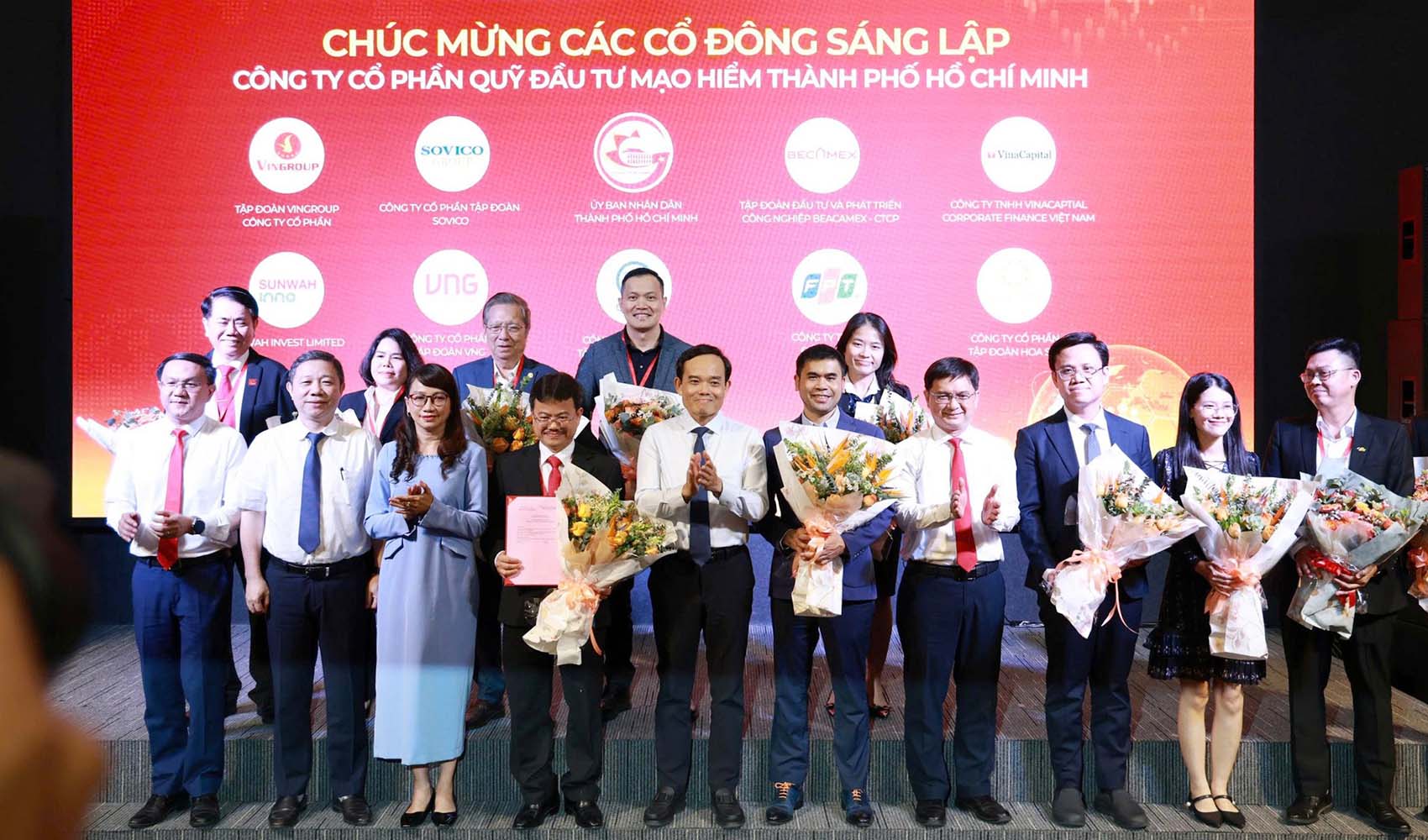
The Ho Chi Minh City Venture Capital Fund is the first venture capital fund model with State capital participation to operate in the form of a joint-stock company.
The list of private shareholders includes many large corporations and enterprises such as Sovico Group, which contributed VND 100 billion; Vingroup, which contributed VND 60 billion; Becamex, which contributed VND 50 billion; VinaCapital, which contributed VND 25 billion; and Sunwah Group (Vietnam), which contributed VND 25 billion;
The remaining shareholders are: Hoa Sen Group, FPT Corporation, CT Group and VNG Corporation, each contributing VND 10 billion;
Speaking at the launch ceremony, Mr. Lam Dinh Thang, Director of the Ho Chi Minh City Department of Science and Technology, said this is the first venture capital fund model with State capital participation to operate in the form of a joint-stock company, implemented under Decree 264. The model is expected to create a breakthrough with four main features.
The first is a clear separation between the ownership rights of the State and investors and the operational authority of a team of professional experts, in line with international practice. With this new approach, investments are managed by an independent team of experts and assessed based on the commercial potential and profitability of projects rather than rigid procedures. By accompanying startups from finance to strategy, the Fund is expected to help startups access professional capital effectively.
The next breakthrough is that, for the first time, an overall risk threshold of up to 50% of the state capital portion within an investment cycle is established. Investment performance will be assessed across the portfolio as a whole rather than by scrutinizing each individual project, allowing state capital to truly play the role of "seed capital" that dares to take risks alongside enterprises.
Alongside this is the "liability exemption" mechanism. This is a legal "shield" that allows the venture capital fund's management team to confidently take the plunge, removing the psychological barrier of officials' hesitation when accompanying startups, and protecting them against objective market risks provided they have complied with transparent procedures.
Finally, there is a strategic vision, with a clear capital-scale target of VND 5,000 billion by 2035 and an investment focus on strategic "core technologies": from artificial intelligence, semiconductor microchips and biotechnology to renewable energy and automation robotics.
Mr. Hoang Duc Trung, Director of VinaCapital Ventures, said he was greatly honored to be entrusted with operating the Ho Chi Minh City Venture Capital Fund, with a goal of raising its scale to VND 5,000 billion after 10 years.
"This is not merely a financial figure, but the confidence that the city's leaders and its people have placed in us to create a breakthrough in innovation and to transform the city's technological profile," Mr. Trung said.
According to Mr. Trung, the scale of VND 500 billion is a driving force to create strong momentum. The Fund's goal is that every dong of investment capital will be a "magnet" attracting at least an additional three to five dong from private and international investment funds. The Fund will play a pioneering role, steering capital into key fields that the market has left open or shied away from out of risk aversion.
Along with this, the Fund will be responsible for selecting the most outstanding "seeds" from the "incubators" across the city, focusing on the Series A and B funding rounds - the stages at which Vietnamese startups are most in need of capital to break through in scale.
The Fund will prioritize investment in core technologies and genuine green, digital transformation solutions, in line with the orientation of the Resolution of the First Congress of the Ho Chi Minh City Party Committee for the 2025-2030 term and the spirit of Resolution No. 57 on breakthroughs in the development of science, technology, innovation and national digital transformation.
"This VND 500 billion is a launchpad for us to realize our aspiration of turning Ho Chi Minh City into a leading 'technology hub' of the region. I believe that in the future, when people speak of the success of Vietnam's flagship startups, the mark of the Ho Chi Minh City Venture Capital Fund will be clearly present as a key accompanying factor," Mr. Hoang Duc Trung stressed.
Source: Báo Đầu tư — baodautu.vn. This article is republished to share knowledge with the founder and investor community in the HCM VIF ecosystem.
Category & tags
Related news
 Ecosystem
Venture capital will be a new asset class
Mr. Hoang Duc Trung believes that, with the State taking the lead and large organizations and enterprises joining forces to spread the momentum, venture capital will fulfil its role as an engine of growth and innovation
 Finance & Banking05/2026
The success of a public-private venture fund is not measured by the number of unicorns
With an initial size of VND 500 billion, how will the government's “seed capital” from the public-private venture fund catalyze the flow of financing into startups?
 Finance & Banking18/05/2026
Ho Chi Minh City sets up venture capital fund: 'Seed capital' for Vietnamese tech
For the first time, Ho Chi Minh City has a venture capital fund operating under a joint-stock company model with the participation of the State and major private corporations.