

Gold Prices Today, July 30, 2026: Surge After Fed Decision
Gold prices today, July 30, 2026, rose by VND 1 million per tael for both SJC gold bars and gold rings. Meanwhile, international prices rebounded from their lows after the Fed decided to keep interest rates unchanged.
Gold prices today, July 30, 2026, rose by VND 1 million per tael for both SJC gold bars and gold rings. Meanwhile, international prices rebounded from their lows after the Fed decided to keep interest rates unchanged.
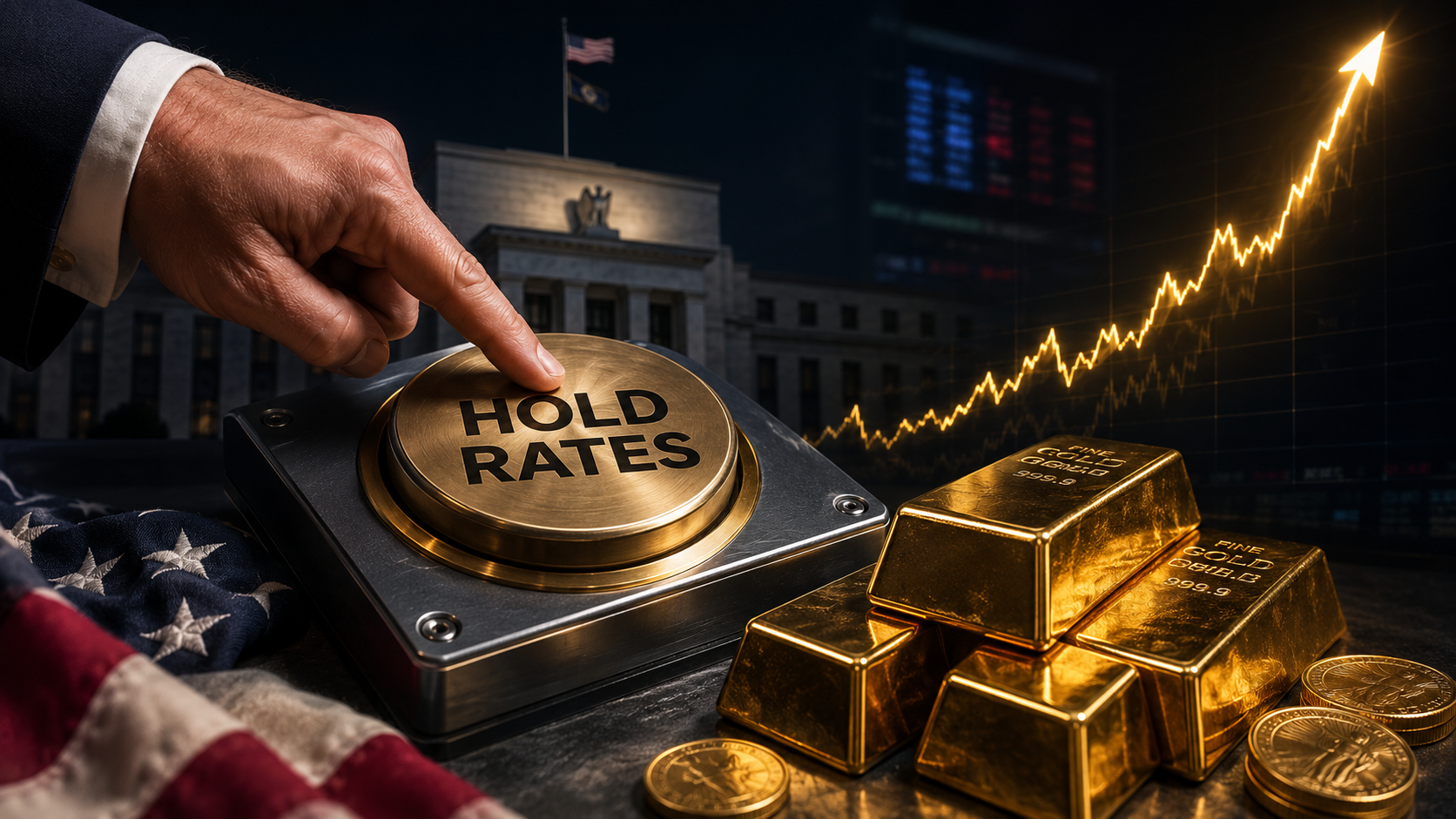
Gold prices today, July 30, 2026
Gold prices today, July 30, 2026, at Saigon Jewelry Company Limited (SJC), listed this morning, rose by VND 1 million per tael in both directions compared with yesterday afternoon. Accordingly, gold bar prices opened at VND 138.5–142.5 million per tael (buy–sell) versus yesterday.
The gap between the buying and selling prices widened to VND 4 million per tael amid strong volatility in the world market.
Similar to gold bars, the price of SJC gold rings also rose by VND 100,000 per mace to VND 13.8–14.2 million per mace (buy–sell).
At other brands, the 9999 Hung Thinh Vuong round gold ring at DOJI rose this morning by VND 100,000 per mace to VND 13.95–14.35 million per mace (buy–sell) compared with yesterday afternoon’s closing price.
The gap between today’s domestic and world gold prices on July 30, 2026 is widening to nearly VND 10.5 million per tael.
World gold prices
Spot gold and silver prices rose slightly at the close of Wednesday’s trading session in the United States. The U.S. Federal Reserve (Fed) kept interest rates unchanged, while rising oil prices, elevated Treasury yields and a sharp stock-market decline continued to boost demand for defensive assets.
Following the Federal Open Market Committee (FOMC) decision, the monetary-policy stance remained “hawkish” for the metals market, even though the Fed held rates in the 3.50–3.75% range.
Three voting members of the FOMC disagreed with the decision and favored raising rates by another 25 basis points. Fed Chair Kevin Warsh said the decision should not be seen as a pause, reaffirmed the 2% inflation target and avoided giving clear policy guidance for the period ahead.
The market reaction was distinctly defensive: stocks were sold off, the U.S. dollar held its strength, oil prices rose and U.S. Treasury yields remained elevated. The yield on the 10-year U.S. Treasury note hovered near 4.6%, while the USD Index stayed above 101 points.
Gold was supported by weakness in the stock market and geopolitical risk, but its upside remained limited by the possibility that the Fed has not yet ended its monetary-tightening cycle.
The situation at the Strait of Hormuz can be described as a shipping route that remains open, but where traffic is under enormous pressure from military tensions and risks to the maritime shipping industry.
Iran resumed missile attacks on U.S. forces in the region after the United States and Saudi Arabia carried out airstrikes against Tehran-backed militias. The widening conflict continues to threaten shipping routes in the Gulf and energy infrastructure.
Brent crude rose 7.3% to USD 88.09 per barrel, while WTI crude traded around USD 84.79 per barrel. This development once again heightens the risk of inflation and interest-rate pressure — factors that frequently limit gold’s advance.
For gold, the impact runs in two directions. Geopolitical risk and tension in the stock market boost defensive demand; conversely, a sharp rise in oil prices keeps inflation expectations and bond yields elevated.
In the financial markets overall, money flowed into oil, stocks fell sharply, the U.S. dollar held its value, while gold and silver rose only slightly.
Traders are watching how interest-rate pricing evolves after the Fed meeting, the GDP report due Thursday, the PCE inflation report on Friday, as well as any new disruptions to shipping routes through the Strait of Hormuz or the Red Sea.
At the open of the Asian session this morning, gold prices today, July 30, 2026, continued to rise USD 20 to near USD 4,090 per ounce.
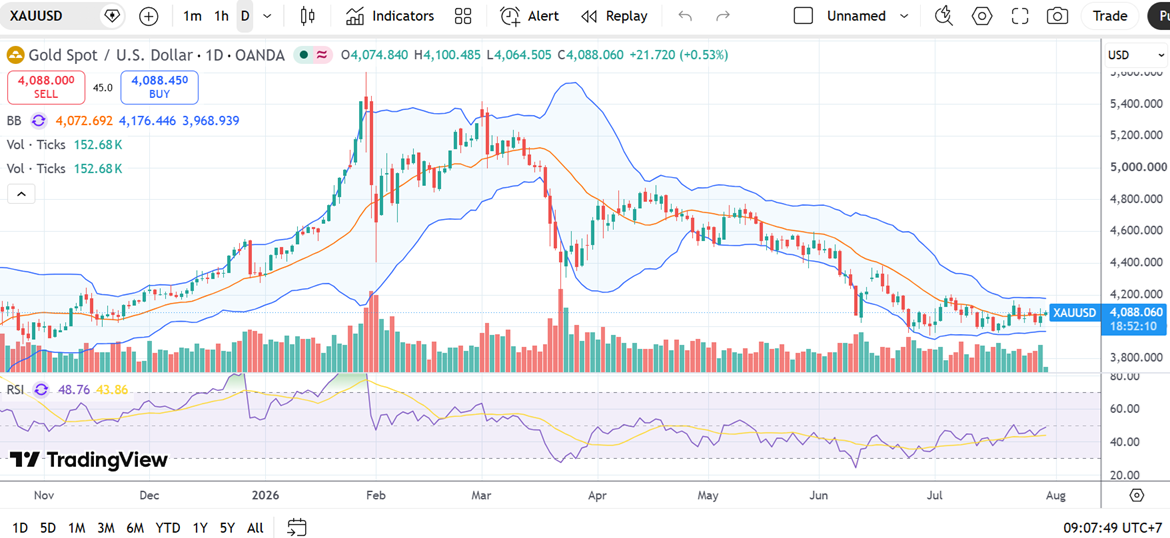
Chart of world gold prices on a daily time frame.
Gold prices are in a sideways state, holding the USD 4,000 per ounce support level. The market may continue to face pressure as consumers take advantage of the high price level to sell jewelry they no longer need.
In an interview with Kitco News, Tobina Kahn, President of House of Kahn Estate Jewelers, said the sharp correction in gold prices has hardly slowed the volume of old jewelry being sold to estate-jewelry dealers. However, the motivation for selling gold has changed considerably from the rush-to-sell sentiment when gold prices peaked during the rally earlier this year.
According to Kahn, the panic sentiment and profit-taking selling when gold prices climbed to near USD 5,600 per ounce in January have largely disappeared. The market is now driven by practical financial decisions and shifting consumer tastes, especially among young people who inherit jewelry they have no intention of using.
“Even though gold prices have fallen, our business is still quite busy,” Kahn told Kitco News. “I think in January, the prevailing sentiment was ‘I want to sell now, I want to sell now,’ because people were worried when prices were so high. No one knew how prices would move.”
The sense of urgency early in the year has now given way to a calmer state. She said the estate-jewelry business is no longer dominated by fear that gold prices might suddenly collapse. Instead, many customers simply view unused jewelry as an asset that can be converted into cash for more practical purposes.
She said one customer received about USD 16,000 for selling a heavy, 18-inch, 18-carat gold necklace.
“Their mindset is like: ‘I need money. Let’s see what she left me that I no longer use,’” she said. “Healthcare costs, living expenses, college tuition or buying a new car for the grandchildren — people are putting that money to more useful purposes.”
One of the biggest trends Kahn has noticed is that more and more young people are bringing in jewelry inherited from their parents or grandparents to sell.
“The older generation is gradually passing away. Children or grandchildren inherit these pieces of jewelry, these gold assets, but they do not suit their style and taste,” she said. “They bring them in to sell and use the money for something else.”
Instead of waiting for gold prices to return to record highs, these people choose to sell jewelry that no longer fits modern fashion trends.
“We are receiving a lot of old jewelry from the 1970s and 1980s,” Kahn said. “Among them are many large, heavy and bulky necklaces.”
She added that heirs often keep a few pieces of sentimental value while selling the rest.
“If they inherit 10 pieces, they usually sell six or seven they do not want to keep, because no one in the family intends to use them,” she said.
According to Kahn, today’s sellers usually care little about where gold prices will trade next year. What they pay more attention to is whether the proceeds can help improve their current financial situation.
“I don’t think anyone ever waited for gold to hit USD 5,000 per ounce, because in the past no one thought prices could reach that level,” she said. “They calculate very practically: How much money can I get, and can I use this money more effectively?”
Although she believes gold prices may eventually return to the USD 5,000 per ounce zone, Kahn argues that waiting for a new price rally is not always the best financial decision.
“Prices can go up, and they can go down,” she said. “But if you’re not using the item, what else can you do with the proceeds?”
Source: TheLeader — theleader.vn. This article is republished to share knowledge with the community of founders and investors in the HCM VIF ecosystem.
Category & tags
Related news
 Ecosystem
Venture capital will be a new asset class
Mr. Hoang Duc Trung believes that, with the State taking the lead and large organizations and enterprises joining forces to spread the momentum, venture capital will fulfil its role as an engine of growth and innovation
 Finance & Banking05/2026
The success of a public-private venture fund is not measured by the number of unicorns
With an initial size of VND 500 billion, how will the government's “seed capital” from the public-private venture fund catalyze the flow of financing into startups?
 Finance & Banking18/05/2026
Ho Chi Minh City sets up venture capital fund: 'Seed capital' for Vietnamese tech
For the first time, Ho Chi Minh City has a venture capital fund operating under a joint-stock company model with the participation of the State and major private corporations.