

Gold price today 4/8/2026: A breakout looks difficult through the end of September
Gold prices today, August 4, 2026, rose by VND1 million per tael for both SJC gold bars and SJC gold rings. Meanwhile, the international price is still 'hovering' above the USD4,000/ounce mark and is forecast to struggle to break out until the end of September.
Gold prices today, August 4, 2026, rose by VND1 million per tael for both SJC gold bars and SJC gold rings. Meanwhile, the international price is still 'hovering' above the USD4,000/ounce mark and is forecast to struggle to break out until the end of September.
Gold price today, August 4, 2026
Gold prices today, August 4, 2026, at Saigon Jewelry Company Limited (SJC) were quoted this morning down VND1 million per tael in both directions compared with yesterday afternoon. Accordingly, gold bars opened at VND137–140 million per tael (buy – sell) compared with yesterday.
The gap between the buying and selling prices held at VND3 million per tael amid strong volatility in the global market.
In a similar move to gold bars, the SJC gold ring price also fell by VND100,000 per mace to VND13.6–13.95 million per mace (buy – sell).
At other brands, the Hung Thinh Vuong 9999 round gold ring at DOJI rose this morning by VND30,000 per mace to VND13.73–14.13 million per mace (buy – sell) compared with yesterday afternoon's closing price.
The gap between today's domestic and world gold prices on August 4, 2026, narrowed to about VND9 million per tael.
World gold price
Spot gold and silver prices rose again in late Monday trading in the United States, as crude oil prices plunged and Treasury bond yields fell, outweighing the weaker safe-haven demand stemming from exploratory diplomatic signals between the U.S. and Iran.
Following the Fed meeting, the market remained particularly sensitive to the interest rate outlook. The U.S. Federal Reserve kept the federal funds rate band unchanged at 3.50–3.75% last Wednesday, with a 9-3 vote; three officials backed a further 25-basis-point rate hike.
The press conference held by Fed Chair Kevin Warsh led the market to view this as a "hawkish hold": the Fed did not tighten immediately, but it also failed to provide sufficient grounds to believe that inflation risks are cooling fast enough to rule out the possibility of further rate increases.
Afterward, June PCE inflation fell to 3.7% year-on-year, while core PCE stood at 3.3%. Initial jobless claims rose to 197,000, while the July ISM manufacturing index climbed to 55.6 points, the highest level since May 2022. Futures markets still priced in the probability of a Fed rate hike in September at around two-thirds. However, this probability has declined compared with before the meeting, as oil prices tumbled during Monday's session, dragging bond yields lower.
The risk premium tied to the Strait of Hormuz has eased but has not disappeared. President Donald Trump temporarily suspended plans to strike Iran and pushed for negotiations aimed at reopening this shipping route while restricting Tehran's nuclear program. Meanwhile, Iran denied holding direct talks with the U.S. and said discussions with Oman on traffic through the Strait of Hormuz were still ongoing.
The clearest impact on the market was reflected in oil prices. WTI crude fell to the USD78–79 per barrel range, while Brent crude retreated to the USD83 per barrel area, after the war risk premium in July had once pushed Brent above USD90 per barrel.
For gold, the impact ran in two directions: easing tensions in the Gulf weakened immediate safe-haven demand, but the inflation risk associated with lower oil prices, falling yields, and a weaker USD helped ease macro pressure on the precious metal.
Daniela Hathorn, senior market analyst at Capital.com, called the effort to push U.S.-Iran diplomacy "a step in the right direction," but warned that the outlook for the coming week remains highly uncertain.
This assessment fairly closely reflects developments in the precious metals market: gold and silver prices remained supported, but neither metal has managed a clear breakout from the consolidation zone formed under the influence of the Fed and tensions in the Strait of Hormuz.
Opening the Asian session this morning, today's gold price on August 4, 2026, continued to edge up and is now near USD4,060 per ounce.
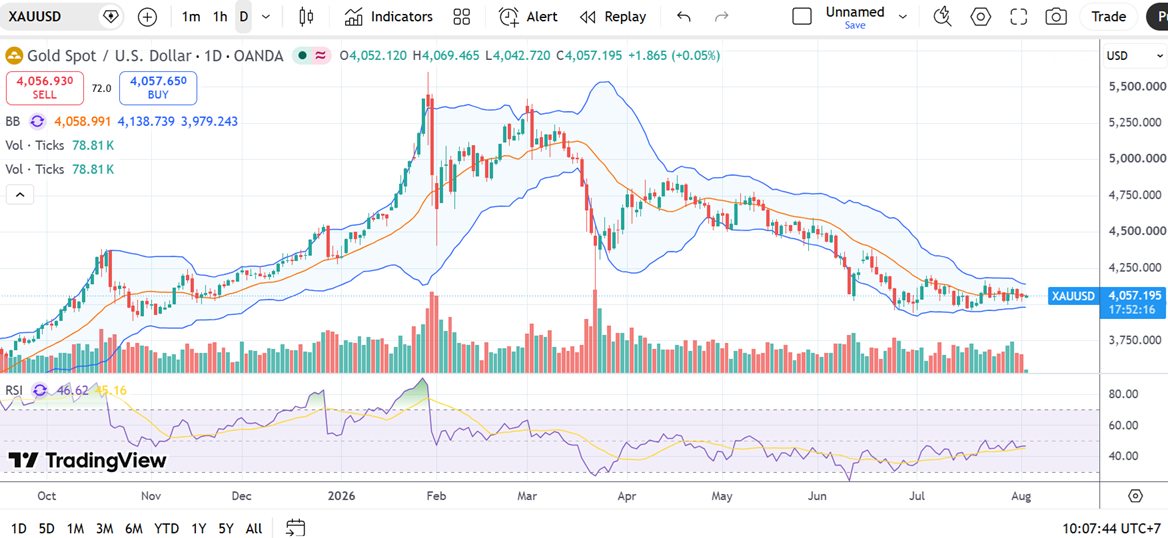
World gold price movements on a daily chart.
Limited downside room for gold in the third quarter
The gold market remains almost flat around the USD4,000/ounce level. One international brokerage forecasts that gold prices will continue to fluctuate within a narrow band throughout the third quarter, as resilient economic growth and higher real yields still pose downside risks.
In its latest quarterly metals market research report, commodity analysts at Sucden Financial said that although gold prices have fallen nearly 30% from their peak in January, the precious metal's valuation remains elevated when measured against traditional macro factors.
"Even after the correction, gold prices remain higher than the level typically established based on real yields and the USD," the analysts noted. "This suggests that much of the geopolitical and macroeconomic risk premium built up since the start of the year has yet to be fully unwound."
However, the analysts see limited downside room for gold in the third quarter.
"We forecast that gold prices will remain supported through the end of September, but will mostly trade within a range. Accordingly, gold could consolidate within a wide band of USD3,950–4,300 per ounce through the end of September. Pullbacks close to the bottom of this price range will continue to attract buying, while rallies above USD4,200 per ounce may struggle to last until Fed policy shifts to a more dovish stance," the analysts said.
According to Sucden, the main headwinds for gold prices remain unchanged. Persistent inflation is forcing major central banks, especially the U.S. Federal Reserve, to maintain tight monetary policy. This pushes real yields higher and raises the opportunity cost of holding non-yielding assets such as gold.
Although the correction has made valuations more reasonable, the report argues that gold prices still appear expensive when placed in the current macroeconomic context.
"The gap between gold prices and traditional valuation measures has narrowed but not disappeared," the analysts noted. They said the possibility of further price declines cannot be ruled out if the market continues to strip out the safe-haven premium accumulated since the start of the year.
Although the short-term outlook remains challenging, Sucden does not view this correction as the end of gold's long-term uptrend.
The firm said structural drivers, including continuous gold buying by central banks, reserve diversification trends, persistently high government debt, and long-term geopolitical instability, still provide an important foundation for the precious metal.
The report also emphasized that investor positioning remains relatively solid despite the correction. However, this means there is potential for further selling if macroeconomic conditions continue to improve or expectations of monetary easing are pushed further out.
A mixed outlook for silver
Sucden argues that silver has a more complex outlook than gold, as this metal is heavily influenced by both monetary investment demand and industrial demand.
Although silver prices have corrected sharply alongside gold, the analysts warn that weakening industrial activity is adding further headwinds.
Sucden pointed out that slowing manufacturing growth momentum and expectations of weaker industrial demand could limit silver's upside potential in the short term, even if investment demand stabilizes.
"Silver prices may remain more volatile than gold but have yet to form a clear trend. We therefore forecast that silver will consolidate within a wide band of USD56–66 per ounce through the end of September. Pullbacks toward the mid-USD50 per ounce area will attract buying, while the current macro environment makes it difficult for prices to sustain gains beyond the upper boundary of this range," the analysts noted.
At the same time, Sucden believes silver will still benefit from many of the same long-term structural trends as gold, including demand for tangible assets and continued investor interest in precious metals as a portfolio diversification tool.
Source: TheLeader — theleader.vn. This article is republished for the purpose of sharing knowledge with the community of founders and investors within the HCM VIF ecosystem.
Category & tags
Related news
 Ecosystem
Venture capital will be a new asset class
Mr. Hoang Duc Trung believes that, with the State taking the lead and large organizations and enterprises joining forces to spread the momentum, venture capital will fulfil its role as an engine of growth and innovation
 Finance & Banking05/2026
The success of a public-private venture fund is not measured by the number of unicorns
With an initial size of VND 500 billion, how will the government's “seed capital” from the public-private venture fund catalyze the flow of financing into startups?
 Finance & Banking18/05/2026
Ho Chi Minh City sets up venture capital fund: 'Seed capital' for Vietnamese tech
For the first time, Ho Chi Minh City has a venture capital fund operating under a joint-stock company model with the participation of the State and major private corporations.