

Gold price today 31/7/2026: Up another VND1.5 million per tael
Gold prices today, 31/7/2026, rose VND1.5 million per tael for both SJC bullion and SJC gold rings. Meanwhile, international prices also remained on an upward trajectory as the USD and oil prices both declined.
Gold prices today, 31/7/2026, rose VND1.5 million per tael for both SJC bullion and SJC gold rings. Meanwhile, international prices also remained on an upward trajectory as the USD and oil prices both declined.
Gold price today 31/7/2026
Gold prices today, 31/7/2026, quoted this morning by Saigon Jewelry Company Limited (SJC), rose VND1.5 million per tael in both directions compared with yesterday afternoon. Accordingly, gold bullion opened at VND139.2 – 143.2 million per tael (buy – sell) versus yesterday.
The gap between the buying and selling prices widened to VND4 million per tael amid strong volatility on the global market.
Mirroring the movement of gold bullion, the price of SJC gold rings also rose VND150,000 per mace to VND13.87 – 14.27 million per mace (buy – sell).
At other brands, the 9999 Hung Thinh Vuong round gold ring at DOJI this morning rose VND80,000 per mace to VND13.95 – 14.35 million per mace (buy – sell) compared with yesterday afternoon’s closing price.
The gap between today’s domestic and international gold prices (31/7/2026) is widening to nearly VND11.5 million per tael.
World gold prices
Spot gold and silver prices rose during Thursday’s trading session in the United States, as the June PCE inflation data cooled and the USD weakened, helping precious metals recover after the U.S. Federal Reserve (Fed) kept interest rates unchanged with a hawkish stance on Wednesday.
Sentiment and positioning in the market following Wednesday’s decision by the U.S. Federal Open Market Committee (FOMC) and the batch of data released on Thursday morning remained mixed. However, the new reports somewhat eased the most hawkish concerns about monetary policy.
The Fed kept interest rates in the 3.50–3.75% range. Three members dissented in favor of raising rates by another 25 basis points, keeping alive the risk of a Fed hike in September.
Data released on Thursday morning showed that U.S. real GDP grew at an annualized rate of 1.5% in the second quarter, down from 2.1% in the first quarter. The headline Personal Consumption Expenditures (PCE) price index for June fell 0.1% month-on-month and rose 3.7% year-on-year. Core PCE rose 0.1% month-on-month and eased to 3.3% year-on-year.
Initial jobless claims rose by 9,000 to 197,000, but remained below forecasts. Meanwhile, continuing jobless claims fell to 1.78 million.
The above data weakened the USD and supported gold prices. However, inflation remained above the Fed’s 2% target, while U.S. Treasury yields continued to stay high. Therefore, the interest-rate outlook remains a headwind for precious metals.
The situation at the Strait of Hormuz can most accurately be described as one in which shipping traffic is still being maintained but is under enormous pressure from military, maritime shipping and diplomatic factors, rather than having returned to normal operating conditions.
Oil prices cooled after Wednesday’s sharp gain, as the market reacted to lower PCE data and renewed diplomatic efforts. However, the U.S.–Iran conflict continued to create a war-risk premium for maritime shipping in the Gulf and the Red Sea.
For gold, the impact remained two-directional. Geopolitical risk supports safe-haven demand, but any sharp rebound in crude oil prices could also revive concerns about inflation and interest rates – a factor that has repeatedly capped gold’s gains.
Across the market as a whole during Thursday’s session, stocks rose, the USD fell, oil prices came off their highs, bond yields stayed high, and precious metals moved higher in unison.
Traders are watching how Fed rate expectations evolve in Friday’s session, the possibility of adjustments to the probability of a September rate hike, fresh remarks from Fed officials, and any news related to the Strait of Hormuz or shipping routes in the Red Sea.
If gold prices hold above USD4,101.10 per ounce, the short-term recovery will remain intact. Conversely, if they fall below USD4,028.40 per ounce, attention will return to the USD3,995.20 per ounce support zone.
At the open of the Asian session this morning, today’s gold price (31/7/2026) fell back nearly USD30 and is currently hovering around USD4,070 per ounce.
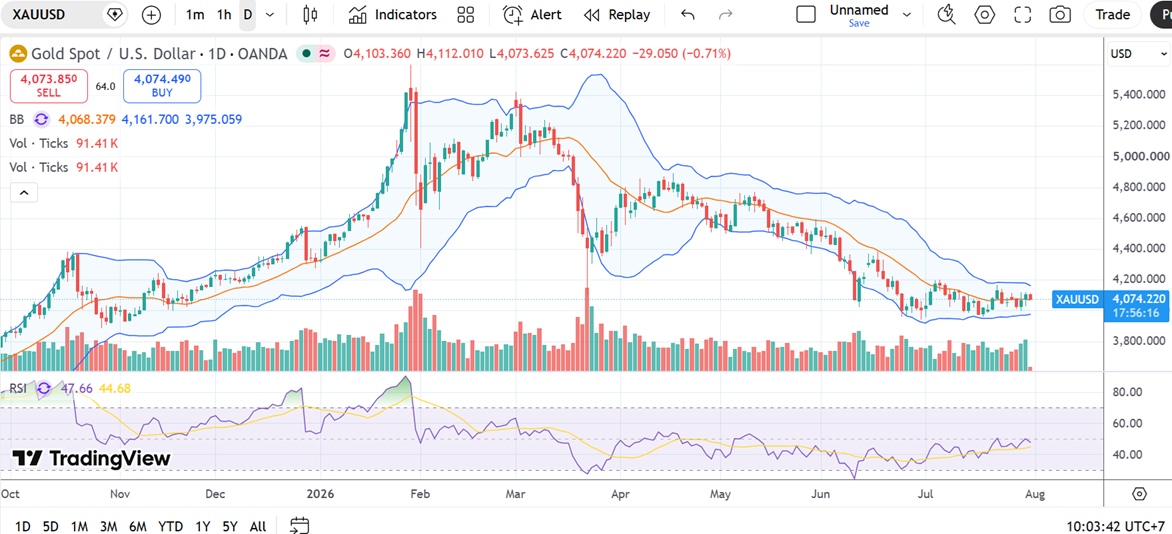
World gold price chart on a daily timeframe.
Gold prices forecast to surge in September
The U.S. Federal Reserve’s decision to keep interest rates unchanged but to signal a hawkish stance is, on the whole, good news for gold and silver prices. However, this decision also prolongs uncertainties related to inflation, interest rates and the market in general beyond the summer. According to experts, that could keep precious metals consolidating within their recent price range for some more time.
Jesse Colombo, an independent precious metals analyst and founder of the BubbleBubble Report, said the precious metals market breathed something of a sigh of relief after the Fed kept interest rates unchanged.
“Although expectations of rate hikes typically put downward pressure on precious metals because these assets do not generate yield, they have held up quite well despite that factor,” he wrote. “This resilience shows that most of the bearish sentiment has already been priced in, and in my view, that pricing-in is even excessive.”
According to Colombo, technical signals show that gold and silver are laying the groundwork for a potential recovery.
“Early last week, gold broke out of the triangle pattern that many bearish commentators had predicted would be pierced to the downside, with claims that prices would fall sharply toward the USD3,000 per ounce zone,” he noted. “But what actually happened was the complete opposite, and I regard this as a clear victory.”
He argued that the breakout signal remains valid, even though prices have yet to advance significantly further. However, Colombo warned that the market is in the middle of summer, when trading volumes are low and liquidity is thin as much of Wall Street’s financial community goes on vacation. Therefore, there is currently not much momentum to push precious metals prices sharply higher. The situation could change as September arrives.
Colombo wants to see gold prices decisively surpass the USD4,100 per ounce threshold for further confirmation of trend strength and of the triangle-pattern breakout signal.
“After that, I want to see prices clear the next barrier in the USD4,300–4,600 per ounce zone,” he wrote. “A strong breakout above this zone would be a clear signal that the recent period of weakness has come to an end.”
Meanwhile, the signal of silver prices breaking out of the triangle pattern last week also remains valid.
“Right now I am waiting for further confirmation of the uptrend, specifically prices clearing the USD60–70 per ounce resistance zone just above. This would give the recovery real momentum and signal that the correction has ended,” he said. However, this development may require trading volumes to pick up again after the summer.
Natixis economists Christopher Hodge, John Briggs and Selin Aker noted that this was the first Fed meeting to feature the kind of “internal disputes” that Chairman Kevin Warsh had once predicted, with three regional Fed presidents voting in dissent in favor of raising rates.
“These dissents came as no surprise, as all three had previously stated publicly that the current policy stance was not sufficient to bring inflation back to the Fed’s 2% target,” they wrote. “Three dissenting votes could be viewed as a somewhat hawkish signal, but these individuals are not necessarily the ones setting policy. In our view, the clearer signal is that all members of the Board of Governors and New York Fed President John Williams supported pausing rate adjustments.”
The experts noted that, aside from the Committee shifting to the phrasing “continue the policy of maintaining ample reserves,” rather than “reaffirming” the policy as before, the official statement was almost unchanged from June.
Following the decision to hold rates steady, Natixis’s assessment of the market was largely unchanged.
“We believe that the hawkish hold, reflected in the three dissenting votes and in Mr. Warsh’s press conference, mainly pushes back the timing at which the market prices in the Fed’s next moves. The uncertainty around how the Fed will respond to data will also persist while awaiting the next CPI report, expected to be released on 12/8,” the team of experts wrote.
“Although this is not our official forecast, it is understandable that the market is still leaving open the possibility of a Fed rate hike in September. The market is currently pricing in about a 60% probability of a Fed hike of 25 basis points, given the three dissenting votes and Mr. Warsh’s repeated emphasis on the goal of price stability.”
According to the economists, the overall outcome is that the uncertainty of July has simply been shifted to September.
“Between now and the September meeting, we will receive two more CPI reports. This window also gives the FOMC more time to assess the past impact and future outlook of oil prices amid the war in Iran,” they wrote. Natixis’s economics team forecasts that the policy rate will be held steady for an extended period, based on the firm’s inflation outlook.
Marc Chandler, Managing Director at Bannockburn Global Forex, said the FOMC decision appeared to be a hawkish hold. However, notably, the more Chairman Warsh affirmed his commitment to bringing inflation back to target, the more short-term interest rates and the USD fell.
“Gold prices had already recovered after falling below USD4,000 per ounce during the North American morning session, but surged following the FOMC decision,” he noted. “Prices briefly climbed slightly above USD4,116 per ounce, setting a three-day high, but failed to hold the momentum and closed slightly below the 20-day moving average, currently around USD4,072.”
“In today’s session, selling pressure emerged as prices attempted to break through USD4,100 per ounce. Silver prices closed fairly firmly, up nearly USD1, but the movement was not truly impressive. This metal is consolidating within yesterday’s trading range.”
Chris Zaccarelli, Chief Investment Officer at Northlight Asset Management, told Kitco News that Mr. Warsh is putting his own stamp on the Fed by keeping the policy statement short and nearly identical to the statement after the June meeting. The only addition was information about the three dissents in favor of raising rates.
“He made his focus on inflation very clear, both directly and indirectly, while going further than any Fed chair in recent years by specifically affirming that the Fed’s inflation target is 2%, not any higher level,” he noted.
“This can be regarded as a hawkish hold, because the Fed did not change interest rates but continued to emphasize price stability as the biggest risk, while playing down risks to the labor market.”
“If upcoming data show that inflation is cooling – a fairly likely possibility given last year’s high base, which makes this year’s figures easier to match or come in lower on a year-on-year comparison – the Fed could keep rates unchanged throughout this year, despite the market currently pricing in two rate hikes,” Zaccarelli said.
“If that scenario plays out, it will be a positive factor for the stock market between now and the end of the year.”
Source: TheLeader — theleader.vn. The article is republished for the purpose of sharing knowledge with the community of founders and investors in the HCM VIF ecosystem.
Category & tags
Related news
 Ecosystem
Venture capital will be a new asset class
Mr. Hoang Duc Trung believes that, with the State taking the lead and large organizations and enterprises joining forces to spread the momentum, venture capital will fulfil its role as an engine of growth and innovation
 Finance & Banking05/2026
The success of a public-private venture fund is not measured by the number of unicorns
With an initial size of VND 500 billion, how will the government's “seed capital” from the public-private venture fund catalyze the flow of financing into startups?
 Finance & Banking18/05/2026
Ho Chi Minh City sets up venture capital fund: 'Seed capital' for Vietnamese tech
For the first time, Ho Chi Minh City has a venture capital fund operating under a joint-stock company model with the participation of the State and major private corporations.