

From the DIC violation penalty: Is real estate’s era of ‘easy’ capital over?
The DIC case shows that regulators are stepping up control over the use of capital after issuance, as the bond market enters a more disciplined phase.
The DIC case shows that regulators are stepping up control over the use of capital after issuance, as the bond market enters a more disciplined phase.
Recently, the State Securities Inspectorate fined DIC Corp VND175 million for using more than VND520 billion out of the total VND600 billion raised from a private bond tranche in a manner inconsistent with the announced plan.
Specifically, instead of using all of the capital for the Long Tan Tourism Urban Area Project, the company used VND200 billion to buy shares in DIC Tourism JSC and VND320.5 billion to repay the principal and interest of an earlier bond tranche.
In addition to the administrative fine, the regulator required DIC to recall the bonds already issued and refund investors along with the interest accrued at the bond interest rate.
For DIC, the impact lies not only in the cost of the penalty but also relates to reputation, capital-raising capacity and investor confidence. More broadly, the case shows that regulators are stepping up control over the use of capital after issuance, as the bond market enters a more disciplined phase.
Cash-flow pressure in the real estate sector
Having to use a large portion of new capital to settle old financial obligations reflects the cash-flow pressure that many real estate enterprises are facing.
According to its Q1/2026 financial statements, DIC recorded net revenue of about VND140 billion and gross profit of nearly VND40 billion, but still posted an after-tax loss of nearly VND10 billion due to high administrative, selling and financial expenses.
Meanwhile, the company’s inventory reached about VND6,800 billion and short-term receivables nearly VND5,800 billion, accounting for more than 70% of total assets of about VND17,700 billion. This shows that most of its resources remain tied up in projects under implementation and in as-yet-uncollected amounts.

High real estate inventory places a burden on business leaders. Photo: HA
This is also a common situation among many real estate enterprises today. Despite owning large land banks, enterprises still struggle to convert assets into cash flow when market liquidity is low, legal procedures drag on and capital costs rise.
Novaland is currently the enterprise with the largest inventory among listed residential real estate firms, at about VND155,000 billion, of which real estate under construction accounts for about VND146,000 billion. Meanwhile, advances from buyers and unrealized revenue amount to only about VND22,000 billion.
At the annual general meeting of shareholders, Novaland founder Mr. Bui Thanh Nhon said the Board of Directors is continuing to resolve outstanding issues in order to work toward the goals set for 2026.
Similarly, Phat Dat Real Estate has about VND15,000 billion in inventory, but advances from buyers and unrealized revenue amount to only about VND20 billion. Khang Dien House also recorded about VND29,000 billion in inventory, while the accompanying sales cash flow reached only about VND700 billion.
These figures show that the major challenge for the real estate sector no longer lies in the scale of assets, but in the ability to turn assets into cash flow to meet financial obligations.
In the previous period, many real estate enterprises were able to expand quickly thanks to abundant capital, accumulating large land banks and implementing many projects at once. Bonds once became a convenient capital-raising channel when interest rates were low and investors’ risk appetite was high.
However, when the market reversed, debt-repayment pressure became more pronounced. Enterprises were forced to restructure their capital, control cash flow and be more cautious in their investment plans.
In DIC’s case, the company reduced its outstanding financial borrowings from about VND2,200 billion at the start of the year to about VND1,400 billion at the end of Q1/2026, equivalent to a decline of more than 36%. The debt-to-equity ratio was maintained at 0.75 times, relatively positive compared with the general benchmark.
However, the use of new capital to settle old obligations shows that cash-flow pressure remains present. This is a common challenge for the sector, as the advantage no longer lies in access to capital, but depends on the ability to complete legal procedures, implement projects and generate cash flow.
Decree 200 and the bond market’s new capital game
The DIC case occurred at a time when Decree 200/2026/ND-CP began to take effect from 5/6/2026. This is seen as an important turning point in the process of restructuring the corporate bond market after the volatile period of 2022–2023.
The new decree raises transparency standards by requiring issuers to clearly disclose the purpose of capital use, repayment capacity, collateral, debt-restructuring plans and related risks.
For bonds serving investment projects, enterprises must clarify implementation progress, legal status and the ability to recover capital. For issuances aimed at restructuring debt, enterprises must publicly disclose the financial obligations to be addressed.
For the real estate sector, which relies heavily on bond capital, the new regulations create considerable pressure on enterprises with high leverage or weak cash flow. The cap on total liabilities-to-equity of below 5 times is expected to help limit risks from excessive use of debt.
In addition, investor-protection mechanisms have also been strengthened, as bonds sold to professional individual investors must have quality collateral or a payment guarantee. Not allowing the issuer’s own shares or bonds to be used as collateral helps reduce the risk of using low-quality assets.
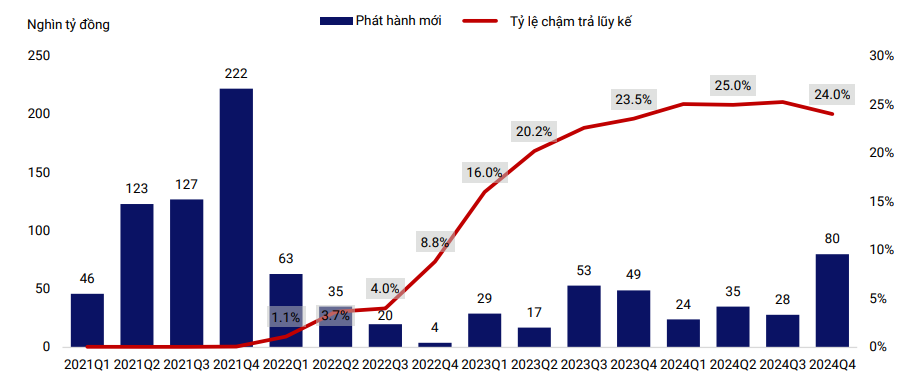
Corporate bond issuance fell sharply during the volatile period of 2022-2023. Photo: VIS Rating
According to VIS Rating, Decree 200 helps unify the legal framework, raise issuance standards and screen out enterprises with weak financial capacity. This is an important foundation for the market to recover and for encouraging enterprises to improve capital governance instead of relying on continuous debt restructuring.
However, the market’s biggest bottleneck remains the ability to price risk. The proportion of bonds with a credit rating is still low, while the market has yet to form a yield curve that reflects differences in credit quality and maturity.
This means bond interest rates do not yet fully reflect the level of risk. The 2022–2023 period showed that many bonds that fell into late payment did not carry significantly higher interest rates than higher-quality bonds, indicating that the market’s ability to differentiate risk is still limited.
Therefore, for the bond market to develop sustainably, the next stage needs to focus on expanding credit ratings, improving the risk-pricing mechanism and enhancing the effectiveness of collateral supervision.
When capital is allocated based on financial quality rather than merely on fundraising capacity, enterprises with genuine cash flow and healthy foundations will have a clearer advantage in the new development cycle.
Source: TheLeader — theleader.vn. The article is republished for the purpose of sharing knowledge with the community of founders and investors in the HCM VIF ecosystem.
Category & tags
Related news
 Ecosystem
Venture capital will be a new asset class
Mr. Hoang Duc Trung believes that, with the State taking the lead and large organizations and enterprises joining forces to spread the momentum, venture capital will fulfil its role as an engine of growth and innovation
 Finance & Banking05/2026
The success of a public-private venture fund is not measured by the number of unicorns
With an initial size of VND 500 billion, how will the government's “seed capital” from the public-private venture fund catalyze the flow of financing into startups?
 Finance & Banking18/05/2026
Ho Chi Minh City sets up venture capital fund: 'Seed capital' for Vietnamese tech
For the first time, Ho Chi Minh City has a venture capital fund operating under a joint-stock company model with the participation of the State and major private corporations.