

Circular 08: A 'lifeline' or just 'breathing room' for the Big 4 banks' capital challenge?
With very large holdings of Treasury deposits, bringing back 20% of term deposits helps banks improve their LDR without sharply increasing deposit mobilization. However, this is seen as a temporary measure that cannot definitively resolve the banks' capital thirst.
With very large holdings of Treasury deposits, bringing back 20% of term deposits helps banks improve their LDR without sharply increasing deposit mobilization. However, this is seen as a temporary measure that cannot definitively resolve the banks' capital thirst.
Circular 08/2026, just issued by the State Bank of Vietnam on May 15, 2026, amends and supplements point a, clause 4, Article 20 of Circular 22/2019 regarding how total deposits are determined when calculating the loan-to-deposit ratio (LDR).
Under the new regulation, banks are allowed to count 20% of the balance of the State Treasury's term deposits in the LDR denominator, while the agency's demand deposits continue to be excluded entirely.
The adjustment comes exactly at a time when the Big 4 group, comprising Vietcombank, VietinBank, BIDV, and Agribank, continuously approaches the 85% ceiling. Against this backdrop, Circular 08 is seen as a short-term "breathing room" and also reflects a more flexible approach by the regulator after the previous tightening phase.
Liquidity pressure is present
According to a recent report by MB Securities (MBS), banking system liquidity continues to be under pressure amid strong credit recovery, while deposit mobilization has not kept pace.
As of April 28, 2026, outstanding credit across the entire system reached about VND19.5 quadrillion, up 4.4% from the start of the year and up 18.26% year-on-year.
Meanwhile, deposit growth remained considerably slower as cash tended to shift toward alternative investment channels such as stocks, real estate, and corporate bonds, even though deposit interest rate levels have risen again since the end of 2025 and continued to edge up in Q1/2026.
The banking sector's liquidity picture shows a state of controlled but challenging tension. The average LDR of listed banks has risen to a high level, and many private banks have even far exceeded 100%.
Within the Big 4 group, although still within the prescribed limit, the pressure is becoming increasingly evident. As of March 31, 2026, Vietcombank recorded an LDR of 84.54%, VietinBank 83.48%, Agribank 83.28%, and BIDV 82.94%.
The figures are all close to the 85% maximum threshold allowed by the SBV. Compared with the start of the year, the upward trend is fairly clear as credit continues to be promoted to support the economy.
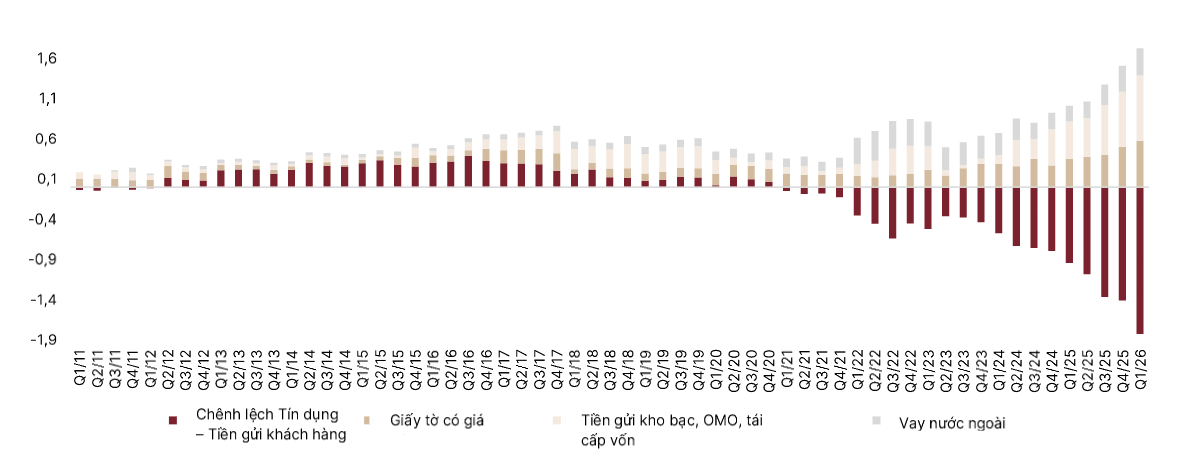
The funding shortfall at banks within the coverage scope (VND trillion). Photo: SSI
The LDR exceeding 100% at many banks forces lenders to rely more on alternative funding sources such as Treasury deposits, the OMO channel, or interbank funds.
In this picture, the Big 4 is the group most affected by the old regulation, as it holds nearly 99.6% of the total balance of State Treasury deposits, estimated at about VND624 trillion. Under the gradual exclusion roadmap in Circular 26/2022, this entire flow of funds was removed from the LDR denominator from the start of 2026.
The consequence is that the funding gap is widening. State-owned banks were forced into an interest rate race in the first months of the year, while also tightening credit to maintain safety ratios.
The mismatch between credit and deposits also makes the risk of maturity imbalance more pronounced. The banking system today still mainly uses short-term funds to finance medium- and long-term loans, especially in the infrastructure and real estate sectors.
In the event of a simultaneous withdrawal shock, although the probability is low, liquidity pressure could still increase significantly. The State Bank of Vietnam has repeatedly required corrective action from units exceeding the threshold, especially banks with an LDR above 100%.
Alongside this is increasingly fierce competition for deposits, dragging down the net interest margin (NIM) and directly affecting the profitability of the entire industry.
Treasury deposits and the "lifeline" role
Against this backdrop, Circular 08 is seen as a timely adjustment. Instead of excluding the State Treasury's term deposits entirely as under the old roadmap, the new regulation allows 20% of this balance to be returned to the LDR denominator. Meanwhile, demand deposits are still excluded entirely, and escrow deposits and special-purpose capital deposits are also not counted.
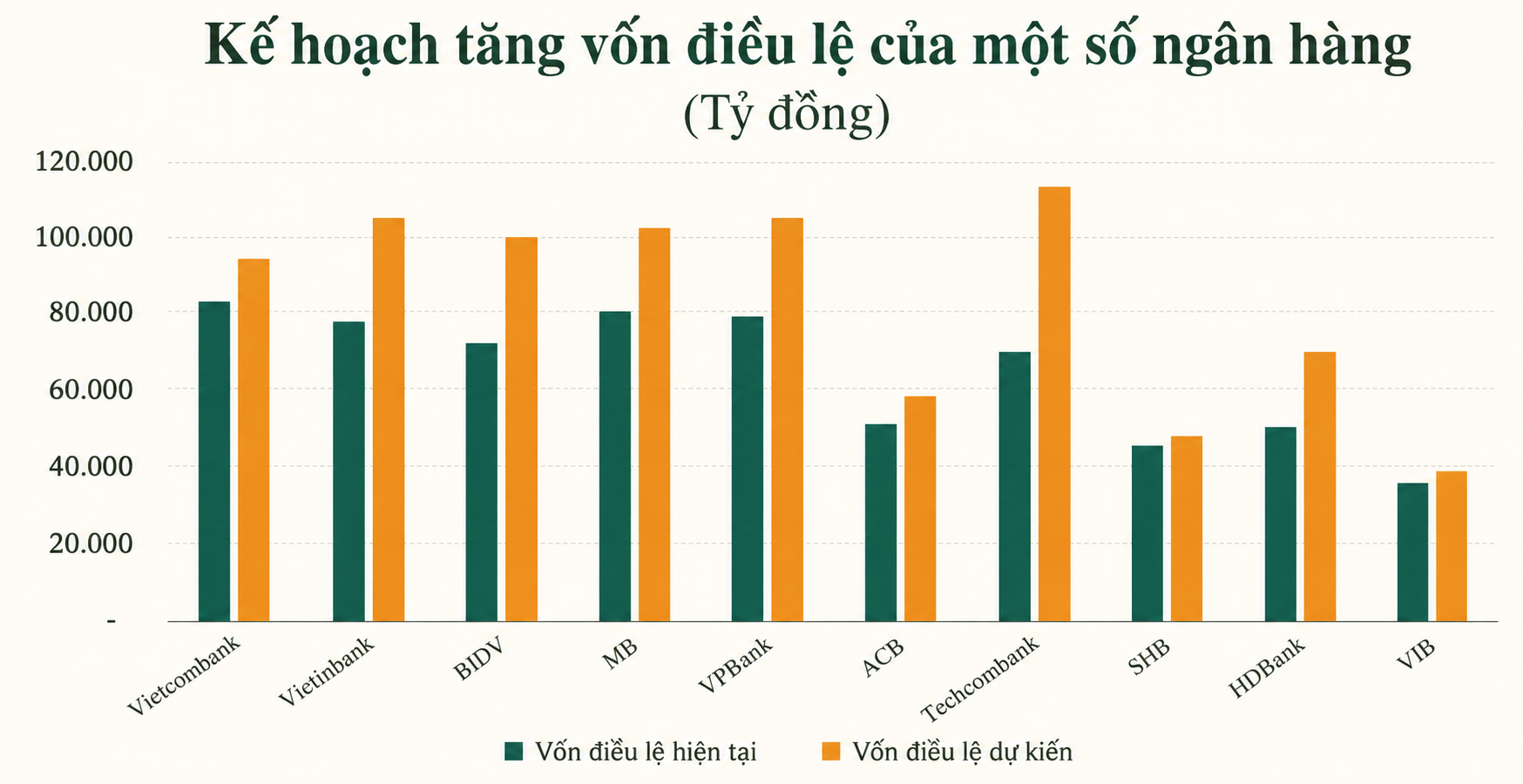
Q1/2026 financial statements show that State Treasury deposits at Vietcombank, BIDV, and VietinBank reached about VND563,000 billion, up nearly 39% from the end of 2025.
Of this, Vietcombank and BIDV each recorded about VND189,000 billion, mostly term deposits. Under Circular 08, each bank may add about VND37,000 billion to the LDR denominator, corresponding to theoretical credit headroom of about VND31,000 billion under the 85% LDR ceiling.
VietinBank recorded about VND185,000 billion in State Treasury deposits but has not disclosed the detailed maturity structure.
This move brings a clear impact on the Big 4. With very large holdings of Treasury deposits, bringing back 20% of term deposits helps banks improve their LDR without sharply increasing high-cost mobilization from the market, improving liquidity indicators as well as credit growth headroom.
This "breathing room" could open up considerable additional credit headroom, especially for the Big 4, which are closest to the threshold, while also serving as growth locomotives and being the most "directly" affected by these new regulations.
However, according to SSI's experts, this is still only a short-term technical solution. The new regulation helps ease immediate pressure but does not address the root of the mismatch between the structure of funding sources and the use of capital.
In the long run, the Big 4 still need to proactively diversify their funding sources, raise the proportion of stable individual deposits, and adjust their lending strategy toward more sustainable maturities.
Amid the draft amendment to Circular 22 orienting a shift to the CDR (Credit-to-Deposit Ratio) indicator, partially loosening the treatment of Treasury deposits becomes all the more notable.
The CDR is expected to reflect reality more closely by adding corporate bond balances to the numerator and excluding interbank deposits from the denominator. The combination of Circular 08 and the roadmap to shift to CDR helps create additional flexible space for the Big 4 to maintain their pillar role in supplying credit to the economy while still controlling risk.
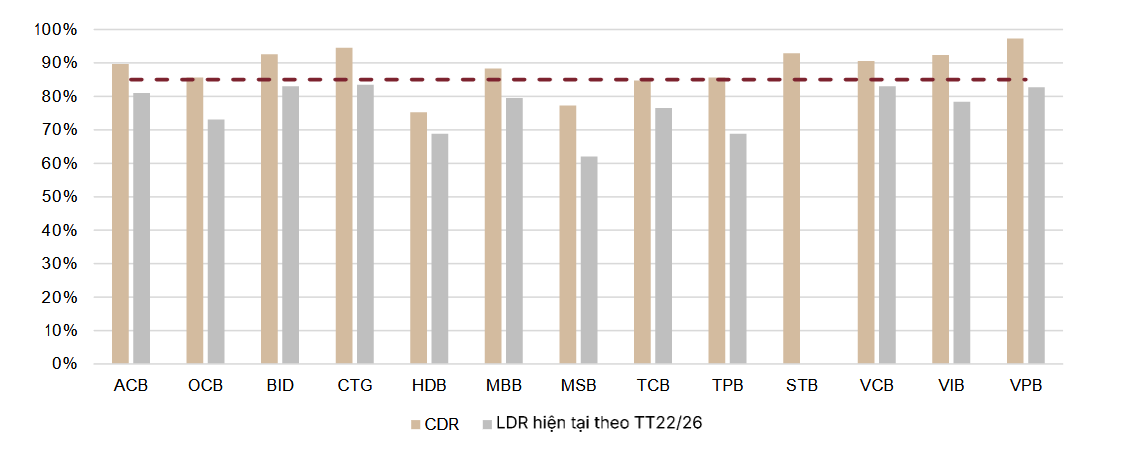
Estimated CDR at banks within SSI's coverage scope. Photo: SSI
ACBS Securities assesses that shifting from the LDR to the CDR calculation shows the regulator's orientation toward tighter management, while also pushing banks to move faster toward international standards.
Nevertheless, the actual impact is considered not too large. The reason is that banks can still choose to apply a standard set of indicators such as the CDR or switch to criteria under Basel III. Therefore, the draft amendment will not create significant pressure on liquidity or the credit expansion capacity of the entire banking industry.
The journey of capital increases and Basel III standards
Despite continuous flexible adjustments such as Circular 08, the LDR or CDR challenge still reflects only part of the banking system's liquidity pressure. The core long-term issue lies in the capacity of own funds to absorb risk, especially as Circular 14/2025 raises capital adequacy standards closer to Basel III from September 2025.
Moreover, the CAR of the Big 4 group currently stands at around just over 10%, significantly lower than the 12–15% of many large private banks. This also makes the pressure to raise capital increasingly urgent.
Against this backdrop, the Big 4 are leveraging undistributed profit to supplement Tier 1 capital, with Vietcombank leading in the scale of retained earnings.
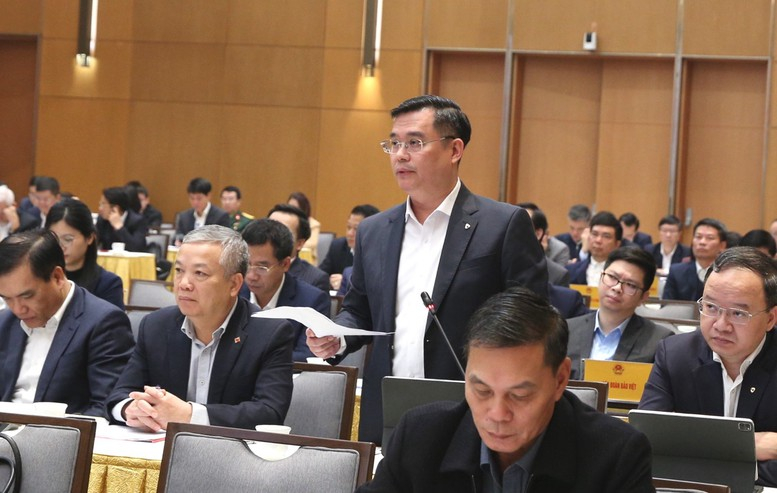
Vietcombank Chairman Nguyen Thanh Tung considers "reserved" profit an important factor helping the bank meet its capital needs.
At the recent Annual General Meeting of Shareholders, Vietcombank Chairman Nguyen Thanh Tung said retaining nearly VND45,000 billion in profit is an important solution helping the bank meet Basel III.
"This is a very important source of capital increase for Vietcombank's charter capital, helping Vietcombank maintain its position as the bank with the largest charter capital in the system," Tung assessed.
In addition to increasing Tier 1 capital, issuing subordinated bonds to supplement Tier 2 capital remains a common solution, despite the high cost involved.
Meanwhile, shifting to the CDR together with the requirement to comply with Basel III indicators such as the LCR (Liquidity Coverage Ratio) or NSFR (Net Stable Funding Ratio) is expected to create additional flexible headroom for banks to meet prudential standards.
Some lenders may reduce the pressure from the 85% ceiling if they achieve high compliance with international standards. This creates an incentive for the Big 4 to accelerate the modernization of risk management instead of relying mainly on technical adjustment measures.
According to SSI, if the 85% CDR ceiling is applied rigidly, many banks will have to accelerate deposit mobilization, which could slow credit growth. Therefore, a step-by-step approach together with adjustments such as Circular 08 is seen as more appropriate during the transition period.
From a long-term perspective, the Big 4 still face the requirement to enhance capital quality, diversify funding sources, and manage maturity risk more tightly. Banks that increase Tier 1 capital well and effectively restructure their balance sheets will have a more sustainable competitive advantage.
According to experts, the current "easy-breathing" period should be used to optimize the funding structure, raise the proportion of stable deposits, diversify medium- and long-term funding sources, and boost digital transformation in order to comprehensively meet Basel III.
For the economy, the role of the Big 4 remains especially important, as this group supplies most of the credit for infrastructure projects and large enterprises. Therefore, maintaining stable liquidity at this group of banks is of key significance for system safety and sustainable economic growth.
Source: TheLeader — theleader.vn. This article is republished for the purpose of sharing knowledge with the community of founders and investors within the HCM VIF ecosystem.
Category & tags
Related news
 Ecosystem
Venture capital will be a new asset class
Mr. Hoang Duc Trung believes that, with the State taking the lead and large organizations and enterprises joining forces to spread the momentum, venture capital will fulfil its role as an engine of growth and innovation
 Finance & Banking05/2026
The success of a public-private venture fund is not measured by the number of unicorns
With an initial size of VND 500 billion, how will the government's “seed capital” from the public-private venture fund catalyze the flow of financing into startups?
 Finance & Banking18/05/2026
Ho Chi Minh City sets up venture capital fund: 'Seed capital' for Vietnamese tech
For the first time, Ho Chi Minh City has a venture capital fund operating under a joint-stock company model with the participation of the State and major private corporations.