

Capital reshapes the race in the securities industry
This shift is making the securities industry increasingly resemble a race in capital-management capability rather than a competition over brokerage scale.
This shift is making the securities industry increasingly resemble a race in capital-management capability rather than a competition over brokerage scale.
After the new trading system went into operation last year, liquidity on Vietnam's stock market has continually set new milestones. Trading value at times exceeded VND40 trillion per session, significantly higher than the peak period of 2021.
In parallel with the rise in liquidity, the market has recorded a notable shift within the securities industry, as firms operate under a model different from before.
In fact, the brokerage segment is no longer the "gold mine" it was during the boom in individual investors. The zero-fee trading race has caused the brokerage "slice of the pie" to shrink ever further amid growing competitive pressure.
Instead, capital scale, fundraising capacity and balance-sheet management ability are becoming crucial factors for securities firms in the new development phase.
A new "game" shifts the balance of power
Throughout a long operating history, Vietnam's stock market has been defined by brokerage market share. The rankings of securities firms were determined mainly by the number of newly opened accounts, trading market share, or fee waiver and reduction policies for individual investors.
However, this growth formula is gradually changing.
According to a recent assessment by FiinRatings, the revenue of securities firms is shifting from fee-based activities to more capital-intensive business lines.
Proprietary investment is now the largest revenue source for most firms in the industry, while margin lending has become one of the most important growth drivers. The share of revenue from brokerage has therefore continuously declined in recent years.
Instead of focusing solely on attracting customers or expanding brokerage market share, firms must increasingly pay more attention to their ability to raise and deploy capital.
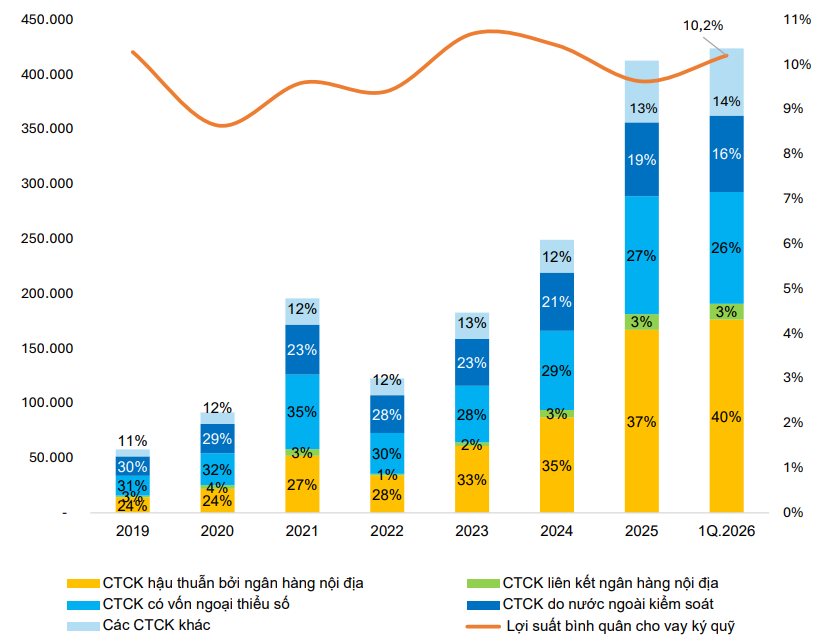
Margin lending value (VND billion), yield and lending market share growth over the years. Photo: FiinRatings
The clearest evidence is data from margin lending activity. By the end of 2025, the industry's total margin loan balance reached about VND412.6 trillion, equivalent to the credit balance of a joint-stock commercial bank among the system's ten largest.
Whereas a few years ago margin was mainly viewed as a trading-support service, it has now become a core business line of many securities firms. The margin loan balance is also growing faster than the market's expansion, showing that stock market liquidity is increasingly supported by credit flows.
As capital becomes one of the decisive factors of competitiveness, the "balance of power" in the securities industry is also beginning to change.
According to FiinRatings, the margin-lending market share of the group of securities firms backed by domestic banks and financial conglomerates rose from about 24% in 2019 to nearly 37% in the first quarter of 2026. This is also the group leading in capital-raising scale, charter capital increases and balance-sheet expansion capability.
The advantage of this group of firms lies in their access to diverse capital sources, their customer ecosystem, and the accompanying financial products.
Moreover, whereas in the past firms that could borrow cheaper capital had more of an advantage in margin lending, the more important question now is how efficiently that capital is deployed. Profitability increasingly depends on customer structure, lending yields, product-pricing strategy and each firm's risk appetite - which are the governance strengths of the leading players.
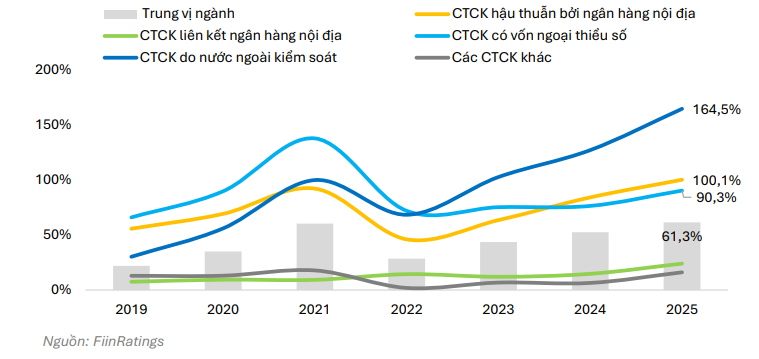
The group of securities firms backed by domestic banks and financial conglomerates holds the advantage in the race to grow loan balances. Photo: FiinRatings
In fact, the securities firms currently leading the market are all pursuing strategies of raising capital, expanding margin lending and developing capital-market-related activities.
Notably, the growth rate of the industry's borrowed capital is far higher than that of equity capital increases.
According to FiinRatings, in 2025 the amount of capital raised through debt was roughly 40 to 50 times the capital raised through equity issuance across all groups of securities firms.
This shows that the securities industry is increasingly becoming a capital-intensive business through a series of financial leverage tools.
A new challenge in capital management
If the 2020-2022 period was the boom era of individual investors, then the 2025-2030 period is expected to be an era of reshaping the securities industry, centered on capital-management capability.
Regulatory changes are accelerating this process. Notably, the Ministry of Finance's Circular 102/2025 raises risk coefficients for certain asset types and tightens available-capital requirements, making margin lending, proprietary investment and the holding of corporate bonds more capital-intensive than before.
Securities firms that grow rapidly and rely heavily on financial leverage will face pressure to raise capital or adjust their business strategies. Meanwhile, FiinRatings notes that the industry's funding structure is increasingly dependent on the banking system.
By 2025, nearly 90% of the capital raised by securities firms came from bank loans, mostly short-term funding. This makes the industry's cost of capital and its ability to expand more "sensitive" to liquidity developments and monetary policy.
In other words, stock market liquidity now depends not only on investors' cash flows but is also more closely tied to the funding capacity of the financial system.
The market-upgrade process will also reinforce this trend. Expanding trading mechanisms for foreign investors and improving market infrastructure require securities firms to have a stronger capital base and better risk-management capability.
The new environment will create additional advantages for the group of firms with large financial resources, while smaller firms will face pressure to raise capital, seek strategic partners, or accept a narrower scope for growth.
Looking more broadly at the years ahead, FiinRatings assesses that the standing of securities firms will be determined more by their ability to raise capital, manage the balance sheet, and deploy capital efficiently. Brokerage activity still plays an important role but is no longer at the center of the industry's business model.
Source: TheLeader — theleader.vn. This article is republished for the purpose of sharing knowledge with the community of founders and investors within the HCM VIF ecosystem.
Category & tags
Related news
 Ecosystem
Venture capital will be a new asset class
Mr. Hoang Duc Trung believes that, with the State taking the lead and large organizations and enterprises joining forces to spread the momentum, venture capital will fulfil its role as an engine of growth and innovation
 Finance & Banking05/2026
The success of a public-private venture fund is not measured by the number of unicorns
With an initial size of VND 500 billion, how will the government's “seed capital” from the public-private venture fund catalyze the flow of financing into startups?
 Finance & Banking18/05/2026
Ho Chi Minh City sets up venture capital fund: 'Seed capital' for Vietnamese tech
For the first time, Ho Chi Minh City has a venture capital fund operating under a joint-stock company model with the participation of the State and major private corporations.