

Capital-Raising Race Creates 'Mega-Brokers' in the Securities Industry
Following the market’s strong rally, “super” securities firms with capital in the tens of trillions of dong are gradually taking shape, while smaller firms face pressure to restructure, merge or be acquired.
Following the market’s strong rally, “super” securities firms with capital in the tens of trillions of dong are gradually taking shape, while smaller firms face pressure to restructure, merge or be acquired if they cannot keep pace.
Vietnam’s stock market broke its historical peak early in the first half of the year, with the VN-Index closing the May 8 session at 1,915.37 points, surpassing the record of 1,902.93 points set earlier in the year.
Along with the strong rally, the number of securities accounts also exploded. In just the first quarter of 2026, the market had more than 12.6 million accounts, achieving its 2030 target nearly five years early.
However, behind that vibrant picture, many securities firms are beginning to realize that their current capital “coat” has become too tight as demand for capital and new products keeps rising.
Demand for margin lending and technology infrastructure requires larger investment, while market-wide margin debt has reached VND 400 trillion. Many large securities firms are also approaching the margin-lending limit of 200% of equity.
In that context, raising capital is no longer just a strategic choice but has become a matter of survival to maintain market share and capture new cash flow. From there, the 2025–2026 capital-raising wave, on a scale of nearly VND 100 trillion, is gradually taking shape, laying the foundation for the emergence of Mega Brokers — “super” institutions with charter capital in the tens of trillions of dong, capable of competing regionally.
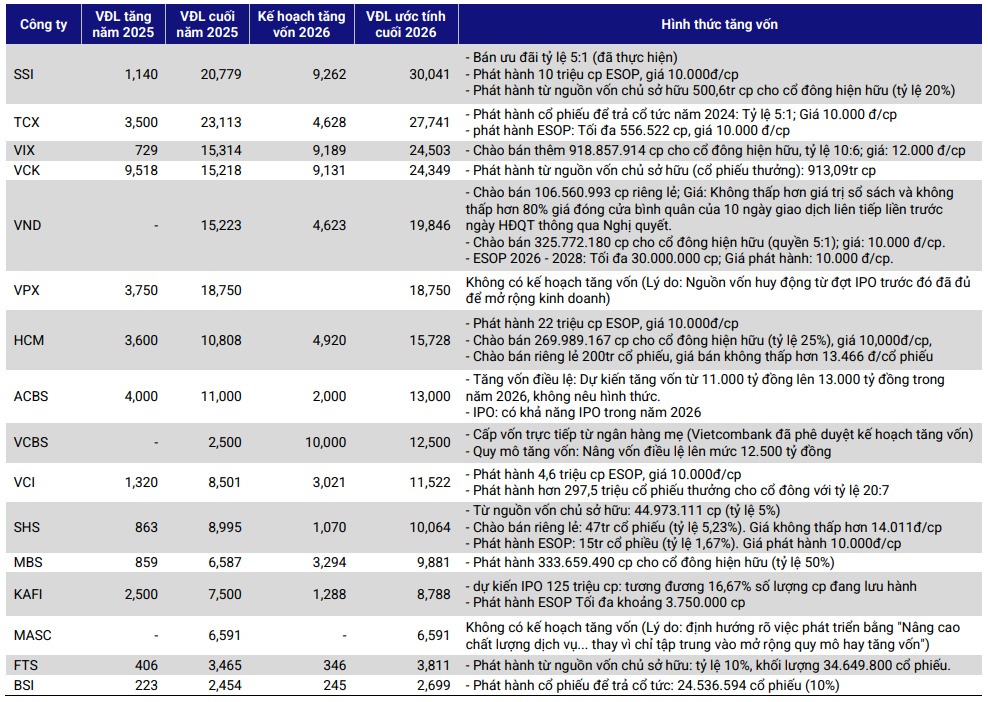
A series of leading securities firms continue the capital-raising race. Photo: S&I Ratings
The impetus for this transformation comes from many sides. The KRX system, operating since 2025, is seen as the market’s “new engine,” paving the way for T+0 trading, short selling and the central counterparty (CCP) clearing mechanism, helping liquidity flow more smoothly and reducing systemic risk.
Pressure increases further as the market expects FTSE Russell to include Vietnam in the emerging-market index basket from September 2026. Billions of USD in passive foreign capital are estimated to flow into the market, not to mention the larger-scale active capital flows. This forces securities firms to quickly build a thicker “capital buffer” to meet the requirements of the new market.
Against this backdrop, leading firms such as SSI Securities, TCBS, VPS and VIX have successively announced large-scale capital-raising plans, making 2026 one of the most extensively restructured periods in the history of the securities industry.
Unlike previous rounds, which were mainly aimed at resolving difficulties or meeting legal requirements, the current capital-raising wave stems from genuine market growth, changes in trading infrastructure and the upgrade opportunity.
The rise of the Mega-Brokers
Within that current, the leading institutions are quickly shaping a new tier of the market, where Mega-Brokers possess enormous capital scale, high risk-bearing capacity and a comprehensive service ecosystem. They both meet the sharply rising margin demand and prepare their positioning to capture the foreign capital flows drawing closer than ever.
SSI Securities leads the game in the style of a traditional institution. After completing a large issuance in early 2026, SSI’s charter capital exceeded VND 24,900 billion, thereby reclaiming the number one position from TCBS.
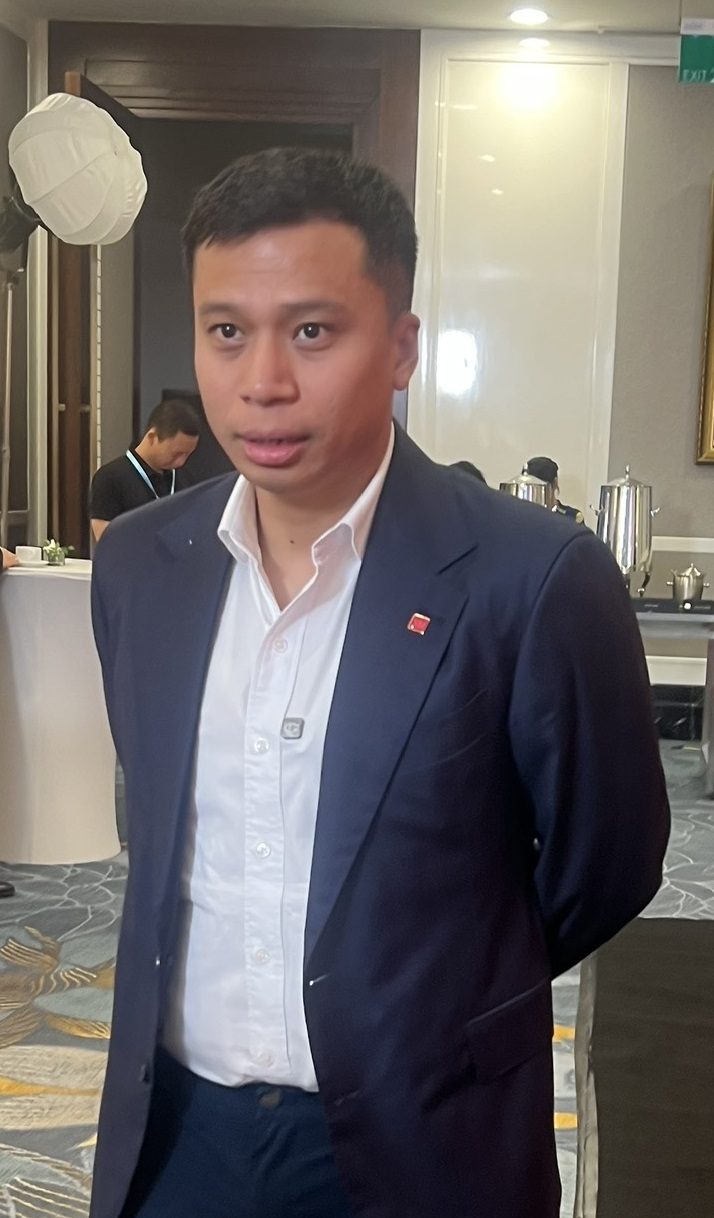
SSI General Director Nguyen Duc Thong
The company continues to plan to raise capital to around VND 30,000 billion through issuing bonus shares at a 5:1 ratio, ESOP and various other forms. The new capital is allocated with about half going to margin-lending activities and the rest serving investment and technology upgrades.
“Maintaining the largest capital base in the industry gives the company the confidence to expand, while also expecting record-high pre-tax profit,” shared Nguyen Duc Thong, General Director of SSI.
Chairman of the Board Nguyen Duy Hung has also repeatedly stressed that stable operations and enhanced transparency will be the foundation for the market-upgrade process to attract long-term capital and drive the sustainable development of the capital market.
Alongside SSI, a new generation of Mega-Brokers is also emerging thanks to the advantage of combining banking and technology. TCBS, with a plan to raise charter capital to VND 27,741 billion, is redefining the brokerage model in the market.
The ecosystem from Techcombank combined with AI helps the company create a strong competitive advantage on fees, even rolling out zero fees on some services, thereby strongly attracting young and professional investors. Its earlier successful listing also propelled TCBS to a leading position in market capitalization and product innovation.
Meanwhile, VPS made a strong breakthrough from its leading brokerage market-share position as charter capital rose to VND 24,350 billion after a bonus issuance. At the shareholders’ meeting, the company’s leadership said 2026 will continue to expand the scale of operations, improve service quality and invest heavily in technology infrastructure.
The company set a revenue target of VND 11,500 billion and pre-tax profit of VND 5,750 billion, a sharp increase from the previous year. Chairman Nguyen Lam Dung also expressed hope that the Vietnamese market will soon be added by MSCI to its upgrade watchlist, thereby opening up room to attract larger foreign capital flows in the coming years.
The capital-raising wave is also quickly spreading across the industry. VIX is aiming for a capital scale of more than VND 24,500 billion, and VND is approaching VND 20,000 billion. HCM and VCBS — with capital directly from Vietcombank — along with many mid-sized firms such as Kafi are also urgently preparing for IPOs.
Conversely, some units such as VPX have chosen to keep their capital unchanged in order to focus on improving operational quality, reflecting a clear difference in development strategy.
Compared with previous capital-raising waves, this time the momentum comes from genuine growth in liquidity, the KRX system and the market-upgrade opportunity. The new capital is also used in a more focused manner, concentrating on margin, proprietary trading, technology and derivative products, laying the foundation for a leap in the operational quality of the whole industry.
The “ripples” behind the overall picture
According to S&I Ratings, the outlook for the securities industry in 2026 is generally positive thanks to an economy targeting GDP growth of over 10%, expansionary fiscal policy and a favorable business environment.
Market liquidity, margin demand and capital-raising activities are expected to rise strongly, creating momentum for brokerage revenue, margin lending and proprietary investment of securities firms.
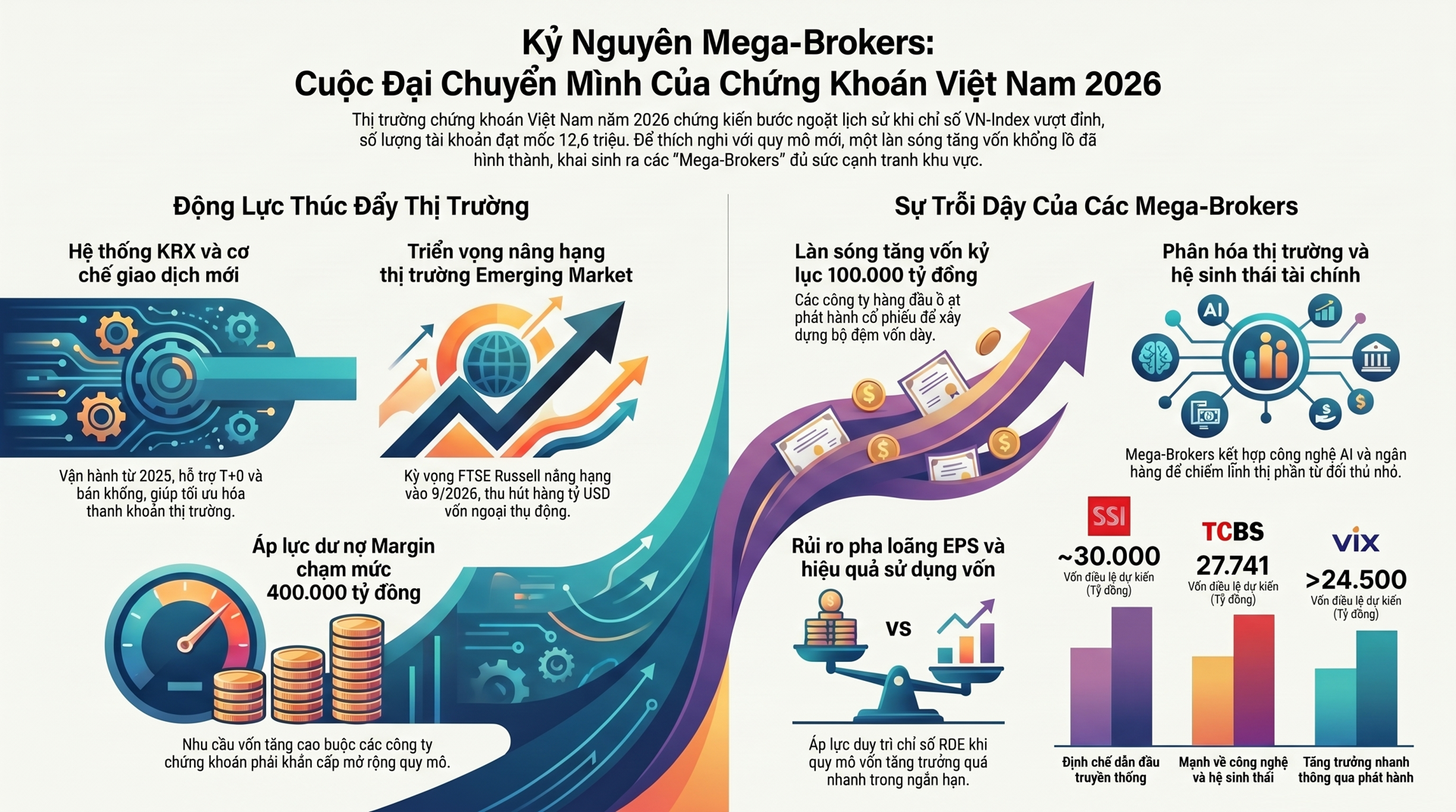
Against this backdrop, the capital-raising wave is forecast to continue booming in 2026 as many top securities firms have approached the margin-debt/equity ceiling and need to supplement resources to meet capital-adequacy requirements and capture foreign capital flows after the foreign ownership room was opened up to 100%.
Moreover, raising the risk coefficient from 10%–30% also makes the need to increase available capital more urgent.
According to S&I Ratings, the three main forms of capital raising are issuance to existing shareholders, private placement to foreign strategic investors, and issuance of long-term bonds. The total scale of capital raising across the industry in 2026 could continue to hover around VND 100 trillion.
This wave is helping shape a new generation of Mega-Brokers with ambitions to strongly expand margin operations, invest in technology, develop financial ecosystems and enter new fields such as digital assets and derivative products.
After the listing wave of many large firms in 2025, mid-sized securities firms are also accelerating their IPOs to join the capital-scale race.
However, behind the vibrant growth picture there is no shortage of pressures to watch. Mass issuance can dilute EPS and create downward pressure on ROE if businesses do not effectively convert the new capital into profit.
Many securities firms still rely heavily on short-term borrowed funds to serve margin and proprietary trading, increasing funding-cost risk when interest rates fluctuate.
S&I Ratings also warns that competitive pressure will grow increasingly fierce, especially for small-scale or highly leveraged firms, as the gap with the leading group widens further.
Nonetheless, the industry’s long-term outlook is still assessed positively thanks to expectations of a market upgrade, rising foreign capital flows and a new legal framework supporting deeper and broader capital-market development.
In that trend, Mega-Brokers with strong capital foundations, good governance and high technology capacity are expected to become the group leading the market’s new growth cycle.
Source: TheLeader — theleader.vn. This article is republished to share knowledge with the community of founders and investors in the HCM VIF ecosystem.
Category & tags
Related news
 Ecosystem
Venture capital will be a new asset class
Mr. Hoang Duc Trung believes that, with the State taking the lead and large organizations and enterprises joining forces to spread the momentum, venture capital will fulfil its role as an engine of growth and innovation
 Finance & Banking05/2026
The success of a public-private venture fund is not measured by the number of unicorns
With an initial size of VND 500 billion, how will the government's “seed capital” from the public-private venture fund catalyze the flow of financing into startups?
 Finance & Banking18/05/2026
Ho Chi Minh City sets up venture capital fund: 'Seed capital' for Vietnamese tech
For the first time, Ho Chi Minh City has a venture capital fund operating under a joint-stock company model with the participation of the State and major private corporations.