

Behind the trillion-dong bank salaries
>> This article is part of the special report "An overview of Vietnamese banking: From financial statements to the pulse of the economy". What are bank salaries revealing about the operating efficiency of the banks? When speaking of the banking industry...
\>> This article is part of the special report "An overview of Vietnamese banking: From financial statements to the pulse of the economy"
What are bank salaries revealing about the operating efficiency of the banks?
When speaking of the banking industry, many people often associate it with attractive incomes and among the highest benefit packages in the economy. However, behind the figures on bank salaries lies not only the story of employees’ incomes, but also a reflection of the operating efficiency, labor productivity and governance capacity of each credit institution.
Data from 27 listed banks show that in the most recent 12 months up to the end of Q1/2026, the banks spent more than VND134,900 billion on salaries, bonuses and employee benefits. In return, this group of banks generated more than VND294,000 billion in after-tax profit. That means each dong of personnel expense is bringing in about VND2.18 of profit for the entire system.
But behind that average figure lies a very large difference among banks. In some places, each dong spent on personnel generates nearly VND4 of profit, while at some other banks, each dong of personnel expense does not even generate VND1 of profit.
The banks that spend the most on employees
In terms of absolute scale, the group of state-owned banks remains the entities with the largest salary funds in the market.
BIDV currently leads with total personnel expenses of more than VND18,300 billion in the most recent 12 months. VietinBank ranks second with about VND16,400 billion, while Vietcombank spent about VND14,400 billion. These three banks alone spent nearly VND50,000 billion on their workforces.
The reason the salary funds of this group are so high is that they operate networks of thousands of transaction points across the country with a workforce far larger than most of the remaining banks.
In the private banking group, MBBank and VPBank are also among the banks with the largest personnel expenses, spending more than VND11,000 billion each per year. These are institutions that own large customer networks and invest heavily in both retail operations and digital transformation.
However, a large salary fund does not necessarily mean low efficiency. What matters more is how much profit the bank is generating from that spending.
Techcombank leads in salary-fund efficiency
When personnel expenses are placed alongside the profit generated, the picture of the banking industry changes considerably.
Techcombank is currently the bank leading the system in the efficiency of its use of human resources. In the 12 months up to Q1/2026, the bank spent about VND7,200 billion on employees but generated nearly VND26,900 billion in after-tax profit. That means for every dong spent on personnel, Techcombank earns VND3.73 of profit.
This result reflects Techcombank’s distinctive business model. The bank focuses heavily on premium customers, large enterprises and a digital technology platform. Thanks to this, the bank can generate large profits without maintaining an overly massive workforce.
In other words, Techcombank is demonstrating labor productivity among the highest in Vietnam’s banking industry.
Techcombank is currently the bank leading the system in the efficiency of its use of human resources. Photo: TCB 2025 Annual Report
SHB and LPBank spring big surprises
Right behind Techcombank are two names rarely mentioned when it comes to personnel efficiency: SHB and LPBank.
SHB achieved a profit-to-personnel-expense ratio of about 3.43 times, while LPBank reached 3.41 times. These are both levels far above the general benchmark of the entire system.
The appearance of these two banks in the leading group reflects the effectiveness of their network restructuring, cost control and improvement in labor productivity in recent years.
HDBank, ACB, MBBank, Vietcombank and VPBank are also among the group with human-resource efficiency above the industry average. What these banks have in common is the ability to sustain profit growth while still keeping the pace of increase in personnel expenses well under control.
Why are banks increasingly focused on labor productivity?
In the past, growth in the banking industry was tied to opening more branches and hiring more employees. However, the development of digital banking is completely changing this model.
Today, banks no longer compete primarily by the number of transaction points or the size of their workforce. Instead, they focus more on raising the productivity of each employee through technology, data and process automation.
This explains why banks with strong digital foundations, such as Techcombank, MBBank or ACB, often record higher human-resource efficiency than the general benchmark.
In an increasingly fierce competitive environment, the ability to generate more profit per dong of personnel expense is becoming a competitive advantage no less important than CASA or NIM.
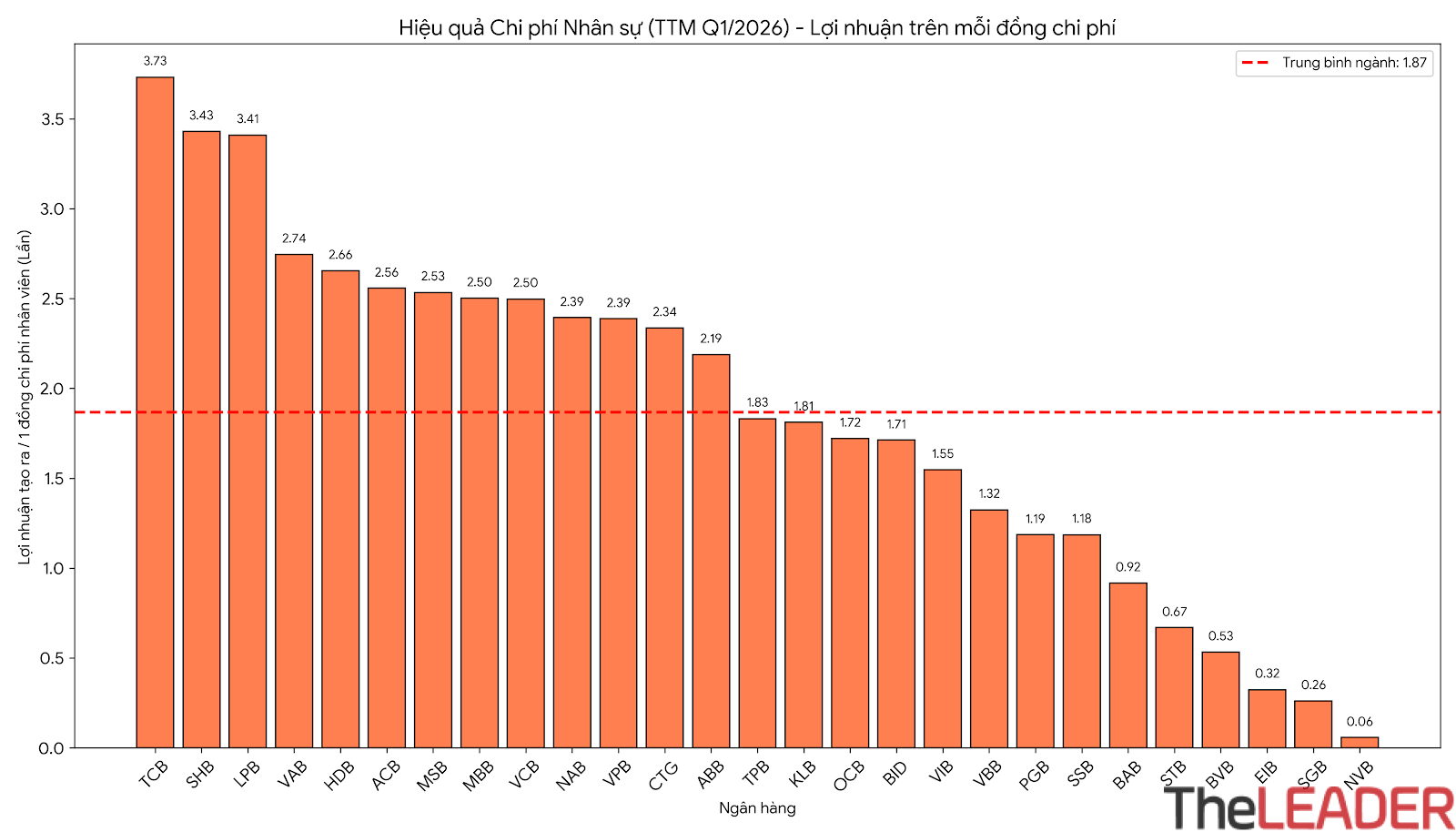
Personnel expense efficiency – Profit per dong of expense of 27 listed banks
When bank salaries are no longer a story about income
On the other side, some banks are still facing many challenges in converting personnel expenses into profit.
NCB, SaigonBank, Eximbank and BVBank all recorded profit-to-personnel-expense ratios significantly lower than the general benchmark. However, the cause does not lie in these banks paying overly high salaries, but mainly stems from limited business efficiency, bad-debt pressure or large provisioning costs.
The case of Sacombank is also quite special. Despite owning a wide network and a salary fund of nearly VND7,000 billion per year, its profit efficiency per dong of personnel expense is only at a below-average level. The main cause stems from the bank still devoting significant resources to handling residual assets from the restructuring process.
That shows that bank salaries today reflect not only each institution’s remuneration policy, but also its profit-generating capacity, asset quality and overall governance efficiency.
The new competition behind bank salaries
The current picture of bank salaries shows a notable trend: the race in the financial industry is no longer simply a race to expand the size of the workforce.
The most successful banks are the institutions that know how to create more value from each employee through technology, data and an efficient business model. Meanwhile, banks with low labor productivity will face increasing pressure to optimize their apparatus and improve operating efficiency.
Viewed from this angle, bank salaries are not just a story about employees’ incomes. They are also a yardstick reflecting the quality of governance, labor productivity and profit-generating capacity of each bank in an industry that is changing very rapidly under the impact of digital transformation.
Table of Efficiency (Profit / VND1 of expense) of 27 banks
No.
Bank
TTM Profit (VND billion)
TTM Personnel Expense (VND billion)
Efficiency (Profit / VND1 of expense)
1
TCB
26,891.20
7,205.60
3.73
2
SHB
12,189.90
3,553.90
3.43
3
LPB
11,167.70
3,275.40
3.41
4
VAB
1,435.50
523
2.74
5
HDB
17,618.10
6,634.60
2.66
6
ACB
16,266.90
6,360.80
2.56
7
MSB
5,877.10
2,319.20
2.53
8
MBB
28,410.80
11,356.30
2.5
9
VCB
35,958.40
14,400.50
2.5
10
NAB
4,517.00
1,886.50
2.39
11
VPB
26,749.10
11,203.30
2.39
12
CTG
38,331.90
16,408.70
2.34
13
ABB
3,675.70
1,680.30
2.19
-
SYSTEM AVERAGE
294,039.60
134,911.70
2.18
14
TPB
7,397.50
4,038.70
1.83
15
KLB
1,988.40
1,097.80
1.81
16
OCB
4,272.80
2,483.70
1.72
17
BID
31,353.70
18,306.60
1.71
18
VIB
7,590.20
4,903.90
1.55
19
VBB
1,142.90
863.3
1.32
20
PGB
724.7
611.2
1.19
21
SSB
3,127.70
2,639.60
1.18
22
BAB
1,274.60
1,390.20
0.92
23
STB
4,626.80
6,911.70
0.67
24
BVB
524.9
985.8
0.53
25
EIB
747.6
2,313.10
0.32
26
SGB
113.2
433.7
0.26
27
NVB
65.3
1,124.30
0.06
\>> This article is part of the special report "An overview of Vietnamese banking: From financial statements to the pulse of the economy"

Source: TheLeader — theleader.vn. The article is republished for the purpose of sharing knowledge with the community of founders and investors in the HCM VIF ecosystem.
Category & tags
Related news
 Ecosystem
Venture capital will be a new asset class
Mr. Hoang Duc Trung believes that, with the State taking the lead and large organizations and enterprises joining forces to spread the momentum, venture capital will fulfil its role as an engine of growth and innovation
 Finance & Banking05/2026
The success of a public-private venture fund is not measured by the number of unicorns
With an initial size of VND 500 billion, how will the government's “seed capital” from the public-private venture fund catalyze the flow of financing into startups?
 Finance & Banking18/05/2026
Ho Chi Minh City sets up venture capital fund: 'Seed capital' for Vietnamese tech
For the first time, Ho Chi Minh City has a venture capital fund operating under a joint-stock company model with the participation of the State and major private corporations.