

Behind the historic capital withdrawal by foreign investors
Foreign investors have net-sold tens of billions of USD over the past few years, yet paradoxically the value of their holdings in Vietnam has continued to rise.
Foreign investors have net-sold tens of billions of USD over the past few years, yet paradoxically the value of their holdings in Vietnam has continued to rise.

Mr. Thomas Nguyen, Head of Global Markets at SSI
From 2024 to the present, foreign investors have continuously net-sold on Vietnam's stock market at a historic scale. In 2025 alone, the total net-selling value of foreign investors reached about 5.1 billion USD - one of the strongest net capital withdrawals the market has ever recorded.
This trend has yet to stop. Cumulatively through the first half of 2026, foreign investors have net-sold about 10 billion USD in less than three years, pushing the share of market capitalization held by foreign investors to a record low.
However, despite that net-selling momentum, over the same period the asset value of foreign investors on Vietnam's stock market still rose from 42.9 billion USD to 44.2 billion USD.
Explaining this, Mr. Thomas Nguyen, Head of Global Markets at SSI, said that foreign investors have sold selectively, and the stocks they continued to hold still grew significantly as the market has risen about 60% over the past few years.
More importantly, selling on the secondary market does not reflect the entire strategy of foreign investors. New IPOs and listings on the stock market show that foreign investors remain actively involved in promising deals.
"Foreign capital is not leaving the market but is changing the way it allocates assets," Mr. Thomas Nguyen said.
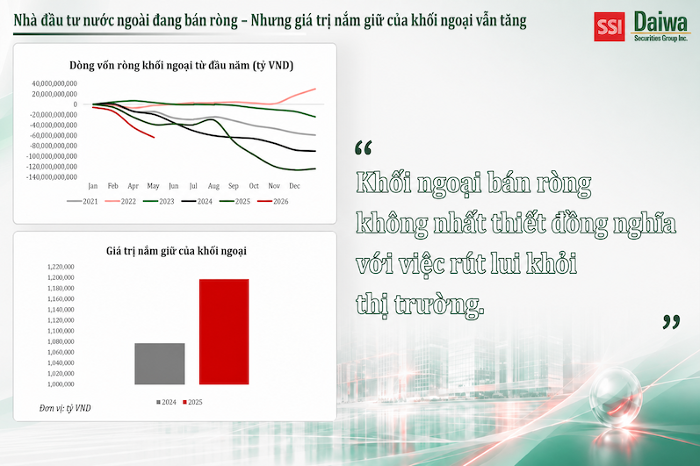
This signal shows that foreign investors are still present in Vietnam; they are merely changing their approach, focusing on higher-quality instruments.
On the other hand, foreign funds are also preparing for a new phase. SSI's leadership is optimistic that, once Vietnam is officially included in the FTSE Russell index basket following the upgrade, capital flows could reverse compared with the recent prolonged net-selling period. He even believes that "the picture will be very different in just about 2 months."
Specifically, starting from September 2026, an institution such as Vanguard could allocate about 2 billion USD when Vietnam's stock market is upgraded. Of this, about 770 million USD could be allocated to VIC shares according to their weighting in the index sets, reflecting the operating characteristics of passive capital flows rather than decisions based on the views of individual fund managers.
The market is becoming more concentrated
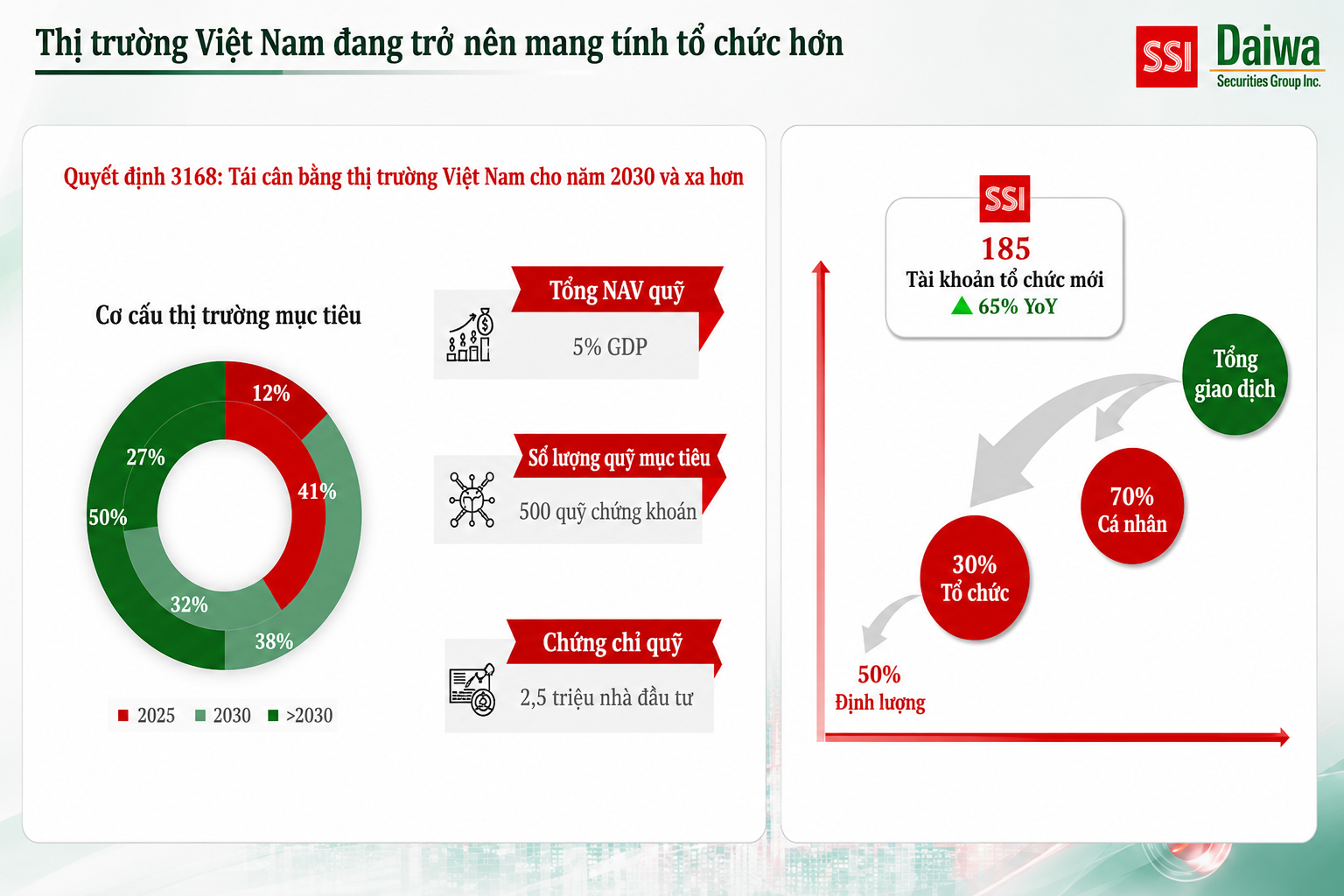
At SSI, from the beginning of 2026 alone, the company opened 185 new institutional client accounts, up 65% year-on-year, mostly from the United States and Europe. Institutional client transactions now account for about 30% of total trading value, double the market-wide average of about 15%.
This shift reflects changes in the market structure. Whereas Vietnam's stock market was previously driven mainly by individual investors, the role of institutional investors is now growing ever larger, giving the market a more stable foundation.
Not only is the scale increasing, but the nature of institutional capital flows is also changing rapidly. About 50% of institutional client transactions at SSI are now quantitative trading.
Rising institutional capital flows are also causing money to become increasingly concentrated in large-cap stocks. From 2024 to the present, Vingroup's capitalization weighting in the VN-Index rose from 3% to 19%; the weighting of the five largest stocks rose from 26% to 39%, while the VN30 group rose from 69% to 73% of total market capitalization.
According to Mr. Thomas Nguyen, this is a common characteristic of emerging markets, where investment funds and passive capital tend to prioritize deploying into large-cap enterprises with high liquidity that account for a significant weighting in the index sets.
"This trend requires the market to have deeper liquidity, a stronger technology platform, a stable trading system and better order execution quality to meet the requirements of international institutions," Mr. Thomas Nguyen observed.
This is also in line with the national orientation. According to the target in Decision 3168, by 2030 individual investors are expected to account for about 70% of transactions, while institutional and foreign investors account for about 30%.
After 2030, the target structure continues to shift, with individual investors accounting for 60% and institutional and foreign investors accounting for 40%.
Nevertheless, to attract more foreign capital, the market needs more listed enterprises in other sectors to more fully reflect the structure of the economy. At present, the market is too heavily concentrated in banking (37%) and real estate (31%).
IPO activity in Vietnam is recovering, but the quality of the instruments has not improved commensurately. Many recent deals have mainly involved subsidiaries of already-listed enterprises, helping to expand the market's scale but not creating many new investment opportunities for institutional capital.
According to Mr. Thomas Nguyen, the market needs more large-scale enterprises with strong growth, transparent governance and operations in new sectors.
For example, the FDI sector is currently a pillar of Vietnam's exports but is almost absent from the stock market. The appearance of the first large-scale IPO from the FDI sector would not merely be a financial transaction, but would serve as concrete proof that Vietnam's capital market is capable of supporting companies with international ownership operating to global standards.
Nguồn: TheLeader — theleader.vn. Bài viết được đăng lại phục vụ mục đích chia sẻ kiến thức cho cộng đồng founder và nhà đầu tư trong hệ sinh thái HCM VIF.
Category & tags
Related news
 Ecosystem
Venture capital will be a new asset class
Mr. Hoang Duc Trung believes that, with the State taking the lead and large organizations and enterprises joining forces to spread the momentum, venture capital will fulfil its role as an engine of growth and innovation
 Finance & Banking05/2026
The success of a public-private venture fund is not measured by the number of unicorns
With an initial size of VND 500 billion, how will the government's “seed capital” from the public-private venture fund catalyze the flow of financing into startups?
 Finance & Banking18/05/2026
Ho Chi Minh City sets up venture capital fund: 'Seed capital' for Vietnamese tech
For the first time, Ho Chi Minh City has a venture capital fund operating under a joint-stock company model with the participation of the State and major private corporations.