

Behind the crucial 'piece of the puzzle' called the financial center
According to experts, VIFC is not merely a place to attract more foreign capital. Its more important role is to become a machine that connects global capital with the economy's investment needs.
According to experts, VIFC is not merely a place to attract more foreign capital. Its more important role is to become a "machine" that connects global capital with the economy's investment needs.
For many years, Vietnam's development story has revolved around a familiar goal: how to mobilize more capital. Accordingly, attracting FDI, expanding credit, developing industrial parks, and building infrastructure have all been aimed at adding resources for growth.
But as Vietnam pushes to build the International Financial Center (VIFC), what many experts emphasize is no longer about finding more capital. The focus has shifted to building a system capable of allocating resources more efficiently.
This is also a sign that the economy's challenge is entering a new phase.
When the capital equation changes
Two decades ago, Vietnam's growth was driven by a combination of abundant labor, competitive costs, and a continuous inflow of investment capital. This model turned Vietnam into one of the world's attractive manufacturing destinations.
At the recent Vietnam Finance Forum 2026 (VFF 2026), Jeffrey Singer, former CEO of the Dubai International Financial Centre (DIFC), said Vietnam possesses "one of the most enviable growth stories in the world," with GDP growth, exports, and FDI all remaining positive.
Yet the fact that the economy continues to grow and keeps attracting capital flows raises another question: why does Vietnam still need to build an international financial center?
The answer lies in the shift in the growth model itself.
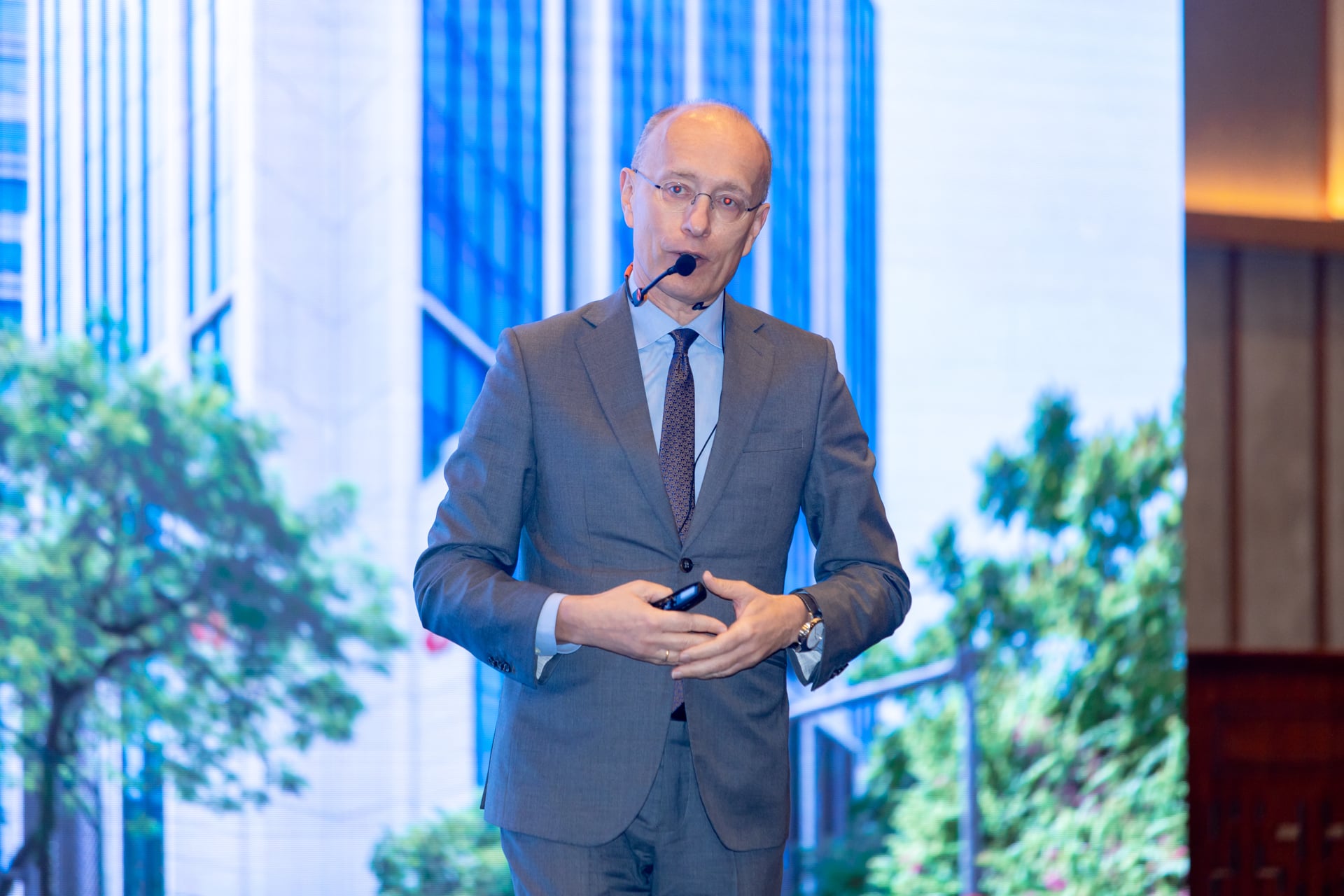
Jens Lottner believes the model based on cheap capital and labor is gradually reaching its limits. Photo: VFF
Jens Lottner, CEO of Techcombank, believes the model based on cheap capital and labor is gradually reaching its limits. The labor force is no longer growing quickly, while the labor participation rate is already very high, leaving increasingly limited room to expand along the horizontal dimension.
To sustain double-digit growth for many years to come, Vietnam must shift toward raising productivity. That shift also changes capital needs.
If capital was previously used mainly to build more factories or industrial parks, the new phase requires long-term investments in infrastructure, data centers, AI, energy transition, and high technology.
In other words, the issue is no longer how much more money the economy needs, but how to channel money into precisely those sectors that can generate higher productivity.
According to calculations shared by Jens Lottner, Vietnam needs about USD1,100 billion in investment capital during the 2026-2030 period.
Of this, about USD400 billion is for restructuring the economy, USD150 billion for transport infrastructure, USD130 billion to upgrade manufacturing, and USD110 billion for the energy transition.
These are all projects with very long lifecycles, requiring stable capital sources along with risk-sharing mechanisms among multiple parties.
Meanwhile, most of the economy's capital today still comes from the banking system, which is designed primarily to meet short- and medium-term needs.
Even when combining resources from the state budget, banks, FDI, and the domestic capital market, a gap of about USD200 billion still remains unfilled.
This gap does not simply reflect a shortage of capital. It shows the mismatch between where capital exists and where capital needs to be used.
Projects such as railways, airports, digital infrastructure, or the energy transition require capital spanning 10 to 20 years, while bank deposits are mainly short-term. This maturity gap makes it difficult even for the banking system to meet the demand.
For this reason, experts argue that Vietnam needs a new financial infrastructure, where the capital market, investment funds, and financial institutions jointly participate in allocating resources to long-term projects.
From this perspective, VIFC is not merely a place to attract more foreign capital. Its more important role is to become a "machine" that connects global capital with the economy's investment needs.
Money always follows trust
To build such a capital-allocation "machine," the prerequisite does not lie in financial products.
According to Jeffrey Singer, what determines whether international capital moves is trust. "Capital follows trust," he emphasized.
To explain this, he recalled Dubai's experience during the 2009 debt crisis.
When Nakheel, Dubai's leading real estate developer (a subsidiary of the state-owned group Dubai World), faced the risk of default on an Islamic bond worth more than USD3.5 billion, what worried investors was not just the size of the debt but the uncertainty over how the legal system would handle the crisis.
Dubai then established a specialized adjudication mechanism based on Common Law (the case-law system) to restructure the debt. A transparent, public, and predictable process helped the market quickly regain confidence.
Just a few years later, the Emirate of Sharjah (part of the UAE) successfully issued USD750 million in Islamic bonds and was oversubscribed 10 times the offering amount.
According to Jeffrey, the lesson here lies not in the size of the bailout package but in investors' belief that the rules of the game will be upheld even when a crisis occurs.
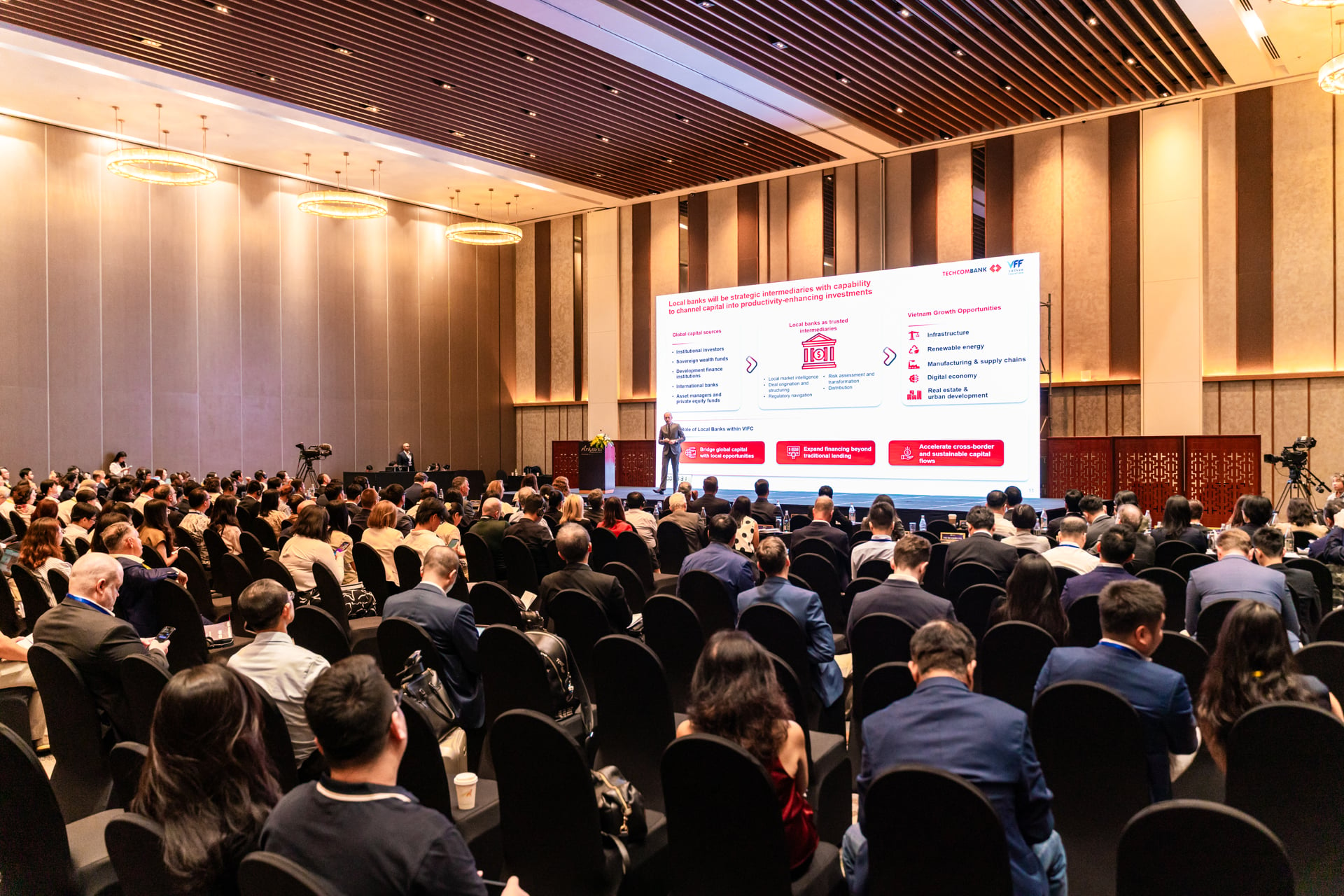
Experts argue that the focus is now shifting to building a system capable of allocating resources more efficiently. Photo: VFF
Enterprises can accept market risk but find it very hard to accept risk stemming from a legal system that is opaque or unpredictable. As such, institutions are not merely management tools but also part of the financial infrastructure.
According to him, just as highways help goods circulate, a transparent legal system helps capital move with lower costs and greater trust.
The competitiveness of a financial center is also not determined by buildings or tax incentives. What makes the difference lies in the quality of institutions, digital infrastructure, human resources, and international connectivity. Most important of all is the reputation accumulated over time.
A new machine for growth
From this perspective, VIFC emerges as a crucial piece of the puzzle in the new development phase. It is not a destination but a financial infrastructure that lays the foundation for growth on the road ahead.
Kevin Bruce Iwanaga, Head of Strategy and Consolidation at the VIFC Da Nang operating agency, said the center will prioritize developing areas such as tokenization, carbon credits, commodity exchanges, fund management, and bonds.
Although these are different financial products, they all aim toward a common goal: turning the assets of the real economy into assets that can be invested, traded, and used to raise capital according to international standards.
For global capital to participate, domestic projects must be standardized in terms of information disclosure, governance, custody, and settlement so that international investors can value them and manage risk.
Therefore, what Vietnam is building is not merely a financial center. Further still, it is an infrastructure connecting global capital with the domestic economy's investment needs.
This shift also reflects a larger change in the economy.
If success was previously measured by the ability to mobilize more resources, in the new phase, the yardstick will be the ability to turn available resources into investments that generate productivity, technological innovation, and long-term growth.
In other words, the financial system needs to shift from a role of supplying capital to one of allocating capital.
Source: TheLeader — theleader.vn. This article is republished for the purpose of sharing knowledge with the community of founders and investors within the HCM VIF ecosystem.
Category & tags
Related news
 Ecosystem
Venture capital will be a new asset class
Mr. Hoang Duc Trung believes that, with the State taking the lead and large organizations and enterprises joining forces to spread the momentum, venture capital will fulfil its role as an engine of growth and innovation
 Finance & Banking05/2026
The success of a public-private venture fund is not measured by the number of unicorns
With an initial size of VND 500 billion, how will the government's “seed capital” from the public-private venture fund catalyze the flow of financing into startups?
 Finance & Banking18/05/2026
Ho Chi Minh City sets up venture capital fund: 'Seed capital' for Vietnamese tech
For the first time, Ho Chi Minh City has a venture capital fund operating under a joint-stock company model with the participation of the State and major private corporations.