

Banking service activities: In whose hands does the pie lie?
>> This article is part of the special report \"An overview of Vietnamese banking: From financial statements to the pulse of the economy\". Banking service activities are becoming a new yardstick. For many years, the revenue of Vietnamese banks...
\>> This article is part of the special report "An overview of Vietnamese banking: From financial statements to the pulse of the economy"
Banking service activities are becoming a new yardstick
For many years, the revenue of Vietnamese banks has come mainly from credit. The interest-rate spread between lending and deposit-taking remains the core profit driver of the entire system. However, as the net interest margin comes under pressure, competition for deposits grows fiercer and bad-debt risk is ever present, banking service activities are increasingly becoming a more important yardstick.
Income from services not only helps banks diversify revenue but also reflects the depth of customer relationships, cross-selling capability, the strength of digital banking and the level of development of the financial ecosystem.
Data for the first quarter of 2026 from 27 banks shows a very clear picture: service activities are gaining a larger role in the system, but the advantage is not evenly distributed. A small group of banks holds most of the "pie" of service income, while many other banks still record very modest results.
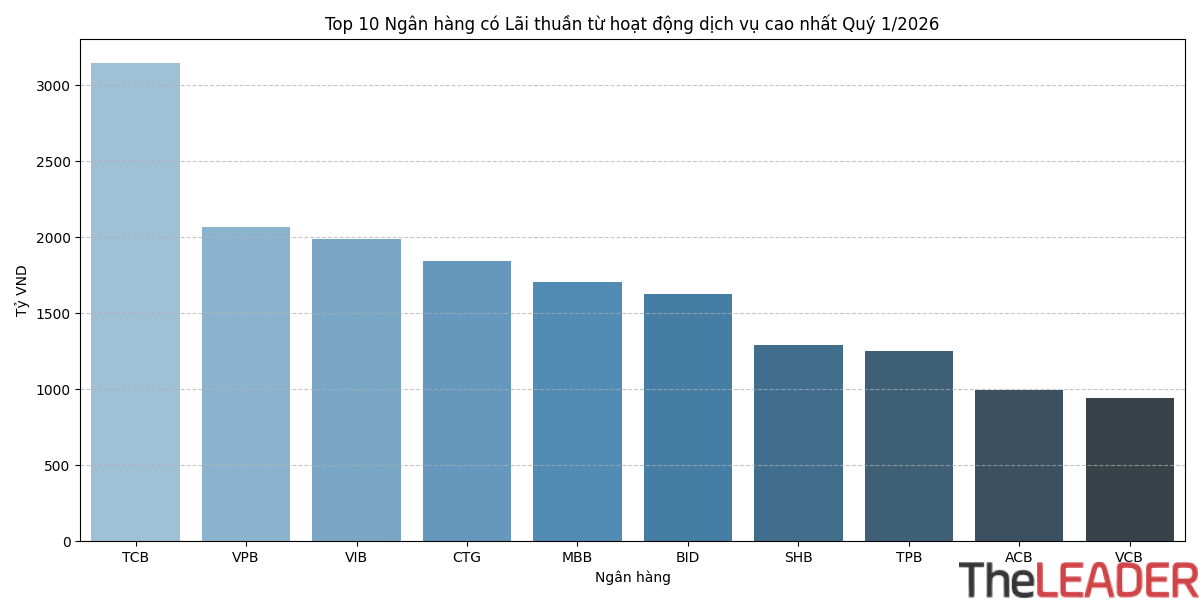
Top 10 banks with the highest net income from service activities in Q1/2026.
The service pie is concentrating in the leading group
In the first quarter of 2026, the average net income from service activities of the 27 banks reached about VND765 billion. However, the median was only about VND413 billion. The large gap between the average and the median indicates very strong divergence.
In other words, the industry-wide average is being pulled up by a group of banks with very large service scale. The rest of the system has yet to generate fee income strong enough to reduce dependence on credit activities.
Techcombank is the bank leading in net service income scale, with more than VND3,148 billion in the first quarter of 2026. This figure far surpasses most of the other banks and shows the strength of its customer ecosystem, investment banking, cards, insurance and digital financial services.
Ranking behind Techcombank are VPBank and VIB. These are all banks with strongly developed retail, card, insurance or financial-ecosystem models. The presence of the private-bank group at the top shows that the service-activities race is no longer the exclusive playground of state-owned banks.
Large banks such as VietinBank, BIDV and Vietcombank still maintain considerable service income scale thanks to their corporate customer base and wide networks. However, competitive pressure from dynamic private banks is becoming increasingly clear.
Techcombank leads in scale, but VIB is the phenomenon in terms of proportion
In terms of absolute scale, Techcombank is the most prominent name. But in terms of the ratio of net service income to total operating income, VIB is a more notable phenomenon.
In the first quarter of 2026, net service income accounted for nearly 34% of VIB's total operating income. That means for every VND3 of income the bank generates, more than VND1 comes from services.
This is a very high proportion in Vietnam's banking industry, where most banks still live mainly on interest income. VIB shows a business model shifting strongly toward non-interest revenue sources, especially in segments such as cards, insurance, payments and retail services.
TPBank and Techcombank are also in the group with a high proportion of service income, at over 25% and 23% respectively. These are banks with strong digitalization platforms, large individual-customer bases and good ability to exploit service products.
What this group has in common is that service activities are no longer an auxiliary part. They are becoming an important pillar of the revenue structure.
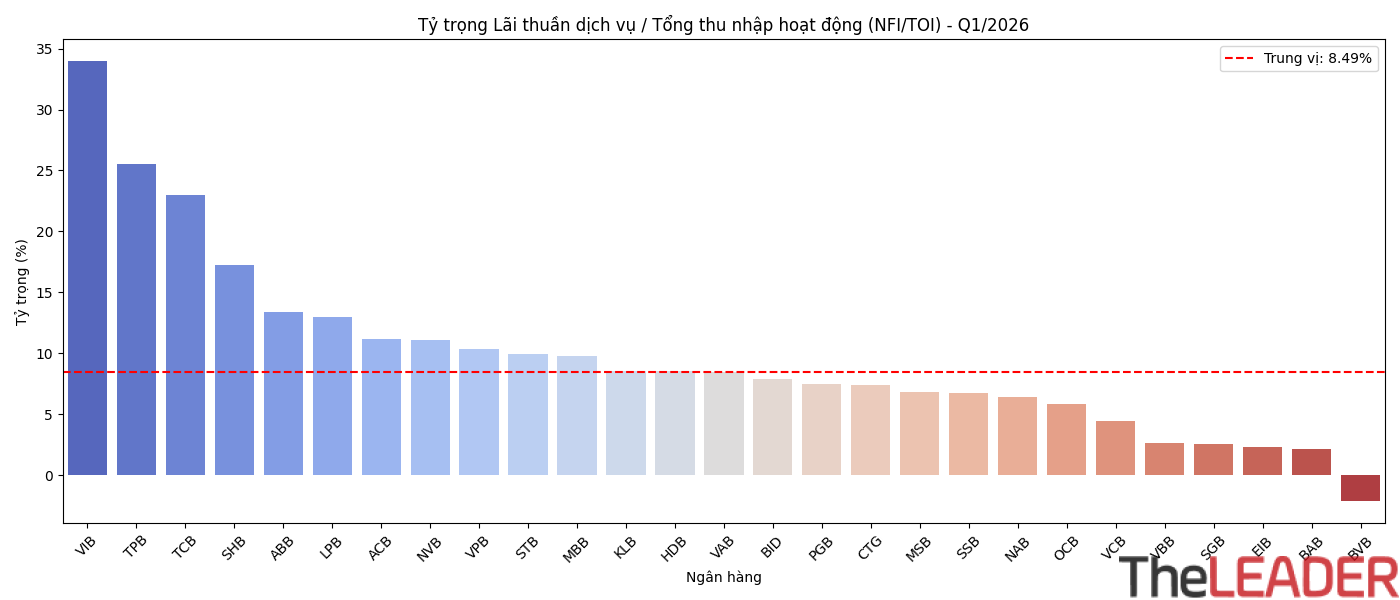
Ratio of net service income to total operating income of 27 banks - Q1/2026
Why is the service proportion more important than absolute scale?
The scale of net service income tells you how much money a bank earns from services. But the ratio of net service income to total operating income is what shows whether a bank depends heavily or lightly on credit.
A bank with large service income but also very large total operating income may still depend mainly on credit. Conversely, a bank with smaller scale but a high service proportion may possess a more balanced revenue model.
This is why the NFI/TOI ratio has become a very important metric when analyzing banking service activities.
For the whole system, the ratio of net service income to total operating income averaged about 9.8%, while the median was 8.49%. This shows that although the story of shifting toward non-interest income is often mentioned, most Vietnamese banks still rely heavily on traditional credit.
This dependence is not a problem during a period of favorable credit growth. But when bad debt rises, provisioning costs increase, or the net interest margin narrows, banks with weak service revenue will be more easily pressured.
Banks that still leave fee income untapped
At the bottom of the rankings, some banks still have very modest results in service activities.
BVBank recorded a net loss from service activities in the first quarter of 2026. Some other banks such as SaigonBank, Bac A Bank and VietBank achieved only very low net service income.
This shows that many small-scale banks have yet to build a product ecosystem strong enough to generate meaningful fee income. They may still rely mainly on traditional lending and deposit-taking, while segments such as cards, payments, insurance, trade finance or digital banking have yet to make a large contribution.
This gap has strategic significance. In the long run, any bank that fails to develop service activities will find it difficult to improve the quality of its revenue. They are more susceptible to interest-rate fluctuations, credit cycles and bad-debt pressure.
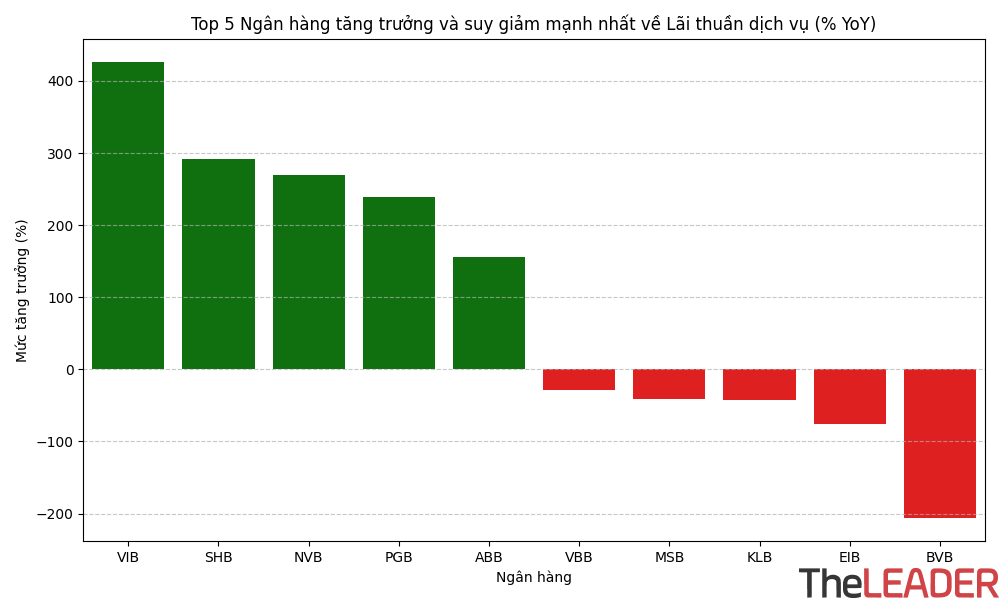
Top 5 banks with the strongest growth and sharpest decline in net service income (% year-on-year)
VIB, SHB and NCB make breakthroughs in growth
Looking at the growth rate year-on-year, the picture of service activities is even more volatile.
VIB recorded net service income growth of over 426%, a very striking figure. SHB and NCB also recorded multiple-fold increases, at over 291% and 269% respectively.
These breakthroughs show that in just one year, the standing of some banks in the service segment can change very quickly. When a bank pushes cross-selling, improves its digital platform or better exploits its existing customer base, service income can rise sharply without expanding the balance sheet too fast.
However, high growth also needs to be viewed with caution. If starting from a low base, the percentage growth rate can be very large, but the absolute scale is not necessarily large enough. Therefore, to assess the true strength of service activities, one must look simultaneously at scale, share of total income and growth rate.
Some banks are falling out of step
Alongside the strong-growth group, quite a few banks recorded a significant decline in the service segment.
BVBank fell sharply and swung from profit to loss in service activities. Eximbank also recorded a large decline year-on-year. This is a notable signal, especially for banks that need to improve the quality of their non-interest income.
The decline in service income can stem from many causes: falling insurance sales, slowing payment activity, fiercer fee competition, or the bank not having products attractive enough to retain customers.
Although the specific causes may differ from bank to bank, the common point is that the service segment is no longer as easy to grow as in the previous period. After the period of overheated bancassurance growth, banks are forced to seek more sustainable fee-income sources from payments, cards, wealth management, trade finance and digital banking.
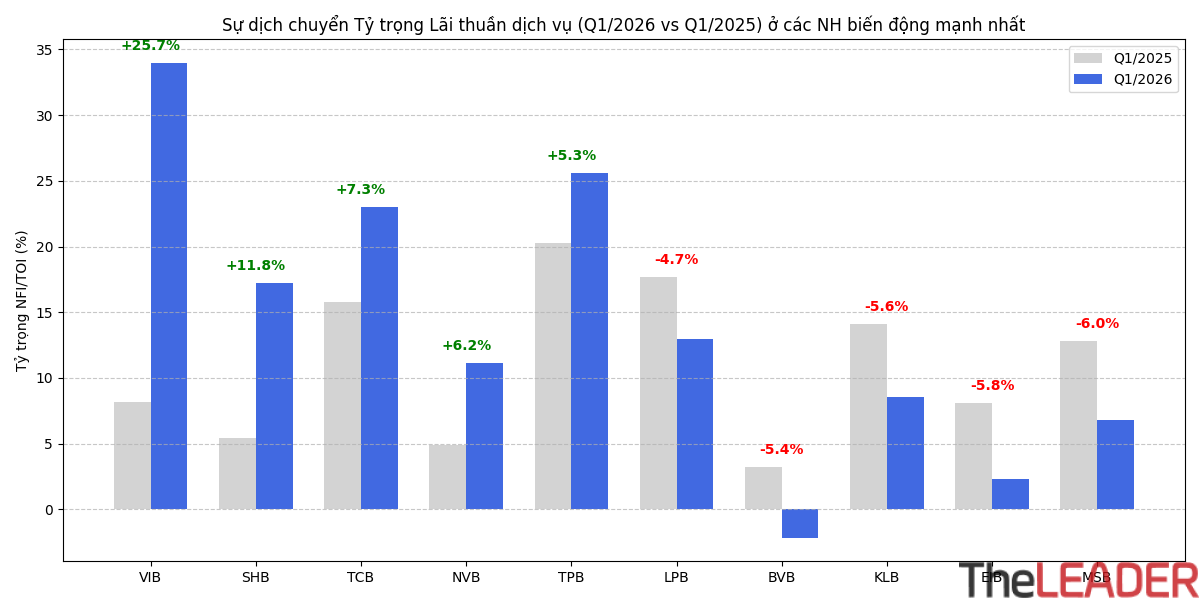
The shift in the net-service-income proportion at the banks with the strongest fluctuations
Changing income structure: Who is shifting the fastest?
Another important indicator is the change in the proportion of net service income within total operating income.
VIB is the bank with the strongest shift, as its NFI/TOI ratio increased by more than 25 percentage points in just one year. This is a very large increase, showing that service activities have significantly changed their role in the bank's revenue model.
SHB and Techcombank also recorded positive improvements in their service proportion. This shows that these banks not only increased the scale of service income but also made services a more important part of total income.
Conversely, some banks such as MSB, Eximbank and KienlongBank recorded a decline in their service proportion. That shows their income structure is shifting toward being less balanced, or at least that the service segment has not kept pace with other revenue sources.
This is a point to watch in the coming quarters, because a change in the service proportion may reflect a deeper change in the banking business model.
What do banking service activities say about the business model?
Banking service activities are not just a line item in the income statement. They reflect how a bank builds relationships with customers.
A bank with strong services usually does not only lend. It can also provide payment accounts, cards, insurance, investment, wealth management, trade finance and digital solutions. When customers use more products, the bank gains more fee income while also enhancing its ability to retain customers.
Conversely, a bank with low service income usually depends more heavily on the interest-rate spread. This model can still generate good profits during periods of rapid credit growth, but it is easily pressured when credit growth slows or bad debt rises.
Therefore, service activities are becoming an important indicator of the quality of the business model. They show whether a bank is truly building a customer ecosystem or merely expanding its loan balance.
The service race is only in its early stage
The Q1/2026 picture shows that Vietnam's banking service activities are strongly diverging.
Techcombank leads in absolute scale. VIB stands out in its share of total income and its growth rate. VPBank, TPBank, SHB and some other private banks are also showing an increasingly better ability to exploit services.
Meanwhile, many small banks have yet to generate service income large enough. Some banks even recorded a decline or a net loss from this segment.
That shows the banking service-activities race is only in its early stage. There is still large room for growth, but not every bank can take advantage of it.
In the coming years, when credit is no longer as easy a path to growth as before, the ability to generate income from services will become increasingly important. The bank that builds a deep customer ecosystem, a strong digital platform and diverse service products will have a greater advantage in maintaining sustainable profits.
Therefore, if credit shows the scale of a bank, then service activities are gradually showing the quality and depth of that bank's model.
\>> This article is part of the special report "An overview of Vietnamese banking: From financial statements to the pulse of the economy"

Source: TheLeader — theleader.vn. This article is republished for the purpose of sharing knowledge with the community of founders and investors within the HCM VIF ecosystem.
Category & tags
Related news
 Ecosystem
Venture capital will be a new asset class
Mr. Hoang Duc Trung believes that, with the State taking the lead and large organizations and enterprises joining forces to spread the momentum, venture capital will fulfil its role as an engine of growth and innovation
 Finance & Banking05/2026
The success of a public-private venture fund is not measured by the number of unicorns
With an initial size of VND 500 billion, how will the government's “seed capital” from the public-private venture fund catalyze the flow of financing into startups?
 Finance & Banking18/05/2026
Ho Chi Minh City sets up venture capital fund: 'Seed capital' for Vietnamese tech
For the first time, Ho Chi Minh City has a venture capital fund operating under a joint-stock company model with the participation of the State and major private corporations.