

Banking sector enters the largest capital-raising cycle in history
The banking sector is striving to strengthen its capital foundation to prepare for the next phase of the economy's development.
The banking sector is striving to strengthen its capital foundation to prepare for the next phase of the economy's development.
After many years in which the stock market played a not-so-prominent role in providing long-term capital for businesses, 2026 is opening a new cycle of equity capital raising. Within that overall picture, the banking sector emerges as the focal point with the largest capital-raising scale ever.
The capital-raising race of the financial "locomotives"
According to a recent report on the "2026 Equity Capital Raising Plan" by FiinGroup, the total planned value of equity raising and IPOs by listed and registered-for-trading businesses on Vietnam's stock market as of 25 May 2026 reached about VND289,500 billion.
This scale is up 86.5% from the amount actually raised in 2025 and 53.7% higher than the average of the past five years.
This is also a sign that capital raising via the equity market is making a strong comeback after a period in which businesses relied more heavily on other funding channels.
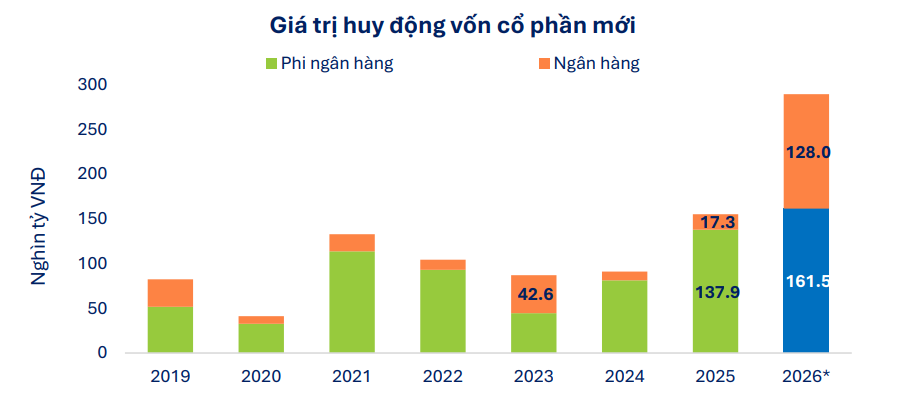
The banking sector is entering the largest capital-raising cycle ever. Photo: FiinGroup
In that wave of capital raising, the banking sector emerges as the leading group with a plan to raise about VND128,000 billion in 2026. This figure is more than seven times higher than in 2025 and up 71.6% from the five-year average. FiinGroup assesses that the banking sector is entering the "largest capital-raising cycle ever."
The sharp increase in capital demand reflects the need to expand the operating scale of the banking system in the new period.
Banks need to strengthen Tier 1 capital, expand their balance sheets and prepare for a new credit-growth cycle, in a context where credit growth continues to outpace the mobilization of funds across the whole system.
Notable capital-raising plans in 2026 are concentrated at many large banks such as Vietcombank, BIDV, VPBank, HDBank, MB Bank and NCB. Most of these plans are expected to be carried out through private placements.
The return of equity capital raising shows that businesses are taking advantage of market conditions to expand their financial resources.
Banking is a sector whose growth is closely tied to capital scale. When equity is supplemented, the ability to expand assets, provide credit and develop other business activities also improves.
In this new capital-raising cycle, the prominent role of the banking group also differs from many other sectors.
Businesses in manufacturing or services usually raise capital to serve investment, expand operations or restructure finances. For banks, raising capital is directly tied to the ability to expand the balance sheet and meet growth needs.
Besides banks, non-bank financial businesses are also stepping up capital raising. The financial services group is expected to raise about VND48,200 billion in 2026, mainly from securities companies through private placements and rights issues to existing shareholders in order to expand margin and proprietary trading activities.
This development shows that the 2026 capital-raising wave is clearly concentrated in the financial sector. Organizations in this field are all preparing greater resources to serve their expansion.
Even so, the pace of the increase in share supply also creates a challenge for the market. When many businesses simultaneously implement issuance plans, the market's ability to absorb the new shares becomes a factor to watch.
Dilution pressure
Raising capital gives businesses more resources to develop, but at the same time the volume of newly issued shares also creates pressure on the ownership structure and share valuation.
According to FiinGroup, the volume of new shares expected to be issued in 2026 reaches about 48.2 billion shares, up 26% from 2025 and equivalent to 17.1% of total shares outstanding as of the end of 2025. This is the highest level in many years.
Of these, about 28.8 billion shares come from splits, stock dividends and bonus shares. Meanwhile, the volume of shares issued to raise actual capital is expected to reach more than 19.4 billion shares, up 91.6% from the previous year.
For the banking sector, dilution risk needs to be considered alongside the ability to generate profit from the new capital. A large capital-raising plan only truly creates value when the bank can use the additional resources to expand operations efficiently, improve profits and maintain a commensurate growth rate.
Conversely, if profit growth is slower than the increase in the number of shares outstanding, the value per share may come under pressure.
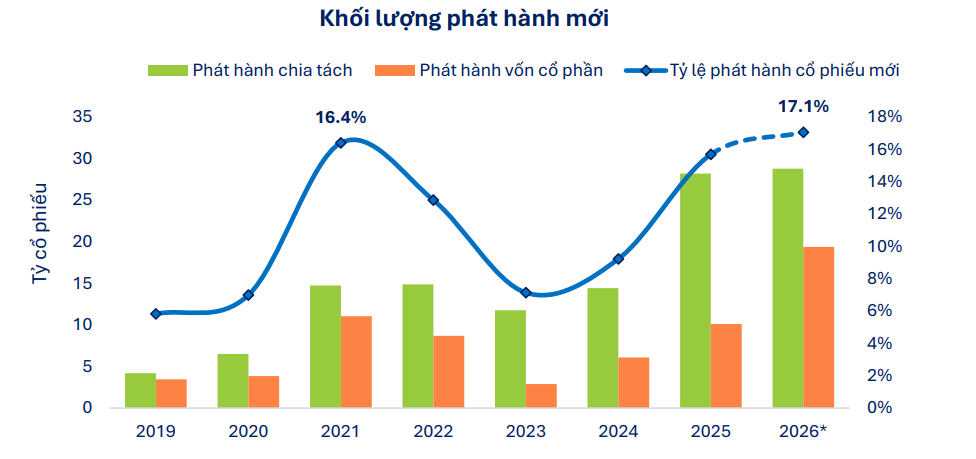
Billions of shares about to be brought to market could increase dilution risk as well as pressure on the valuation level. Photo: FiinGroup
FiinGroup also notes that this risk needs to be monitored in a context where market liquidity has not recovered strongly, foreign investors continue to be net sellers and corporate profit growth is more clearly differentiated among sectors. A large supply of shares brought to market could increase pressure on the valuation level.
Behind the 2026 capital-raising wave is a change in the role of the stock market. After a period in which businesses relied more heavily on bank credit and corporate bonds, the equity market is gradually returning to its position as a channel for raising medium- and long-term capital.
The banking sector, with a capital-raising scale of up to VND128,000 billion, is the clearest evidence of this trend. Large banks are seeking to strengthen their capital foundation to prepare for the next phase of development.
Nevertheless, the large capital-raising cycle also raises higher requirements for both businesses and investors. For businesses, the new capital must be used efficiently to generate genuine growth.
For investors, the key factor lies not in how many additional shares a bank issues, but in its ability to convert that capital into future profits.
2026 is therefore becoming a notable milestone for the banking sector as the capital-raising race moves to an unprecedented scale. The opportunity to expand comes with the requirement for a more careful assessment of capital-use efficiency and the market's ability to absorb the new supply.
Source: TheLeader — theleader.vn. This article is republished for the purpose of sharing knowledge with the community of founders and investors in the HCM VIF ecosystem.
Category & tags
Related news
 Ecosystem
Venture capital will be a new asset class
Mr. Hoang Duc Trung believes that, with the State taking the lead and large organizations and enterprises joining forces to spread the momentum, venture capital will fulfil its role as an engine of growth and innovation
 Finance & Banking05/2026
The success of a public-private venture fund is not measured by the number of unicorns
With an initial size of VND 500 billion, how will the government's “seed capital” from the public-private venture fund catalyze the flow of financing into startups?
 Finance & Banking18/05/2026
Ho Chi Minh City sets up venture capital fund: 'Seed capital' for Vietnamese tech
For the first time, Ho Chi Minh City has a venture capital fund operating under a joint-stock company model with the participation of the State and major private corporations.