

Bank equity: The trillion-dong race behind credit growth
More than a financial buffer, bank equity is now determining the ability to grow credit and long-term competitiveness. The latest data reveals notable trends in the banking industry.
\* This article is part of the special report "An overview of Vietnamese banking: From financial statements to the pulse of the economy"
From a race in asset scale to a race in capital capability
For many years, total assets have often been seen as the yardstick reflecting a bank's standing in the market. However, as capital-adequacy requirements are increasingly tightened and headroom for credit growth becomes an important competitive factor, the focus of the banking industry is gradually shifting to another metric: bank equity.
Equity is not only a "cushion" absorbing risk but also the resource that determines the ability to expand business, meet international governance standards and sustain growth over the long term. That is why the capital-raising race in recent years is unfolding more strongly than ever and has become one of the most notable trends in Vietnam's banking industry.
Vietcombank continues to lead in equity
Data for the first quarter of 2026 shows that Vietcombank continues to be the bank with the largest equity in the system, at more than VND234 trillion. This is the result of many years of maintaining high business efficiency and a persistent capital-accumulation policy.
Notably, although it possesses asset scale among the largest in the market, Vietcombank does not use excessively high financial leverage. Compared with many banks of the same scale, this bank's debt-to-equity ratio remains at a relatively safe level. That shows Vietcombank's development strategy is oriented toward a balance between growth and financial stability, rather than focusing solely on expanding scale through mobilized capital.
The gap between state-owned and private banks is narrowing
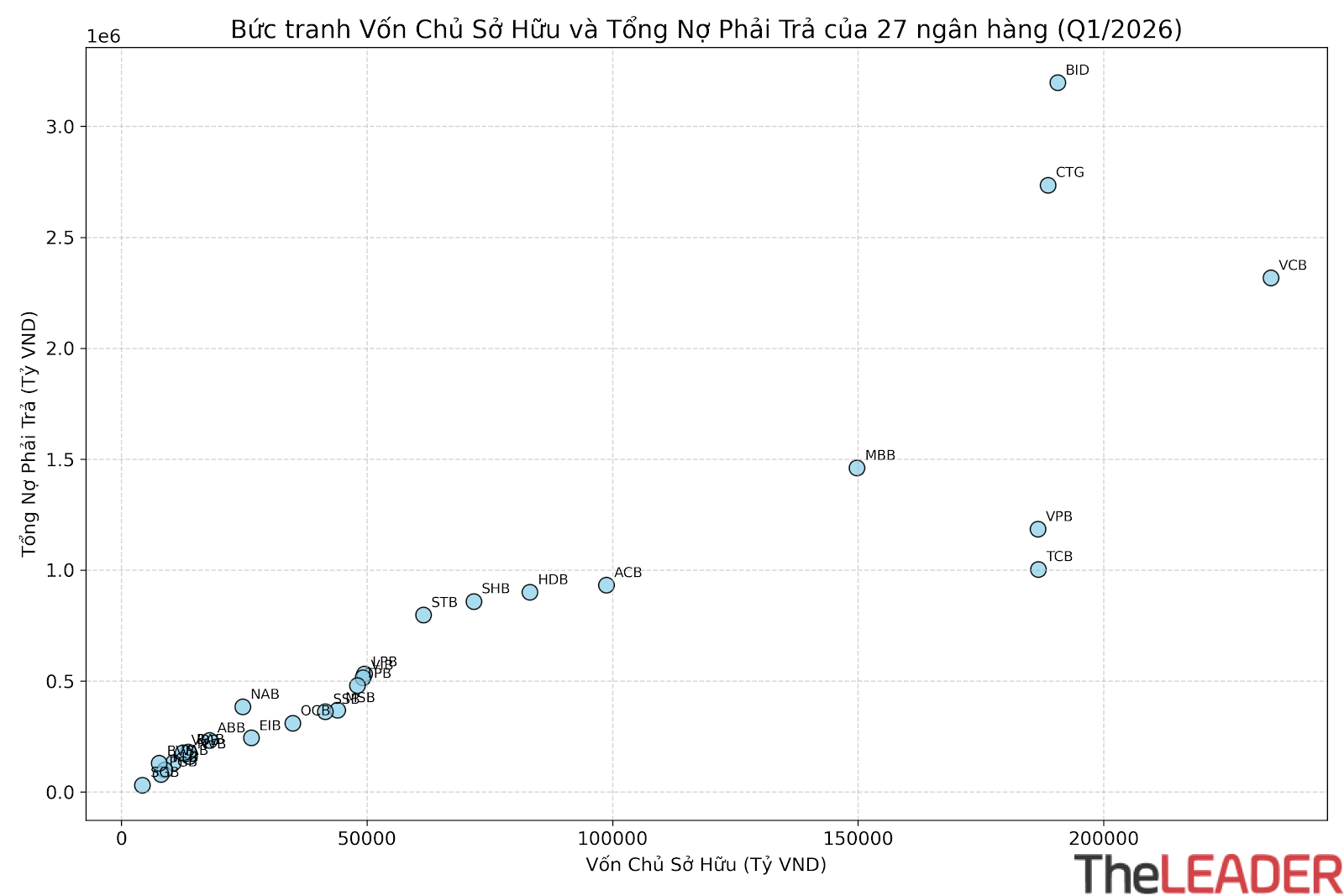
One of the most notable developments in the current bank-equity picture is the strong rise of the private-bank bloc.
Whereas in the past BIDV and VietinBank created a fairly large gap over the rest of the market, now Techcombank and VPBank have moved very close to the leading group. As of the end of the first quarter of 2026, the equity of both Techcombank and VPBank reached approximately VND187 trillion, nearly equivalent to the two state-owned "giants."
This change reflects the reality that private banks are actively strengthening their internal financial capacity by retaining earnings and raising capital continuously. This is not only a story of scale but also a preparation for a new growth phase, as capital requirements increasingly become a barrier to credit activities.
Two development strategies are taking clear shape
Observing the balance-sheet structure shows that Vietnam's banking industry is seeing two relatively distinct development models emerge.
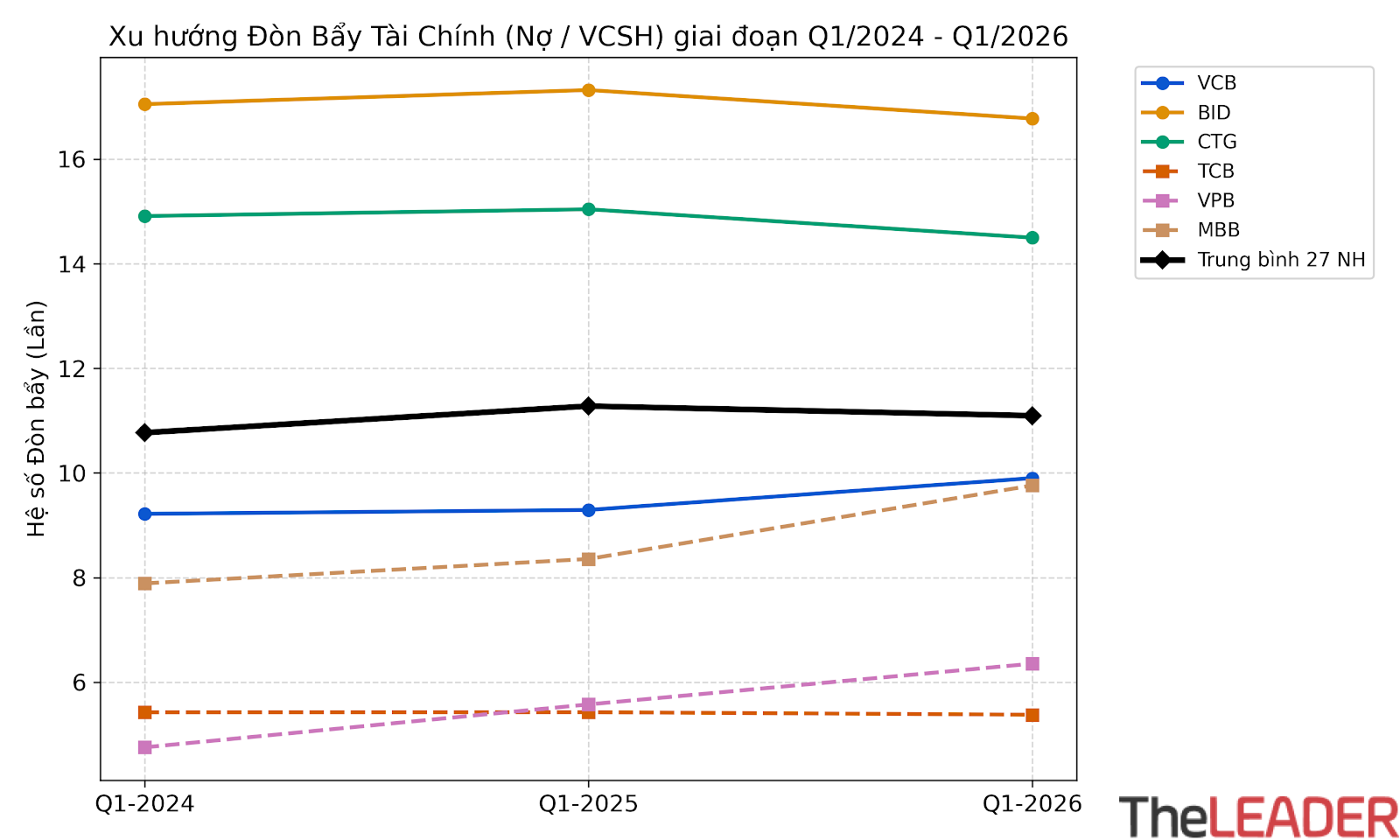
The state-owned bank bloc still relies mainly on its deposit-mobilization advantage to expand asset scale. With their extensive networks and strong ability to attract deposits, these banks maintain high financial leverage to maximize loan balances and market share.
Conversely, many large private banks are choosing a different path. Instead of pushing leverage, they focus on accumulating equity and building a thicker financial buffer. This keeps the leverage ratios of banks such as Techcombank and VPBank significantly lower than the general level of the system.
This strategy may slow the pace of asset expansion in the short term, but in return it creates greater room for growth in the future and helps the bank stay more proactive in the face of economic fluctuations.
The capital-raising trend is spreading across the whole system
Not only large banks, but many medium- and small-scale banks are also pushing to strengthen their capital capacity. The period from the first quarter of 2024 to the first quarter of 2026 recorded a significant improvement in equity at most credit institutions.
This development reflects a change in the banking industry's governance mindset. Whereas in the past credit growth was the top goal, now the quality of growth and the ability to withstand risk are being given higher priority. Increasing equity has become a necessary condition for banks to meet Basel standards, expand credit limits and invest in digital transformation.
Equity will determine competitive advantage in the coming period
In a context where the economy faces many fluctuations and capital-safety regulations are increasingly stringent, equity is becoming a strategic factor for each bank.
Banks with a large capital buffer will have more room to expand credit, develop new business lines and cope with market shocks. Conversely, banks with limited capital capacity will face greater pressure in sustaining their growth rate.
If total assets reflect current scale, then bank equity is the yardstick of future strength. The capital-raising race is therefore no longer merely a financial metric but is becoming a competition in long-term development capability. The movements underway suggest that the landscape of Vietnam's banking industry over the next decade may be determined not by which bank is the largest, but by which bank possesses the most solid capital foundation.
This article is part of the special report: "An overview of Vietnamese banking: From financial statements to the pulse of the economy"

"Real-estate credit: The blind spot at the Big 3 and the movements of the rest")
Real-estate credit: The blind spot at the Big 3 and the movements of the rest
Finance - 1 month
Real-estate business lending still accounts for a large share at many banks. However, millions of billions of dong in loan balances classified as "other" at Vietcombank, BIDV and VietinBank are creating a notable blind spot.
Source: TheLeader — theleader.vn. This article is republished for the purpose of sharing knowledge with the community of founders and investors within the HCM VIF ecosystem.
Category & tags
Related news
 Ecosystem
Venture capital will be a new asset class
Mr. Hoang Duc Trung believes that, with the State taking the lead and large organizations and enterprises joining forces to spread the momentum, venture capital will fulfil its role as an engine of growth and innovation
 Finance & Banking05/2026
The success of a public-private venture fund is not measured by the number of unicorns
With an initial size of VND 500 billion, how will the government's “seed capital” from the public-private venture fund catalyze the flow of financing into startups?
 Finance & Banking18/05/2026
Ho Chi Minh City sets up venture capital fund: 'Seed capital' for Vietnamese tech
For the first time, Ho Chi Minh City has a venture capital fund operating under a joint-stock company model with the participation of the State and major private corporations.