

As money gets 'more expensive,' the corporate bond market diverges
While the real estate group quietly "gathers capital" through the private placement channel, banks are showing caution in the face of sharply rising interest rate pressure.
While the real estate group quietly "gathers capital" through the private placement channel, banks are showing caution in the face of sharply rising interest rate pressure.
FiinRatings' recently published Q1/2026 bond market focus report has sketched out a notable paradox: the corporate bond market is growing in volume but showing signs of "running out of breath" in quality as interest rate pressure becomes increasingly clear.
Money is getting "more expensive"
After a period of maintaining low interest rates to stimulate growth, the financial system is entering a cycle with more pressure. A high exchange rate, rising inflation expectations, recovering credit demand, and the race to attract deposits among banks are pushing the cost of capital across the market up clearly. In this context, corporate bonds are forced to raise their yields to retain their appeal to investors.
In other words, enterprises wanting to borrow through bonds can no longer expect the "easy-breathing" cost of capital of the past.
For enterprises with healthy balance sheets, this is merely an additional cost. But for units with high leverage, weak cash flow, large inventories, or dependence on refinancing, rising interest rates will be a matter of survival.
According to data from FiinRatings, in Q1/2026, total issuance value reached VND40.3 trillion, up more than 60% year-on-year. At first glance this figure looks positive, but compared with recent quarters, the pace of issuance has slowed considerably.
FiinRatings argues that the biggest bottleneck lies in the cost of capital, as coupon interest rate levels are no longer anchored in the low zone but are shifting upward.
Of this, the credit institution group recorded an increase of up to 67.8 basis points, while the real estate group, already accustomed to high interest rate levels, continued to have to accept an additional 40 basis points compared with the previous quarter.
Rising interest rates not only make borrowing costs more expensive but also make enterprises more cautious in their mobilization decisions. According to FiinRatings' expert, high interest rate levels are creating a wait-and-see sentiment in the market. Enterprises no longer issue at all costs but are forced to carefully weigh cash flow and timing, and wait for clearer signals from macro policy.
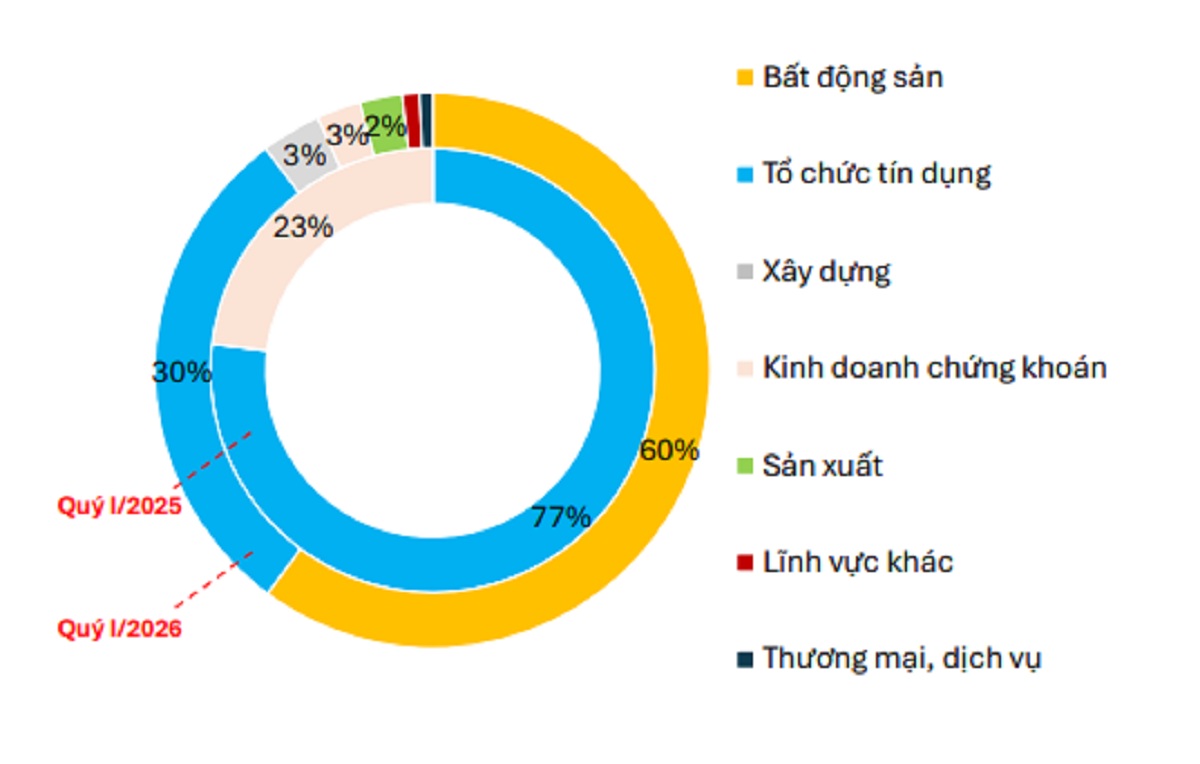
Issuance structure by sector, Q1/2026 and Q1/2025. Source: FiinRatings
The view that "money is no longer cheap" was also raised by experts at Vietcombank Securities (VCBS).
Data from VCBS shows that interbank interest rates in April, although easing at times, quickly rebounded strongly toward the end of the month. Rates for tenors from overnight to three months ranged from 6.267% to 7.4%, reflecting that system liquidity is no longer as abundant as before and has become sensitive to end-of-quarter capital needs or exchange rate pressure.
To stabilize the market, the State Bank of Vietnam net injected more than VND86,237 billion through the open market channel.
According to VCBS, exchange rate pressure remains a factor keeping the market in a defensive state. Although the free-market exchange rate has cooled from the VND28,000/USD mark at the end of Q1, the USD price at commercial banks remains close to the band ceiling. Along with that, the April CPI rose 5.46% year-on-year, while the average for the first four months of the year stood at 3.99%.
"The upward inflation trend is prompting investors to demand higher yields to compensate for risk," VCBS's expert explained.
Meanwhile, in the primary market, the State Treasury also successfully mobilized VND45,455 billion in government bonds in April, down 45% from the previous month. However, the winning yields for the 5-year and 10-year tenors both edged up to 3.86% and 4.16%, respectively.
"As of the end of April, the 2026 issuance plan was only more than 25% complete, showing that capital mobilization pressure in the coming period remains large and yield levels are unlikely to cool soon," VCBS forecast.
Amid money getting "more expensive," the structure of the corporate bond market this quarter also reversed notably.
According to FiinRatings, the non-bank enterprise group rose to account for more than 70% of total issuance value, 3.9 times higher than the same period last year, replacing the familiar leading role of the banking bloc.
Of this, real estate continues to hold the largest position, despite legal bottlenecks that have not been fully untangled and cash-flow pressure still weighing on the entire sector.
A typical example is the bond issuance by Marina Center Investment Company Limited, worth up to VND10,196 billion. This issuance had a long 10-year tenor with a fairly low step-up interest rate starting from 4% and was backed by collateral.
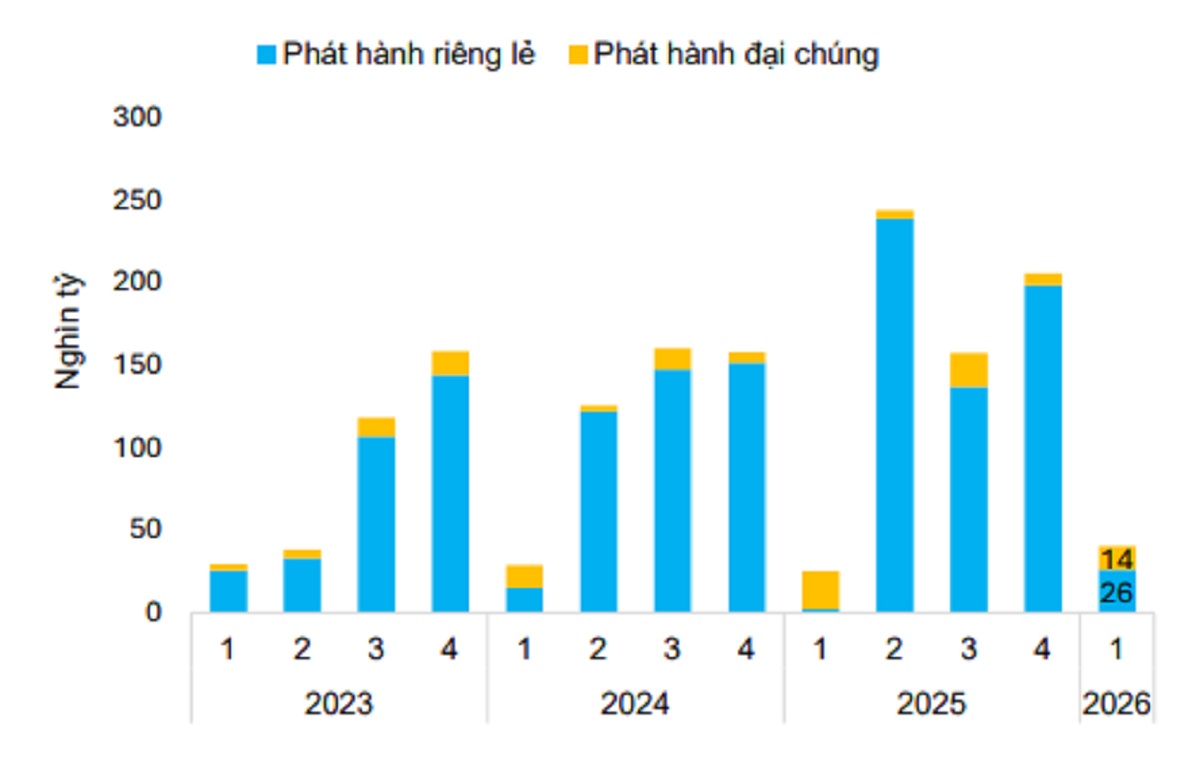
Issuance value in the corporate bond market by type. Source: FiinRatings
But a notable point is that the public issuance channel, which is mainly where banks issue, recorded several issuances in Q1 from non-financial enterprises such as Transimex JSC, Coteccons Construction JSC, and BAF Agriculture JSC.
This shows that enterprises have begun to consider the public channel to raise capital, as Decree 245, which helps shape this channel, took effect in September 2025.
Conversely, the banking bloc, a force once seen as the "locomotive" of the bond market, unexpectedly narrowed its presence. This group's share of issuance fell to just under 30%, a rare low in recent quarters.
Instead of accepting long-term bond issuance at an increasingly expensive cost of capital, many banks are choosing the more cautious path of increasing deposit mobilization, leveraging short-term funds, and flexibly maneuvering in the interbank market to cope with the tense liquidity pressure.
Debt repayment pressure
If Q1 was merely a calculated warm-up, then Q2 and Q3/2026 are truly the "trial by fire" phase for the corporate bond market. The "specter" of bad debt has never disappeared and is now returning through the debt figures on the maturity schedule.
According to data from FiinRatings, it is estimated that pressure will begin to rise sharply from Q2 with about VND42.2 trillion of bonds maturing. In Q3, the pressure peaks as the maturity value surges to VND73.3 trillion.
This means that in the coming six months, the market must handle more than VND115,000 billion of principal, which will be a harsh test of enterprises' liquidity capacity.
More worrying still, more than half of the maturing debt is falling on the shoulders of the real estate enterprise group. This is a segment that has not truly passed the difficult phase, as the market recovers slowly and purchasing power remains cautious. Cash flow from sales is trickling in, not yet strong enough to both sustain operations and bear maturing debt obligations. Conversely, floating interest rates continue to climb along with market levels, making the cost of capital increasingly expensive.
Meanwhile, the door to rolling over debt through issuing new bonds is also narrowing as investors become more cautious, more demanding, and no longer easily part with their money after previous shocks to confidence.
Reality in the corporate bond market this quarter has sent warning signals early. Specifically, the market recorded about VND12.8 trillion of bonds facing problems, including late payment of interest or principal. This figure shows that if enterprises do not promptly prepare plans to restructure cash flow, sell assets, or negotiate debt extensions, the maturity pressure in the second half of the year will erupt.
While the private placement channel, which accounts for more than 90% of market share, increasingly reveals dark spots in terms of risk and transparency, the regulator is resolutely pivoting the market toward a public issuance trajectory. This is not merely a technical change but a restructuring of trust in the corporate bond market.
According to FiinRatings' assessment, a series of new regulations taking effect from late 2025 and early 2026 are gradually forming a quality "filter," forcing enterprises that want to raise capital to step into the light instead of relying on closed deals. In other words, the market is moving toward a new standard with three key focal points.
First, credit ratings become a mandatory requirement, helping investors see the financial health of enterprises before deploying capital, instead of buying based on sales pitches or attractive interest rates.
Second, the investor protection mechanism is tightened further, with clauses on collateral, priority rights, and information disclosure responsibilities clearly codified into law.
The final point is that the era of enterprises raising capital but using cash flow ambiguously is gradually coming to a close. Transparently stipulating the purpose of capital use is now no longer an option but a mandatory condition for enterprises to access the market.
According to FiinRatings' experts, if the dossier processing timeline continues to be shortened by the regulator, the public issuance channel can fully become a sustainable "lifeline" for enterprises in the coming period. Because this is not only a place to raise capital but also a place to affirm the reputation of enterprises that do business honestly.
Source: TheLeader — theleader.vn. This article is republished for the purpose of sharing knowledge with the community of founders and investors within the HCM VIF ecosystem.
Category & tags
Related news
 Ecosystem
Venture capital will be a new asset class
Mr. Hoang Duc Trung believes that, with the State taking the lead and large organizations and enterprises joining forces to spread the momentum, venture capital will fulfil its role as an engine of growth and innovation
 Finance & Banking05/2026
The success of a public-private venture fund is not measured by the number of unicorns
With an initial size of VND 500 billion, how will the government's “seed capital” from the public-private venture fund catalyze the flow of financing into startups?
 Finance & Banking18/05/2026
Ho Chi Minh City sets up venture capital fund: 'Seed capital' for Vietnamese tech
For the first time, Ho Chi Minh City has a venture capital fund operating under a joint-stock company model with the participation of the State and major private corporations.