

A new test for the bond market
Debt repayment and refinancing pressure is not only a cash-flow problem for businesses, but also a test of the quality of the bond market after a period of strong restructuring.
Debt repayment and refinancing pressure is not only a cash-flow problem for businesses, but also a test of the quality of the bond market after a period of strong restructuring.

Many businesses still face heavy bond repayment pressure. Illustrative photo: Hoang Anh
The corporate bond market continues to slow down
According to VIS Rating's analysis, the corporate bond market in Q2/2026 shows a growth pace that has slowed compared with the same period last year, as business conditions became less favorable, interest rates stayed high due to systemic liquidity pressure, and geopolitical volatility continued.
Primary issuance in the quarter reached VND223 trillion, down 8.5% year on year as bank issuance fell 39.4%, tighter liquidity conditions and the approach toward regulatory liquidity-ratio limits reduced investor demand.
Meanwhile, issuance by real estate businesses surged 123%, concentrated among a few large developers. Techcom Securities (TCBS) was recorded as accounting for about half of the advisory market share for non-bank corporate bonds.
Tighter mobilization conditions pushed coupon rates higher, averaging 8.5% for banks (up 2.6 percentage points year on year) and 11.5% for real estate businesses (up 0.8 percentage points year on year).
Even so, the issue lies not only in rising interest rates, but in businesses' ability to absorb high capital costs at a time when their operating cash flows have not recovered commensurately.
Statistics from CBRE Vietnam show that, in the first half of the year, the number of apartments successfully transacted in Hanoi in the quarter reached only about 5,800 units, equivalent to 68% of the total newly launched supply in the period. This is a significantly lower absorption rate than in the 2024-2025 period, when the take-up rate of new apartments regularly exceeded 90%, and in some quarters sales even outpaced newly launched supply.
The firm estimates that about 2,800 apartments launched in Q2 had yet to find buyers, contributing to pushing primary inventory to its highest level in many years.
Ms. Nguyen Hoai An, Director of CBRE Hanoi, said that instead of deciding to commit money quickly as they did during the earlier period of low interest rates, buyers today tend to consider their cash flow and the timing of home purchases more carefully, especially for products that require substantial financial leverage.
Meanwhile, according to Mr. Le Dinh Chung, General Director of SGO Land, although not the entire market is "slowing down" - cash flow still exists in projects with clear legal status, guaranteed progress, reasonable prices and serving genuine housing demand - the slower liquidity also reflects that the 2026 real estate market has not played out the scenario of a synchronized, explosive recovery that many earlier optimistic expectations had projected.
In fact, after two years of continuous apartment price increases, the financial endurance of genuine end-user buyers has reached its limit, while individual investors have become more cautious for fear of buying at the peak price zone.
Buyers' caution in turn puts direct pressure on the cash flows of real estate businesses. While sales slow down and project legal issues have not been fully resolved, developers still have to maintain funding for financial obligations related to land, construction costs, loan interest - particularly loan interest - and the repayment of maturing bond principal.
In the past quarter, only one first-time bond default was recorded, that of Construction Business Development Company Limited No. 3, but counting companies that have repeatedly delayed bond payments, familiar names continue to appear such as Hung Thinh and Thien Ha - Bang Duong. In early July 2026, two large businesses successively announced delays in repaying maturing bond principal and interest, including Novaland and Tracodi, with the cause being that they had not yet arranged sufficient funds.
Bong Sen Corp has also just continued to disclose information about the delay in fulfilling its obligation to pay more than VND3,010 billion in maturing bond interest because its account had been frozen.
A longer road is needed for the bond market
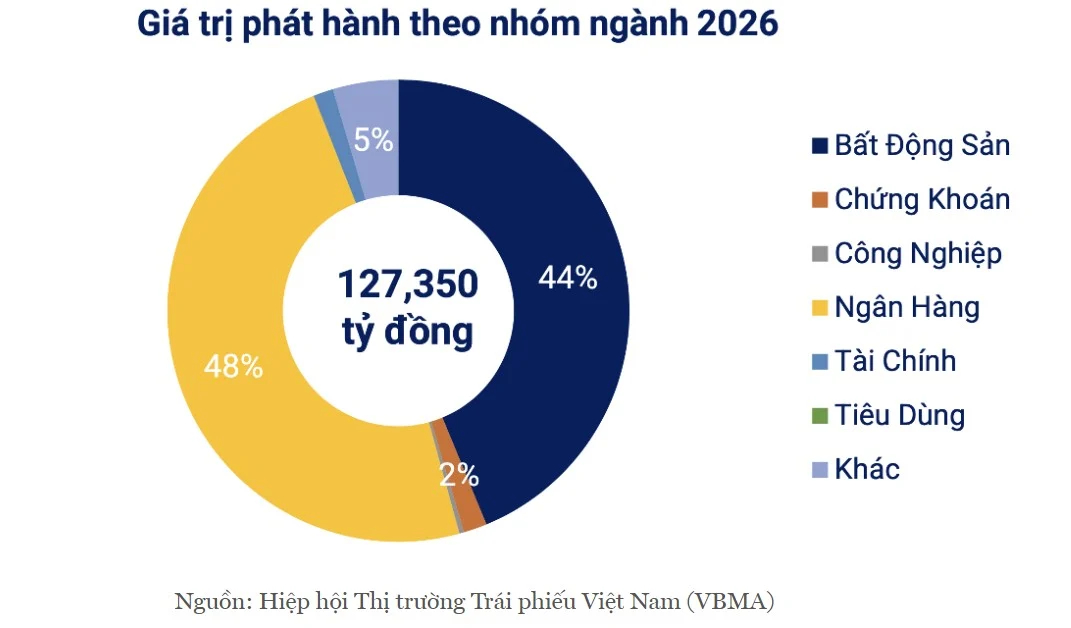
In FiinGroup's latest update, total principal and interest cash flows due in the second half of 2026 are estimated at about VND192.5 trillion, up 14.4% year on year, mainly concentrated in two groups: banks with VND87.6 trillion and real estate with VND82.9 trillion.
Meanwhile, according to the market report for the second week of July 2026 by the Vietnam Bond Market Association (VBMA), from now until the end of 2026 there will be more than VND111 trillion of corporate bonds maturing. Although this figure is lower than the maturity scale of many earlier periods, it still represents very significant pressure, as it is concentrated in a number of sectors with high capital needs, especially real estate.
Notably, nearly VND60 trillion, equivalent to about nearly 55%, belongs to the real estate business group.
These figures in the structure reflect a noteworthy reality: maturity pressure is not evenly distributed across the market but concentrated largely in the real estate group - a field still simultaneously facing declining sales liquidity, high capital costs and increasingly divergent access to new funding.
Looking at a longer horizon over the next year, refinancing risk is rising as about VND235,000 billion of bonds will mature.
With market liquidity continuing to tighten and interest rates at high levels - including bonds whose interest rates have been adjusted up to 14-16% per year - businesses' ability to access new funding will face greater difficulty, especially the real estate business group.
It should also be noted that, in its latest update, VIS Rating emphasized that Decree 200, effective from 5 June 2026, has a positive impact on credit quality by tightening issuance conditions, increasing transparency and better protecting investors in the private placement bond market - which accounts for about 90% of issuance value.
However, this also means that refinancing will be more difficult for quite a few of the groups that delayed payments during the 2022-2023 volatile period, such as Van Thinh Phat, Novaland, Hung Thinh or R&H Group. The cash flows raised from bonds by these groups were all highly leveraged, focused on speculative projects rather than serving genuine housing demand.
In the past, the lack of transparency and the absence of credit ratings made it difficult for investors to assess risk, resulting in valuations and risk premiums that did not fully reflect the level of risk. But with requirements for detailed and standardized information disclosure that allow investors to more clearly assess the financial fundamentals of the issuer - including cash-flow generation, leverage and debt-servicing capacity - new issuance to restructure capital is not easy.
This is also why the end of 2026 is seen as an important test for the bond market in general, and for delinquent businesses in particular, after the restructuring period. When a large volume of principal and interest obligations comes due at the same time, businesses' actual ability to pay will reveal whether the recent restructuring process has helped improve financial health or has merely bought time to deal with difficulties.
Source: TheLeader — theleader.vn. This article is republished for the purpose of sharing knowledge with the community of founders and investors in the HCM VIF ecosystem.
Category & tags
Related news
 Ecosystem
Venture capital will be a new asset class
Mr. Hoang Duc Trung believes that, with the State taking the lead and large organizations and enterprises joining forces to spread the momentum, venture capital will fulfil its role as an engine of growth and innovation
 Finance & Banking05/2026
The success of a public-private venture fund is not measured by the number of unicorns
With an initial size of VND 500 billion, how will the government's “seed capital” from the public-private venture fund catalyze the flow of financing into startups?
 Finance & Banking18/05/2026
Ho Chi Minh City sets up venture capital fund: 'Seed capital' for Vietnamese tech
For the first time, Ho Chi Minh City has a venture capital fund operating under a joint-stock company model with the participation of the State and major private corporations.