

A New Boost for Credit
The State Bank of Vietnam’s move to raise the ratio of short-term funds used for medium- and long-term lending to 40% is seen as a step that will help unlock additional credit flows for the economy.
The State Bank of Vietnam’s move to raise the ratio of short-term funds used for medium- and long-term lending to 40% is seen as a step that will help unlock additional credit flows for the economy.
The State Bank of Vietnam (SBV) recently officially issued Circular No. 25/2026/TT-NHNN, amending and supplementing a number of articles of Circular 22/2019/TT-NHNN, raising the maximum ratio of short-term funds used for medium- and long-term lending from 30% to 40% in bank operations, effective from July 1, 2026.
The circular was built on the basis of conclusions and resolutions of the Central Committee and the Government on the socio-economic development plan for the 2026–2030 period, with the central goal of realizing double-digit economic growth.
Expanding credit room for the economy
Vietnam is entering a new growth cycle with capital demand on a very large scale. It is estimated that total investment-capital demand in the 2026–2030 period could reach VND 38.5 quadrillion, while the state budget can meet only about 20%. The rest will have to rely on the private sector, FDI flows and, in particular, credit from the banking system.
For that reason, raising the ratio of short-term funds used for medium- and long-term lending from 30% to 40% will help banks expand credit room and better meet the growing capital demand of the infrastructure, industrial, energy and real-estate sectors.
“The essence of banking is maturity transformation — mobilizing short-term and lending long-term. If risk is well controlled, widening the band will help banks optimize the efficiency of capital use and improve profit from interest-rate spreads,” analyzed Truong Hien Phuong, Senior Director at KIS Vietnam Securities Corporation.
Beyond raising the ratio of short-term funds for medium- and long-term lending, Circular No. 25/2026/TT-NHNN also adjusts the loan-to-deposit ratio (LDR) in a more flexible direction. This is seen as an important step to increase flexibility in monetary-policy management. Accordingly, during periods when system liquidity is under pressure or public-investment disbursement is slow, idle funds from the State Treasury can become a buffer to support liquidity for the banking system.

Raising the ratio of short-term funds used for medium- and long-term lending from 30% to 40% will help banks expand credit room. Photo: Hoang Anh
According to Vietcombank Securities (VCBS), the most notable impact of Circular 25 is the expansion of room for medium- and long-term lending, thereby increasing the ability to supply capital to the economy.
According to VCBS’s calculations, raising the cap on the ratio of short-term funds for medium- and long-term lending from 30% to 40% could create about VND 1 quadrillion in additional medium- and long-term credit room. This capital will flow mainly into sectors with long payback cycles such as real estate, renewable energy, industrial infrastructure and public investment, helping support the sector-wide credit-growth target of around 17% in 2026.
VCBS argues that this is not a step backward in risk management, but a controlled easing solution to support economic growth, while also creating a buffer for banks to prepare for the Basel III roadmap from 2028.
In addition, raising the cap also helps reduce pressure to mobilize long-term funds, thereby improving funding costs and creating room to lift NIM in the second half of 2026.
State-owned banks such as BIDV, VietinBank and Vietcombank benefit thanks to solid liquidity foundations and stable long-term deposit sources. Meanwhile, large private banks such as Techcombank, MB, Sacombank, ACB and VPBank have additional room to expand credit in high-yield segments such as home loans, infrastructure and real estate.
Notably, small and medium-sized banks are assessed to benefit most clearly, as many are operating close to the regulatory threshold. Raising the cap to 40% will help reduce liquidity pressure and cool the race on long-term deposit rates.
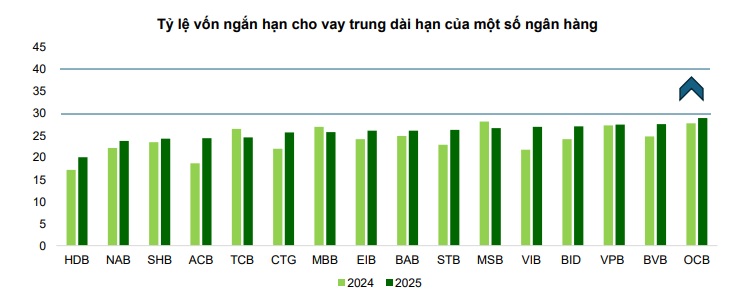
The ratio of short-term funds used for medium- and long-term lending at some banks. Source: VCBS
Over the long term, banks pioneering the implementation of Basel III such as VIB, Techcombank, ACB, VPBank, HDBank, TPBank and OCB are expected to hold a clear advantage thanks to their ability to optimize capital and expand credit growth.
Even so, VCBS notes that raising the cap also places higher demands on liquidity-risk management. In a context where 80–90% of the system’s mobilized funds are still short-term deposits, banks will have to tightly control the maturity mismatch between funding sources and assets to ensure operational safety.
Accepting more risk in exchange for growth?
Tran Ba Duy, Investment Advisory Director at VPS Securities Corporation, assessed that raising the cap on the ratio of short-term funds used for medium- and long-term lending will give banks additional room to expand credit, especially for long-term loans.
“In a context where the funding structure of Vietnam’s banking system is mainly short-term, this regulation helps credit institutions be more flexible in supplying capital to the economy,” he said.
In the past, the State Bank of Vietnam tightly controlled this ratio to limit the risk of maturity mismatch between mobilized funds and lending. However, the easing move shows that the regulator is accepting a higher level of risk to prioritize the goal of economic growth, by boosting the flow of capital into the corporate sector.
According to Duy, the timing of the policy is quite appropriate, as inflationary pressure shows signs of cooling thanks to falling world oil prices after recent geopolitical developments. This creates additional room for the regulator to implement liquidity-support measures without placing too much pressure on the price level.
“Easing this ratio is like adding capital for real-estate and construction businesses. Businesses that need long-term loans will be the direct beneficiaries,” Duy remarked.
However, he also noted that the benefits mainly accrue to the borrowing businesses, while the pressure of risk management will fall more heavily on the banks.
If the use of short-term funds for long-term lending increases too sharply, the system could face liquidity risk in the future. Therefore, the challenge is for banks to maintain capital-adequacy ratios and risk management at appropriate levels.
According to Truong Hien Phuong, when allowed to use a larger proportion of short-term mobilized funds to finance medium- and long-term loans, banks will have more room in allocating capital. This helps the banking system be more flexible in credit activities and creates conditions to expand capital flows for projects with medium- and long-term capital needs.
“In essence, this policy gives banks additional resources to pump capital into the economy. Instead of having to separate too strictly between medium- and long-term mobilized funds and loans of the same maturity, banks can be more flexible in using short-term funds to meet long-term credit demand,” Phuong remarked.
However, increasing the ratio of short-term funds for medium- and long-term lending also means maturity risk rises.
Nonetheless, he believes the increase from 30% to 40% is not yet too high to create significant risk to the whole system. The actual level of impact also depends on the governance capacity of each bank.
“Being allowed to raise the ratio does not mean banks will use this limit to the maximum. Banks with abundant funds can still keep the ratio lower to ensure safety. Therefore, risk does exist but is not yet at a worrying level,” the expert said.
In addition, credit risk comes not only from the funding structure but also depends on the quality of loan appraisal and management. Even when using funds appropriate in maturity, a bank can still face risk if it chooses ineffective customers or projects.
“The most important factor is still each bank’s capacity in capital management, liquidity management and credit-appraisal quality. If governance is good, the level of risk arising from raising the ratio to 40% is not too great,” Phuong concluded.
Source: TheLeader — theleader.vn. This article is republished to share knowledge with the community of founders and investors in the HCM VIF ecosystem.
Category & tags
Related news
 Ecosystem
Venture capital will be a new asset class
Mr. Hoang Duc Trung believes that, with the State taking the lead and large organizations and enterprises joining forces to spread the momentum, venture capital will fulfil its role as an engine of growth and innovation
 Finance & Banking05/2026
The success of a public-private venture fund is not measured by the number of unicorns
With an initial size of VND 500 billion, how will the government's “seed capital” from the public-private venture fund catalyze the flow of financing into startups?
 Finance & Banking18/05/2026
Ho Chi Minh City sets up venture capital fund: 'Seed capital' for Vietnamese tech
For the first time, Ho Chi Minh City has a venture capital fund operating under a joint-stock company model with the participation of the State and major private corporations.