

Government to draw up special action programme for second half of the year
The government has been asked to build a special action programme for the second half of the year, with clear tasks, clear owners, clear responsibilities, clear timelines, clear results and clear oversight mechanisms.
The government has been asked to build a special action programme for the second half of the year, in the spirit of "clear tasks, clear owners, clear responsibilities, clear timelines, clear results and clear oversight mechanisms".
At the recent regular June government press conference, Minister and Chairman of the Government Office Dang Son Phong gave a comprehensive assessment of socio-economic performance in the first half of the year and set out key tasks for the second half of 2026.
According to Dang Son Phong, the conference took place against a backdrop of a fast-moving, complex and unpredictable global environment, while at home the government has been driving hard on key priorities such as improving institutions, reforming administrative procedures, removing bottlenecks in the economy, promoting new growth drivers and striving to hit double-digit growth in 2026.
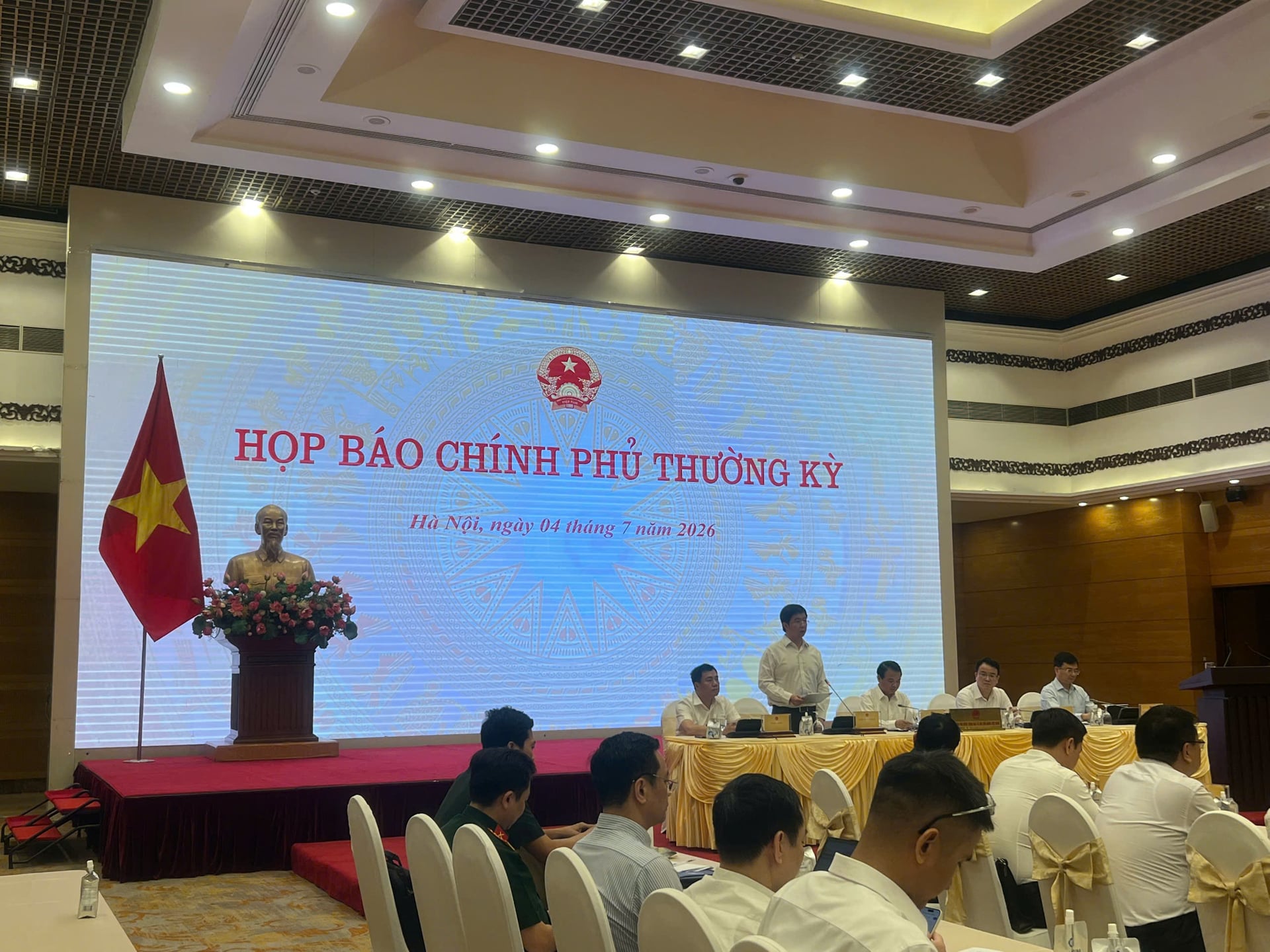
Assessing first-half results, government members agreed that the economy is maintaining a positive recovery across most sectors. Macroeconomic conditions are broadly stable and inflation is under control, while manufacturing and processing, construction, services, tourism and exports have all shown positive momentum.
Notably, GDP grew 8.18% in the first half of 2026, the highest rate in years. Nine localities recorded double-digit growth. State budget revenue reached about 62% of the annual estimate, up 17.2% year on year, despite roughly 89 trillion dong in tax exemptions and reductions. Total import-export turnover rose 27.1%, exceeding 550 billion USD.
Foreign direct investment remained a bright spot, while the number of newly established and reactivated businesses exceeded the number withdrawing from the market, reflecting business confidence in the economy's prospects.
Dang Son Phong said the government also praised results in strategic infrastructure development, institutional reform, decentralisation and delegation, digital transformation and science and technology, along with progress in education, healthcare, social welfare, defence, security and foreign affairs.
Alongside those achievements, however, the conference identified a number of shortcomings needing prompt attention. Although economic growth reached nearly 8.2%, it fell short of the 9.7% target set for the first half. As many as 25 of 34 localities grew below target.
Growth remains uneven across regions, domestic demand is still weak, the business and investment environment does not yet meet development requirements, compliance time and costs remain high, and the roll-out of the two-tier local government model has been hesitant in some places.
Reporting on directives issued at the conference, Dang Son Phong said General Secretary and President To Lam and Prime Minister Le Minh Hung asked the government to implement coordinated measures to maintain macroeconomic stability, control inflation, secure major balances and strive for growth of at least 10% for the full year.
In particular, the General Secretary and President asked the government to build a special action programme for the final six months of the year in the spirit of "clear tasks, clear owners, clear responsibilities, clear timelines, clear results and clear oversight mechanisms".
The focus is on removing institutional bottlenecks, harnessing the leading role of public investment, unlocking private investment, strengthening business capacity and ensuring energy, food and data security as well as digital sovereignty.
Party leaders also asked ministries, agencies and localities to move quickly to draft 2027 development plans from the third quarter of 2026, based on an accurate assessment of bottlenecks, with specific management scenarios, clearly designated lead agencies and accountable individuals, and public disclosure of results.
Leaders must personally direct key tasks and put an end to the practice of citing difficulties without proposing solutions, while growth responsibility is to be tied to each minister, agency head, party secretary and local chairman.
Source: TheLeader — theleader.vn. Republished to share knowledge with founders and investors in the HCM VIF ecosystem.
Category & tags
Related news
 Ecosystem
Venture capital will be a new asset class
Mr. Hoang Duc Trung believes that, with the State taking the lead and large organizations and enterprises joining forces to spread the momentum, venture capital will fulfil its role as an engine of growth and innovation
 Finance & Banking05/2026
The success of a public-private venture fund is not measured by the number of unicorns
With an initial size of VND 500 billion, how will the government's “seed capital” from the public-private venture fund catalyze the flow of financing into startups?
 Finance & Banking18/05/2026
Ho Chi Minh City sets up venture capital fund: 'Seed capital' for Vietnamese tech
For the first time, Ho Chi Minh City has a venture capital fund operating under a joint-stock company model with the participation of the State and major private corporations.